Śiva added dance to theatre in the Nāṭya-Veda, while Brahmā is responsible for elaborations based on vāk
"Šiva is said there to have
added only dance to theatre. As between Brahmā and Šiva, the former is said
to be responsible for all the elaboration based on vāk."
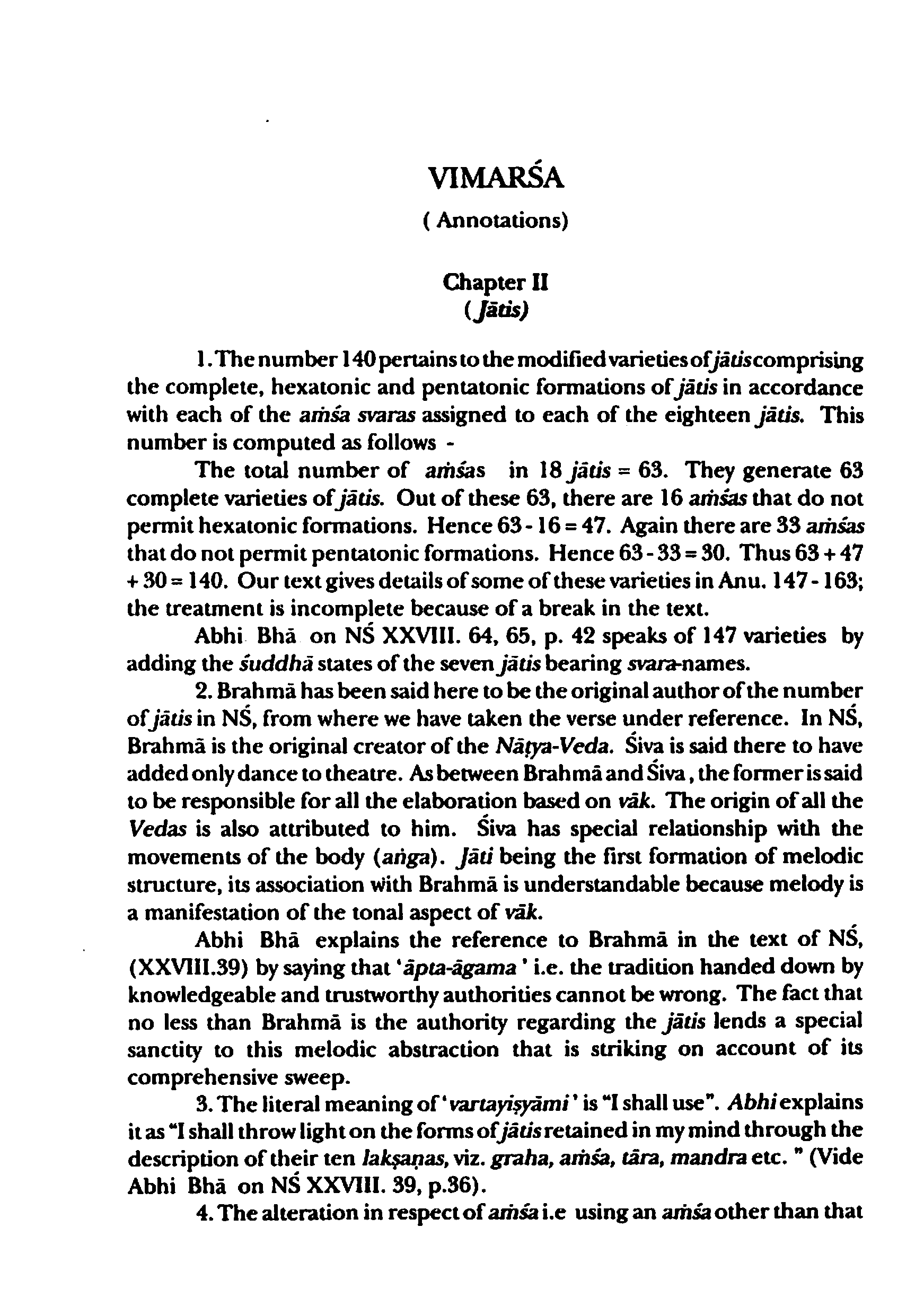
VIMARŠA
(Annotations)
Chapter II
(Jātis)
1. The number 140 pertains to the modified varieties of jātis comprising
the complete, hexatonic and pentatonic formations of jātis in accordance
with each of the amsa svaras assigned to each of the eighteen jātis. This
number is computed as follows -
The total number of amsas in 18 \text{ jatis} = 63. They generate 63
complete varieties of jātis. Out of these 63, there are 16 amsas that do not
permit hexatonic formations. Hence 63 - 16 = 47. Again there are 33 \text{ amsas}
that do not permit pentatonic formations. Hence 63 - 33 = 30. Thus 63 + 47
+30 = 140. Our text gives details of some of these varieties in Anu. 147 - 163;
the treatment is incomplete because of a break in the text.
Abhi Bhā on NŚ XXVIII. 64, 65, p. 42 speaks of 147 varieties by
adding the śuddhā states of the seven jātis bearing svara-names.
2. Brahmā has been said here to be the original author of the number
of jātis in NS, from where we have taken the verse under reference. In NS,
Brahmā is the original creator of the Nāṭya-Veda. Šiva is said there to have
added only dance to theatre. As between Brahmā and Šiva, the former is said
to be responsible for all the elaboration based on vāk. The origin of all the
Vedas is also attributed to him. Siva has special relationship with the
movements of the body (anga). Jāti being the first formation of melodic
structure, its association with Brahmā is understandable because melody is
a manifestation of the tonal aspect of vāk.
Abhi Bhā explains the reference to Brahmā in the text of NS,
(XXVIII.39) by saying that 'apta-agama' i.e. the tradition handed down by
knowledgeable and trustworthy authorities cannot be wrong. The fact that
no less than Brahmā is the authority regarding the jātis lends a special
sanctity to this melodic abstraction that is striking on account of its
comprehensive sweep.
3. The literal meaning of 'vartayişyāmi' is "I shall use". Abhi explains
it as "I shall throw light on the forms of jātis retained in my mind through the
description of their ten lakṣaṇas, viz. graha, aṁśa, tāra, mandra etc. " (Vide
Abhi Bhā on NS XXVIII. 39, p.36).
4. The alteration in respect of amsa i.e using an amsa other than that