Brahmasthāna is the point of origin for the second svara
"know (that) as the second svara arising out of the brahmasthāna
(brahmagranthi)."
<sup>47</sup>
TRANSLATION
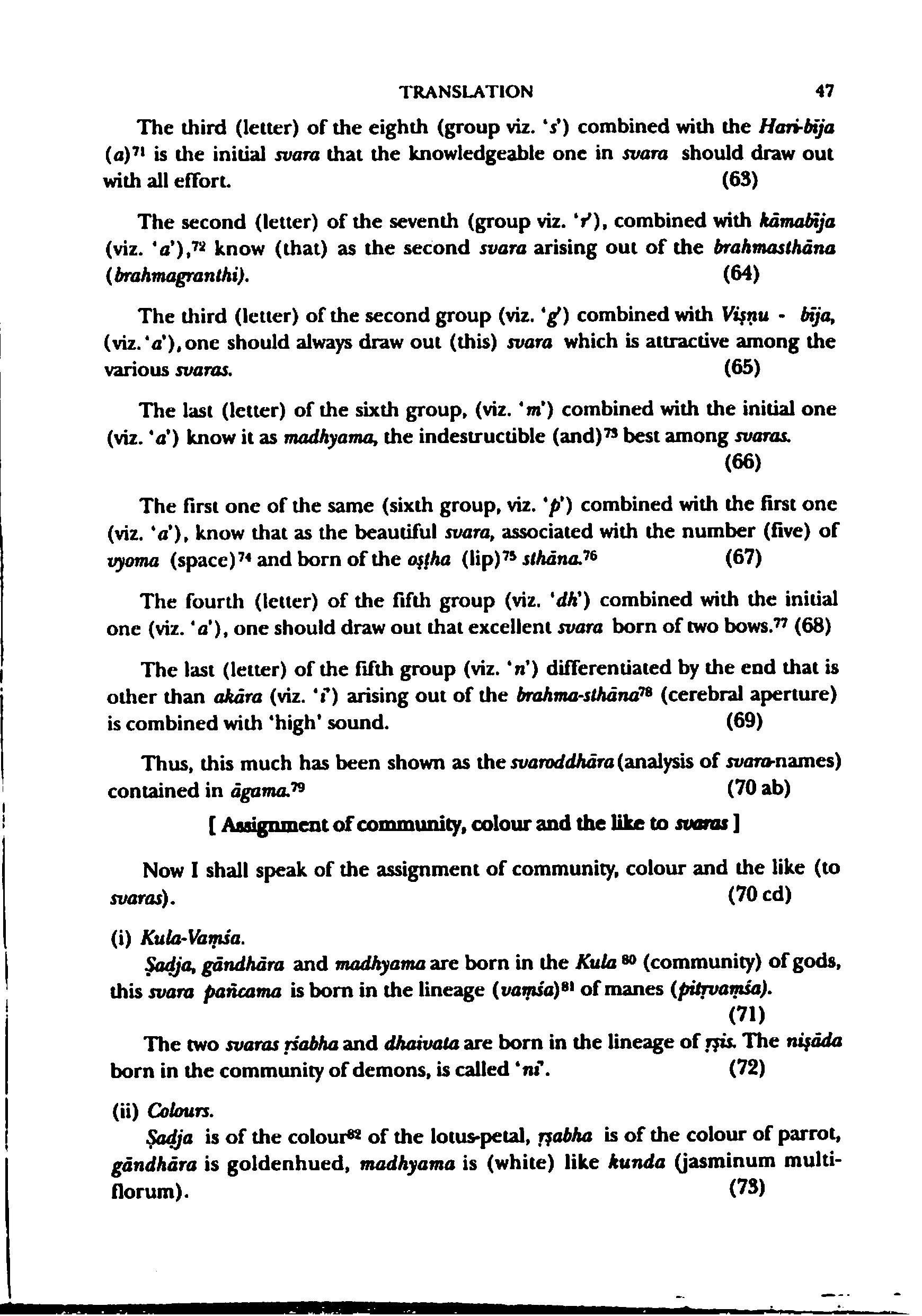
The third (letter) of the eighth (group viz. 's') combined with the Hari-bija
(a)^{71} is the initial svara that the knowledgeable one in svara should draw out
with all effort.
(63)
The second (letter) of the seventh (group viz. 'r'), combined with kāmabīja
(viz. 'a'),72 know (that) as the second svara arising out of the brahmasthāna
(64)
(brahmagranthi).
The third (letter) of the second group (viz. 'g') combined with Viṣṇu - bīja,
(viz. 'a'), one should always draw out (this) svara which is attractive among the
(65)
various svaras.
The last (letter) of the sixth group, (viz. 'm') combined with the initial one
(viz. 'a') know it as madhyama, the indestructible (and)<sup>73</sup> best among svaras.
(66)
The first one of the same (sixth group, viz. 'p') combined with the first one
(viz. 'a'), know that as the beautiful svara, associated with the number (five) of
(67)
vyoma (space)<sup>74</sup> and born of the ostha (lip)<sup>75</sup> sthāna.<sup>76</sup>
The fourth (letter) of the fifth group (viz. 'dh') combined with the initial
one (viz. 'a'), one should draw out that excellent svara born of two bows.<sup>77</sup> (68)
The last (letter) of the fifth group (viz. 'n') differentiated by the end that is
other than akāra (viz. 'i') arising out of the brahma-sthāna78 (cerebral aperture)
(69)
is combined with 'high' sound.
Thus, this much has been shown as the svaroddhāra (analysis of svara-names)
(70 ab)
contained in agama.79
[ Assignment of community, colour and the like to svaras ]
Now I shall speak of the assignment of community, colour and the like (to
(70 \text{ cd})
svaras).
(i) Kula-Vamśa.
Şadja, gāndhāra and madhyama are born in the Kula 80 (community) of gods,
this svara pañcama is born in the lineage (vaṃśa)81 of manes (pitṛvaṃśa).
(71)
The two svaras ršabha and dhaivata are born in the lineage of rsis. The niṣāda
(72)
born in the community of demons, is called 'ni'.
(ii) Colours.
Ṣaḍja is of the colour of the lotus-petal, ṛṣabha is of the colour of parrot,
gāndhāra is goldenhued, madhyama is (white) like kunda (jasminum multi-
(73)
florum).