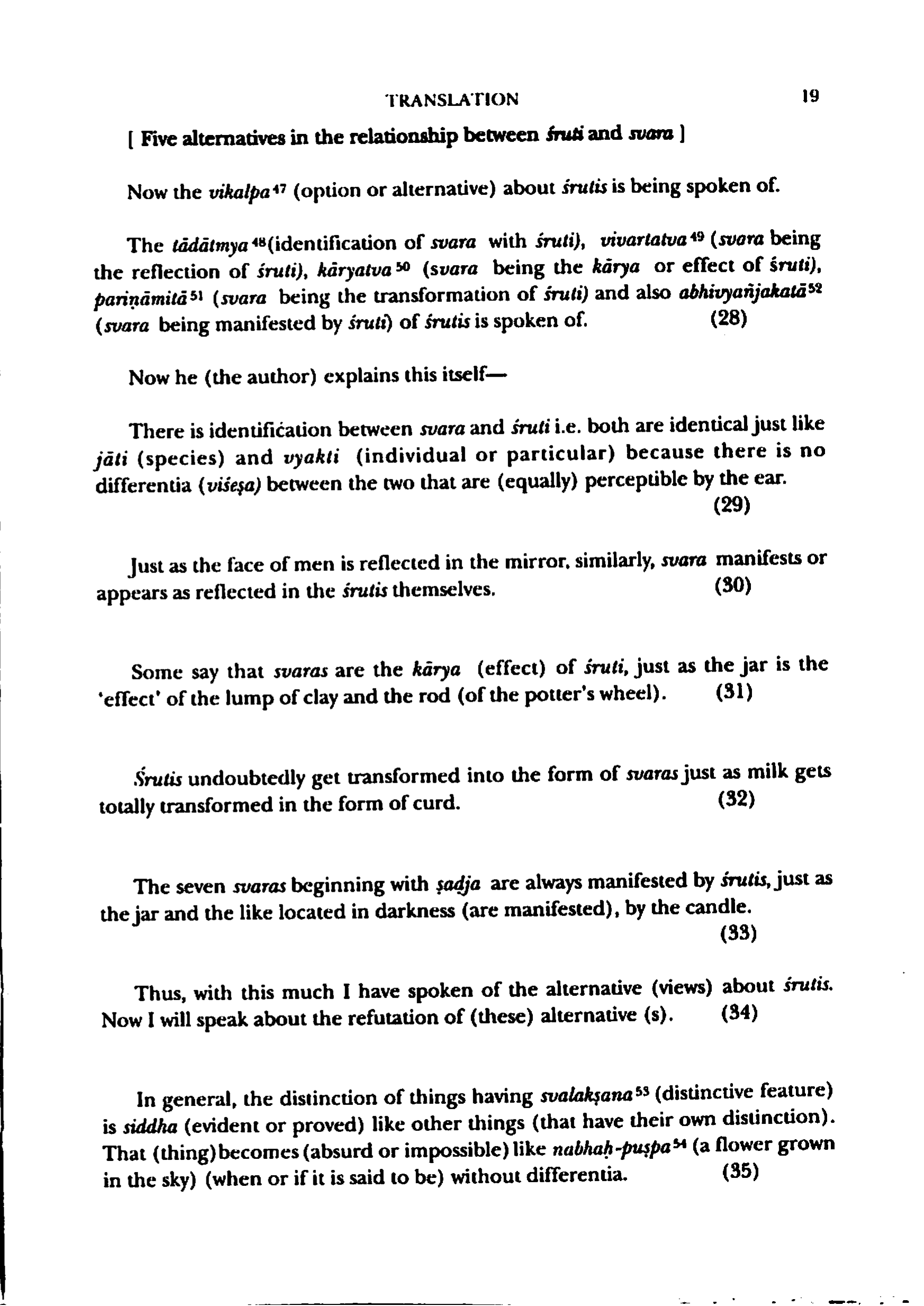
Nabhaḥpuṣpa (a flower grown in the sky) is a classic example of an absurdity or impossibility
"Nabhaḥpuṣpa i.e. a flower grown in the sky is a classic example of an absurdity or impossibility just like vandhyāputra, the son of a sterile woman."
165
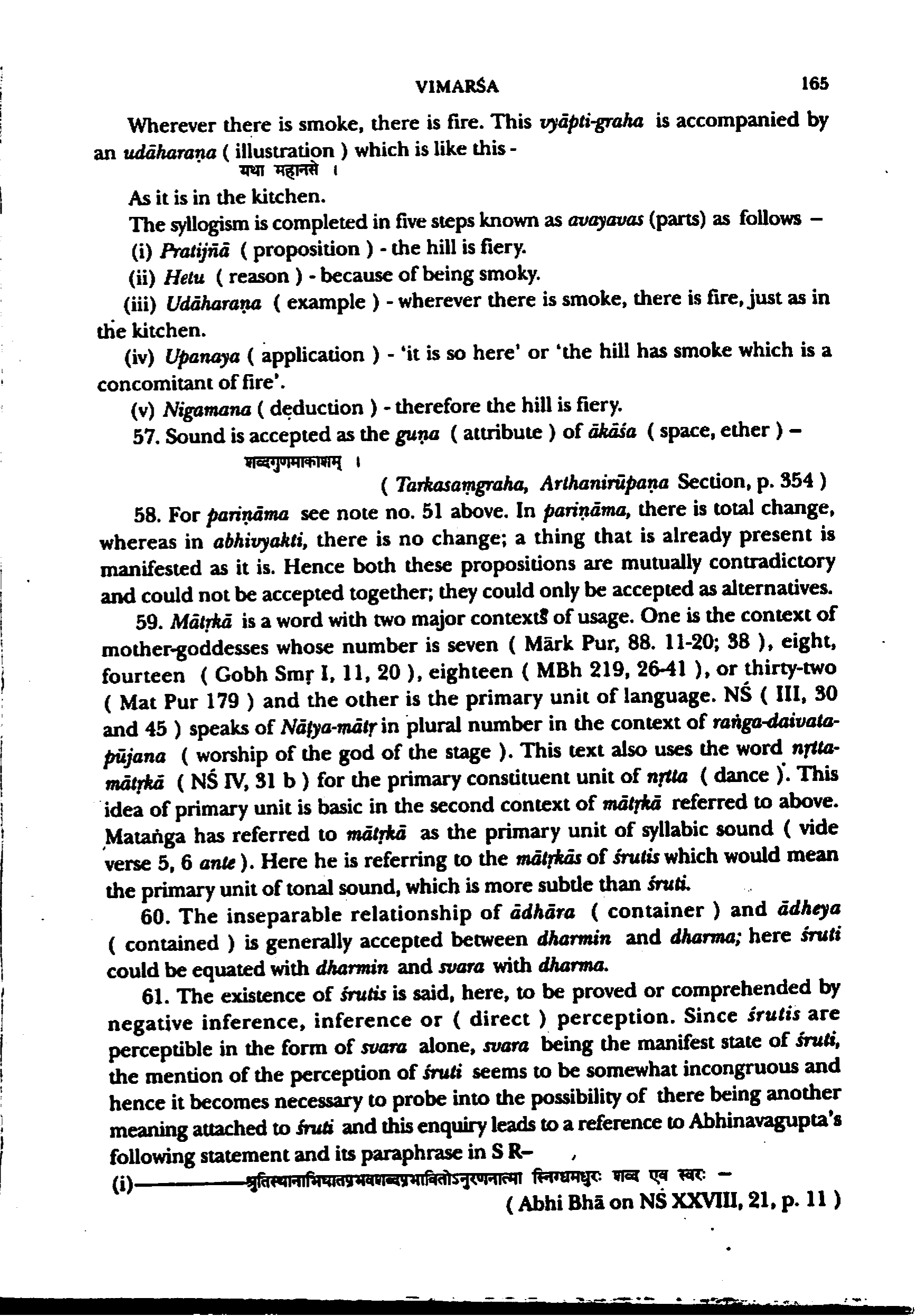
VIMARŚA
Wherever there is smoke, there is fire. This vyāpti-graha is accompanied by
an udāharaņa (illustration) which is like this-
यथा महानसे ।
As it is in the kitchen.
The syllogism is completed in five steps known as avayavas (parts) as follows -
(i) Pratijā (proposition) - the hill is fiery.
(ii) Hetu (reason) - because of being smoky.
(iii) Udāharaņa (example) - wherever there is smoke, there is fire, just as in
the kitchen.
(iv) Upanaya (application) - 'it is so here' or 'the hill has smoke which is a
concomitant of fire'.
(v) Nigamana (deduction) - therefore the hill is fiery.
57. Sound is accepted as the guṇa (attribute) of ākāśa (space, ether) -
शब्दगणमाकाशम् ।
(Tarkasamgraha, Arthanirūpaņa Section, p. 354)
58. For parināma see note no. 51 above. In parināma, there is total change,
whereas in abhivyakti, there is no change; a thing that is already present is
manifested as it is. Hence both these propositions are mutually contradictory
and could not be accepted together; they could only be accepted as alternatives.
59. Mātṛkā is a word with two major contexts of usage. One is the context of
mother-goddesses whose number is seven (Märk Pur, 88. 11-20; 38), eight,
fourteen (Gobh Smr I, 11, 20), eighteen (MBh 219, 26-41), or thirty-two
(Mat Pur 179) and the other is the primary unit of language. NŚ (III, 30
and 45) speaks of Nāţya-mātr in plural number in the context of ranga-daivata-
pūjana (worship of the god of the stage). This text also uses the word nata-
mātṛkā (NŚ IV, 31 b) for the primary constituent unit of nṛtta (dance). This
idea of primary unit is basic in the second context of mātņkā referred to above.
Matanga has referred to mātrkā as the primary unit of syllabic sound (vide
verse 5, 6 ante). Here he is referring to the mātṛkās of śrutis which would mean
the primary unit of tonal sound, which is more subtle than śruti.
60. The inseparable relationship of ādhāra (container) and ādheya
(contained) is generally accepted between dharmin and dharma; here śruti
could be equated with dharmin and svara with dharma.
61. The existence of śrutis is said, here, to be proved or comprehended by
negative inference, inference or (direct) perception. Since srutis are
perceptible in the form of svara alone, svara being the manifest state of śruti,
the mention of the perception of sruti seems to be somewhat incongruous and
hence it becomes necessary to probe into the possibility of there being another
meaning attached to śruti and this enquiry leads to a reference to Abhinavagupta's
following statement and its paraphrase in S R-
(i) ------श्रुतिस्थानाभिघातप्रभवशब्दप्रभावितोऽनुरणनात्मा स्निग्धमधुरः शब्द एव स्वरः -
(Abhi Bhā on NS XXVIII, 21, p. 11)
--------------------------------------
. -
THE WORLD