Upward throw is the literal translation of ūrdhvaparikṣepa
"Upward throw is the literal translation of ūrdhvaparikṣepa."
VIMARŚA
<sup>189</sup>
117. Conflict with varna is not easily comprehensible. Perhaps the idea is that
whatever pattern is established in an alaṅkāra it should be followed all-through.
If varna is taken to stand for syllabic unit, then the conflict and its prohibition
become clear.
118. Using an alaṅkāra without a varņa ( melodic movement ) is a
contradiction in itself; here also, as above (note 117) the idea seems to be that
an alaṅkāra should not be used without establishing a definite pattern. Here
varna as a syllabic unit does not seem to be relevant.
119. Abhi Bhā on this ( NŚ XXIX, 45 ) says that four functions of alaṅkāra in
relation to varna (the syllabic unit) have been figuratively spoken of as—(i)
the alaṅkāra makes the varņa bright or brilliant ( like the moon ), (ii) it
'threads' or connects the varņa (like a river), (iii) it makes the varņa blossom
(like a flower on a creeper) and (iv) it makes the varna colourful or delightful
(like an ornament on a woman).
120. It is notable that all illustrations begin with sadja and do not extend
beyond the tāra şadja.
121-145. All these notes pertain to 'sa' that belongs to tāra-sthāna.
Section VII ( Pada-giti )
1,2,3. Giti literally means song or the act of singing, but here it stands for
specific pattern of singing with reference to the text of the song as manifest in
its syllabic units (akşara) and metre (chandas). NŠ mentions only these four
gītis, but BrD speaks of gītis also in the context of grāma-rāgas. In order to
distinguish between these two types of gitis, the first type being related to the
rendering of text and the second type being related to the rendering of raga, we
have qualified the gitis under reference with pada, and the gitis of raga
classification will be qualified with svara or raga.
4. Nivitta lit. means retreated or returned to; in alankāras nivitti means
descent (of svaras); here it means repetition.
5. Nivitta lit. means receded or held back as opposed to pravitta meaning
proceeded or set forth. Here it means accomplished or completed.
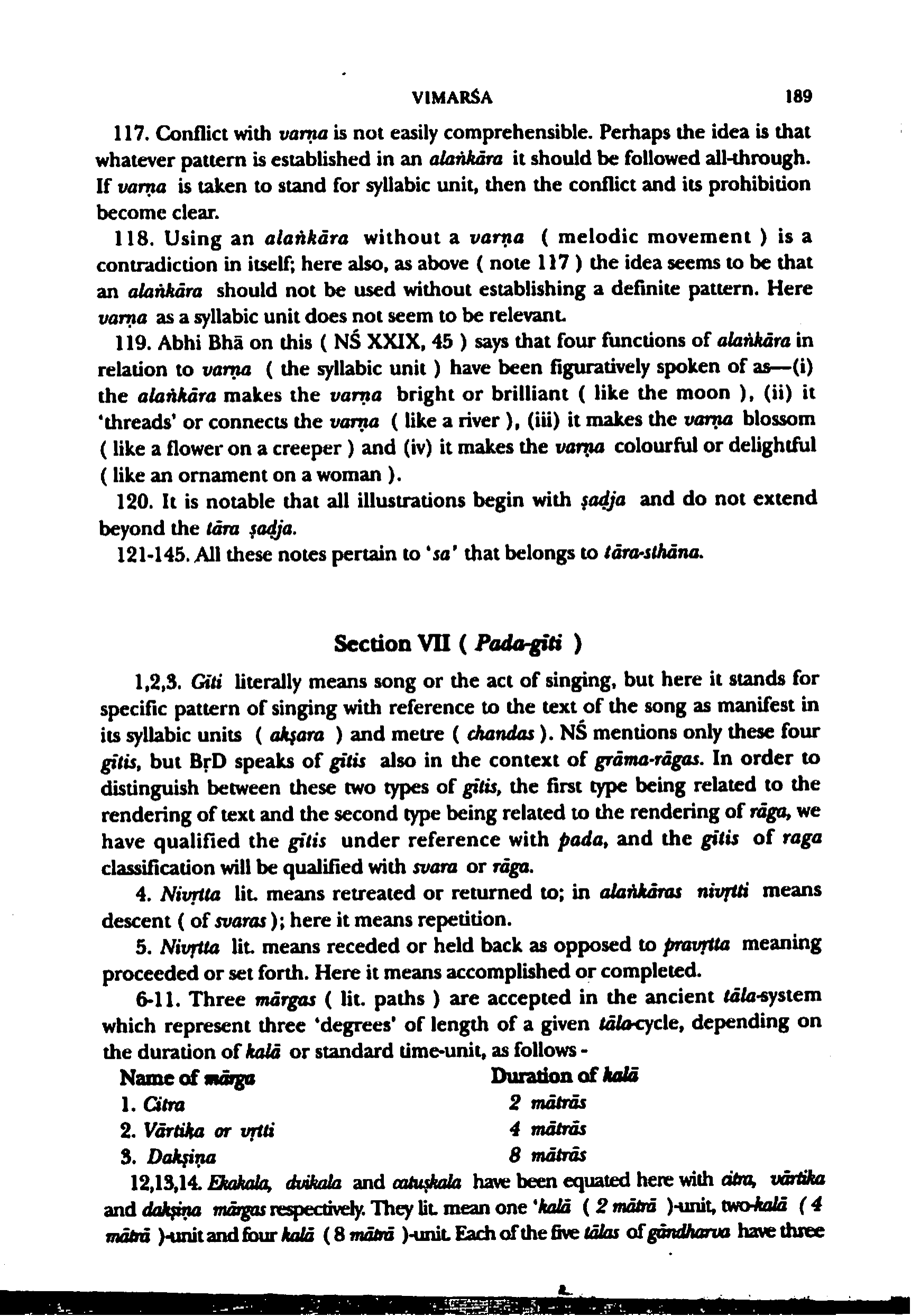
6-11. Three mārgas (lit. paths) are accepted in the ancient tāla-system
which represent three 'degrees' of length of a given tāla-cycle, depending on
the duration of kalā or standard time-unit, as follows -
Duration of kalā
Name of marga
<sup>2</sup> mātrās
<sup>1</sup>. Citra
<sup>4</sup> mātrās
<sup>2</sup>. Vārtika or vṛtti
<sup>8</sup> mātrās
<sup>3</sup>. Daksina
12,13,14. Ekakala, dvikala and catuşkala have been equated here with citra, vārtika
and dakṣiṇa mārgas respectively. They lit. mean one 'kalā (2 mātrā )-unit, two-kalā (4
mātrā)-unit and four kalā (8 mātrā)-unit. Each of the five tālas of gāndharva have three
T <sup>1</sup>