Gitanuga vadya has varieties including ogha (profuse strokes for each song unit) and anugata (instrumental rendering that follows but is not perfectly identical with song)
"Ogha is one of the three types of gitanuga vadya (instrumental rendering that follows 'song'). When the instrument uses profuse strokes for each unit of 'song' or melody that is ogha."
VIMARSA
<sup>191</sup>
30,31. 'Pāṇi-vivartitam' of the text has been rendered by us as brought about
by pāņi (graha). Lit. 'vivartita' would mean 'reflected'. The relative
predominance of gita and vādya has been viewed here alongwith temporal
factors like mārga, laya, yati (see note 34 below) etc. in NS XXIX, p. 101
( prose portion not commented upon by Abhinavagupta and put by the editor
within square brackets) and in S R VI, 168-170 as others' opinion. The
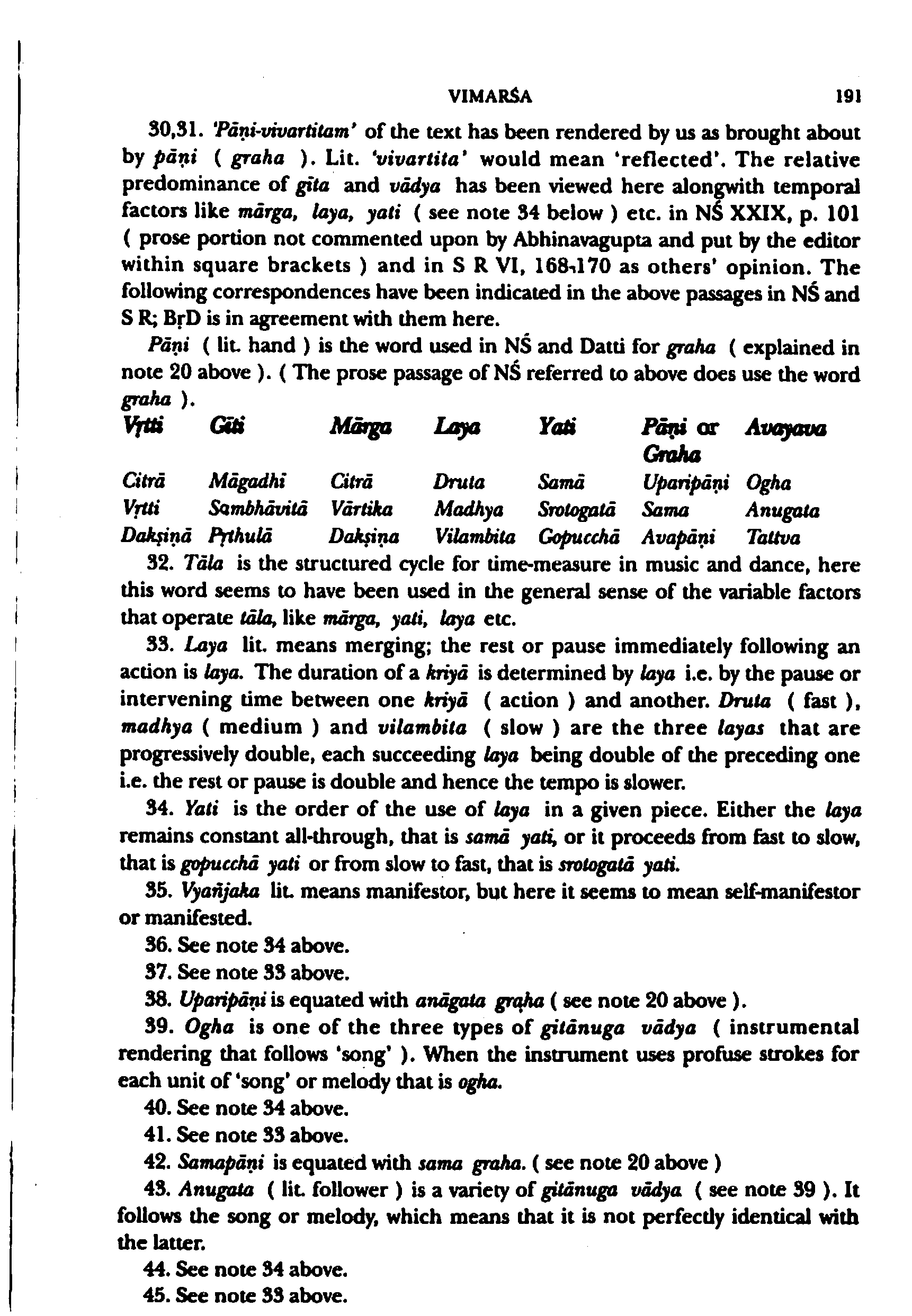
following correspondences have been indicated in the above passages in NS and
S R; BrD is in agreement with them here.
Pāņi (lit. hand) is the word used in NS and Datti for graha (explained in
note 20 above ). (The prose passage of NS referred to above does use the word
graha).
Vytti
Giti
Mārga
Yati
Pāņi or
Avayava
Laya
Graha
Citrā
Māgadhi
Citrā
Druta
Samā
Uparipāņi
Ogha
Vytti
Sambhāvitā Vārtika
Madhya
Srotogatā Sama
Anugata
Daksiņā Pythulā
Daksina
Vilambita
Gopucchā Avapāņi
Tattva
32. Tāla is the structured cycle for time-measure in music and dance, here
this word seems to have been used in the general sense of the variable factors
that operate tāla, like mārga, yati, laya etc.
33. Laya lit. means merging; the rest or pause immediately following an
action is laya. The duration of a kriyā is determined by laya i.e. by the pause or
intervening time between one kriyā (action) and another. Druta (fast),
madhya (medium) and vilambita (slow) are the three layas that are
progressively double, each succeeding laya being double of the preceding one
i.e. the rest or pause is double and hence the tempo is slower.
34. Yati is the order of the use of laya in a given piece. Either the laya
remains constant all-through, that is samā yati, or it proceeds from fast to slow,
that is gopucchā yati or from slow to fast, that is srotogatā yati.
35. Vyanjaka lit. means manifestor, but here it seems to mean self-manifestor
or manifested.
<sup>36</sup>. See note <sup>34</sup> above.
<sup>37</sup>. See note <sup>33</sup> above.
38. Uparipāņi is equated with anāgata graha ( see note 20 above ).
39. Ogha is one of the three types of gitanuga vadya (instrumental
rendering that follows 'song'). When the instrument uses profuse strokes for
each unit of 'song' or melody that is ogha.
40. See note 34 above.
41. See note 33 above.
42. Samapāņi is equated with sama graha. ( see note 20 above )
43. Anugata (lit. follower) is a variety of gitānuga vādya (see note 39). It
follows the song or melody, which means that it is not perfectly identical with
the latter.
44. See note 34 above.
45. See note 33 above.