1: VIMARŚA
2: 175
3: 61. Like Suśruta, Bh Prak VII, 27 also mentions tvak (skin) as the first dhātu,
4: instead of rasa (chyle) of our text. Monier Williams also enumerates seven
5: dhātus as chyle ( rasa ), blood, flush, fat, bone, marrow, semen; replacing tuak
6: with rasa.
7: 62. The seven minerals are not clear.
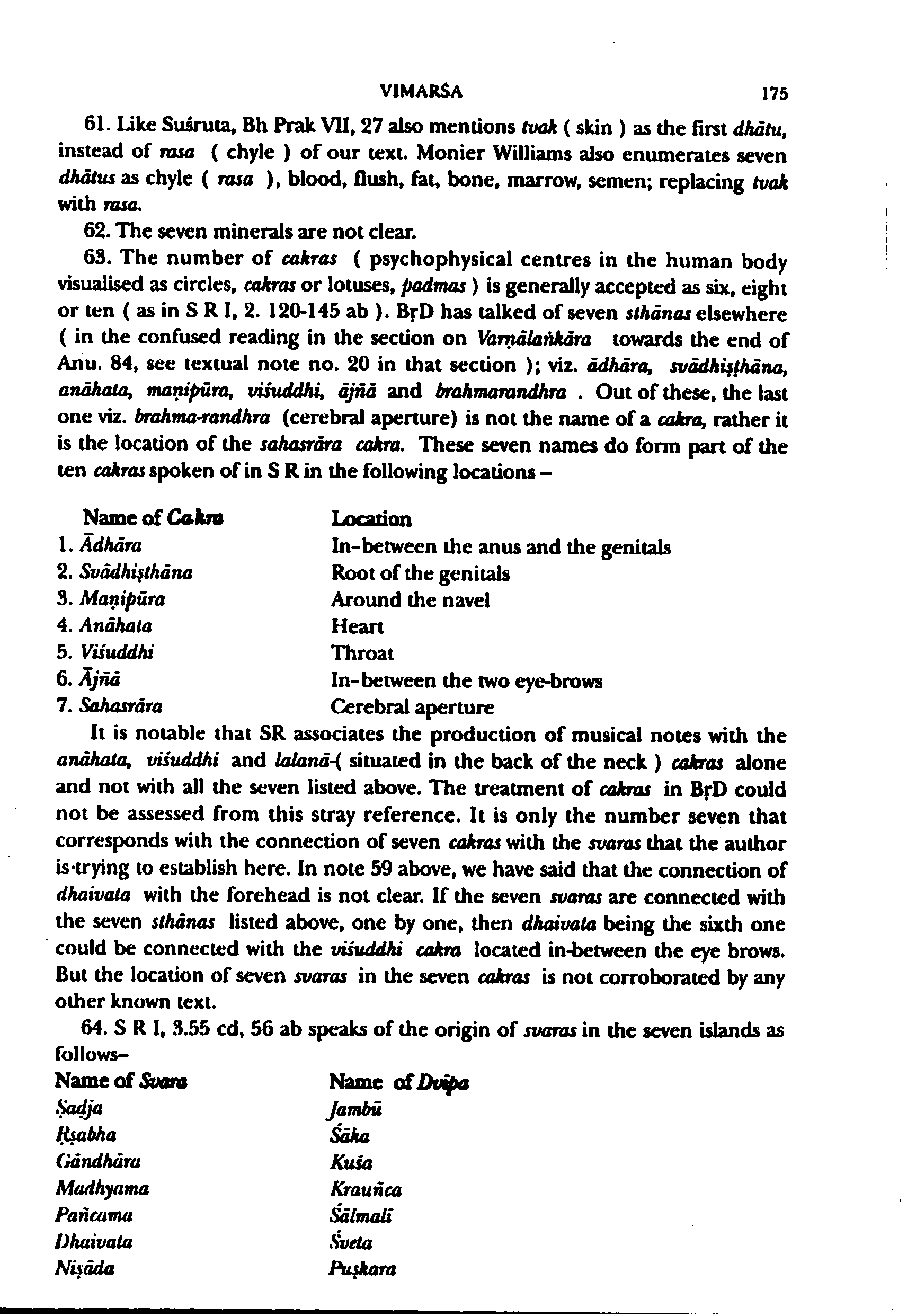
8: 63. The number of cakras (psychophysical centres in the human body
9: visualised as circles, cakras or lotuses, padmas) is generally accepted as six, eight
10: or ten (as in SRI, 2. 120-145 ab). ByD has talked of seven sthanas elsewhere
11: ( in the confused reading in the section on Varṇālankāra towards the end of
12: Anu. 84, see textual note no. 20 in that section ); viz. ādhāra, svādhişṭhāna,
13: anāhata, maņipūra, višuddhi, ājñā and brahmarandhra. Out of these, the last
14: one viz. brahma-randhra (cerebral aperture) is not the name of a cakra, rather it
15: is the location of the sahasrāra cakra. These seven names do form part of the
16: ten cakras spoken of in SR in the following locations -
17: Name of Cakra
18: Location
19: 1. Ādhāra
20: In-between the anus and the genitals
21: 2. Svādhişthāna
22: Root of the genitals
23: 3. Manipūra
24: Around the navel
25: 4. Anāhata
26: Heart
27: 5. Visuddhi
28: Throat
29: 6. Ājāā
30: In-between the two eye-brows
31: 7. Sahasrāra
32: Cerebral aperture
33: It is notable that SR associates the production of musical notes with the
34: anāhata, višuddhi and lalanā-( situated in the back of the neck ) cakras alone
35: and not with all the seven listed above. The treatment of cakras in BrD could
36: not be assessed from this stray reference. It is only the number seven that
37: corresponds with the connection of seven cakras with the svaras that the author
38: is trying to establish here. In note 59 above, we have said that the connection of
39: dhaivata with the forehead is not clear. If the seven svaras are connected with
40: the seven sthanas listed above, one by one, then dhaivata being the sixth one
41: could be connected with the viśuddhi cakra located in-between the eye brows.
42: But the location of seven svaras in the seven cakras is not corroborated by any
43: other known text.
44: 64. S R I, 3.55 cd, 56 ab speaks of the origin of svaras in the seven islands as
45: follows-
46: Name of Svara
47: Name of Duipa
48: Sadja
49: Jambū
50: Šāka
51: Rsabha
52: Gändhära
53: Kuśa
54: Madhyama
55: Krauñca
56: Pañcama
57: Sālmalī
58: Dhaivata
59: Sveta
60: Nisāda
61: Puşkara
Crop image (token + contexte)
Pas de crop disponible (Layer B n'a pas tourne sur ce token).
Page complete
Cote token (RIGHT) — line ?, token surligne en jaune
Contexte semantique (LEFT)
BRHADDESI
174
sadjagrāma; in madhyamagrāma sadja becomes madhyama, but there also the point of
reference is the şadja of şadjagrāma.
Sadja, as the one born of the six svaras has been explained by Kallinātha as
the one that is illuminated by the six svaras that are inherent in it; here also the
special importance of şadja is obvious. Brahaspati interprets the origin of şadja
from six svaras in this way—şadja becomes the second, third, fourth, fifth, sixth
and seventh svara in the murchanas of rsabha, gandhara, madhyama, pancama,
dhaivata and nişāda respectively (vide his commentary on the 28th chapter of
NS, p-22-23).
Şadja as the one born of the six angas (parts) in the human body is not easy
to comprehend. Kallinātha enumerates the six angas as the nose, throat, chest,
palate, tongue and teeth, leaving lip and cerebrum out of the eight locations
(sthanas) enumerated in Pa Si (15) in the context of the production of letters.
It is not clear as to how these sthanas could be relevant to sadja.
54. The association of virility with pabha is implicit in the simile of a bull
among cows.
55. Gām dhārayati iti gāndharvam is a similar etymological formulation given
by Abhinavagupta. (cf. Abhi Bhā on NŚ XXVIII, 9, 10)
56. Madhyama is the middle one, its position being in the middle of two
triads viz. sa-ni-ga and pa-dha-ni.
57. Pañcama (fifth) is the initial svara of the second triad and is hence
responsible for the elaboration of the first triad into a heptad.
58. The derivation of 'dhaivata' from dhivan is non-Paninian etymology,
because according to Pāṇini's grammar, 'dhīmān' and not 'dhīvān' is the correct
word.
It is interesting to note that dhaivata has been considered to be perceptible
by those possessing 'dhi' i.e. intelligence or wisdom. While ga-ma-pa-ni can be
tuned according to the relationship of the fourth and the fifth, as follows,
dhaivata and rsabha cannot be tuned in a similar way-
- pañcama - relationship of fifth.
1. Şadja
2. Şadja - madhyama - relationship of fourth.
3. Madhyama - niṣāda - relationship of fourth.
- gāndhāra - relationship of fifth. (backwards)
4. niṣāda
For tuning dhaivata, one has to take recourse to the relationship of third
from madhyama and then from dhaivata back to reabha is the relationship of
fifth. It is, perhaps, on this account that dhaivata is associated with the wise
ones; the relationship of third is perhaps not as obvious as that of the fourth
and the fifth.
59. The forehead is not a location traditionally accepted in the context of
production of sounds in the Siksā texts. The association of dhaivata with the
forehead is not clear ( see note 63 in this section ).
60. Niṣāda is the last one in the ascending order of seven svaras, hence the
six preceding svaras could be said to rest on it. In western thought it is the
leading note as it 'leads' to the next register.
174
sadjagrāma; in madhyamagrāma sadja becomes madhyama, but there also the point of
reference is the şadja of şadjagrāma.
Sadja, as the one born of the six svaras has been explained by Kallinātha as
the one that is illuminated by the six svaras that are inherent in it; here also the
special importance of şadja is obvious. Brahaspati interprets the origin of şadja
from six svaras in this way—şadja becomes the second, third, fourth, fifth, sixth
and seventh svara in the murchanas of rsabha, gandhara, madhyama, pancama,
dhaivata and nişāda respectively (vide his commentary on the 28th chapter of
NS, p-22-23).
Şadja as the one born of the six angas (parts) in the human body is not easy
to comprehend. Kallinātha enumerates the six angas as the nose, throat, chest,
palate, tongue and teeth, leaving lip and cerebrum out of the eight locations
(sthanas) enumerated in Pa Si (15) in the context of the production of letters.
It is not clear as to how these sthanas could be relevant to sadja.
54. The association of virility with pabha is implicit in the simile of a bull
among cows.
55. Gām dhārayati iti gāndharvam is a similar etymological formulation given
by Abhinavagupta. (cf. Abhi Bhā on NŚ XXVIII, 9, 10)
56. Madhyama is the middle one, its position being in the middle of two
triads viz. sa-ni-ga and pa-dha-ni.
57. Pañcama (fifth) is the initial svara of the second triad and is hence
responsible for the elaboration of the first triad into a heptad.
58. The derivation of 'dhaivata' from dhivan is non-Paninian etymology,
because according to Pāṇini's grammar, 'dhīmān' and not 'dhīvān' is the correct
word.
It is interesting to note that dhaivata has been considered to be perceptible
by those possessing 'dhi' i.e. intelligence or wisdom. While ga-ma-pa-ni can be
tuned according to the relationship of the fourth and the fifth, as follows,
dhaivata and rsabha cannot be tuned in a similar way-
- pañcama - relationship of fifth.
1. Şadja
2. Şadja - madhyama - relationship of fourth.
3. Madhyama - niṣāda - relationship of fourth.
- gāndhāra - relationship of fifth. (backwards)
4. niṣāda
For tuning dhaivata, one has to take recourse to the relationship of third
from madhyama and then from dhaivata back to reabha is the relationship of
fifth. It is, perhaps, on this account that dhaivata is associated with the wise
ones; the relationship of third is perhaps not as obvious as that of the fourth
and the fifth.
59. The forehead is not a location traditionally accepted in the context of
production of sounds in the Siksā texts. The association of dhaivata with the
forehead is not clear ( see note 63 in this section ).
60. Niṣāda is the last one in the ascending order of seven svaras, hence the
six preceding svaras could be said to rest on it. In western thought it is the
leading note as it 'leads' to the next register.
Voir figures de la page (diagrammes / tables)
Pas de figure detectee sur cette page (Surya layout n'a rien identifie).
Pourquoi flagué
- Tres proche d'un mot connu du dico Sanskrit (1 lettre de difference)
Vu par
OCR Surya Translitterateur Dico Sanskrit IA visuelle
Raisonnement IA visuelle
(aucun reasoning Layer B disponible)