Source scans · vol_II_p128
recto · open full
scan recto
verso · open full
scan verso
Bṛhaddeśī · Volume II
pp. 238–239folio 128
Devanāgarī (Bṛhaddeśī)
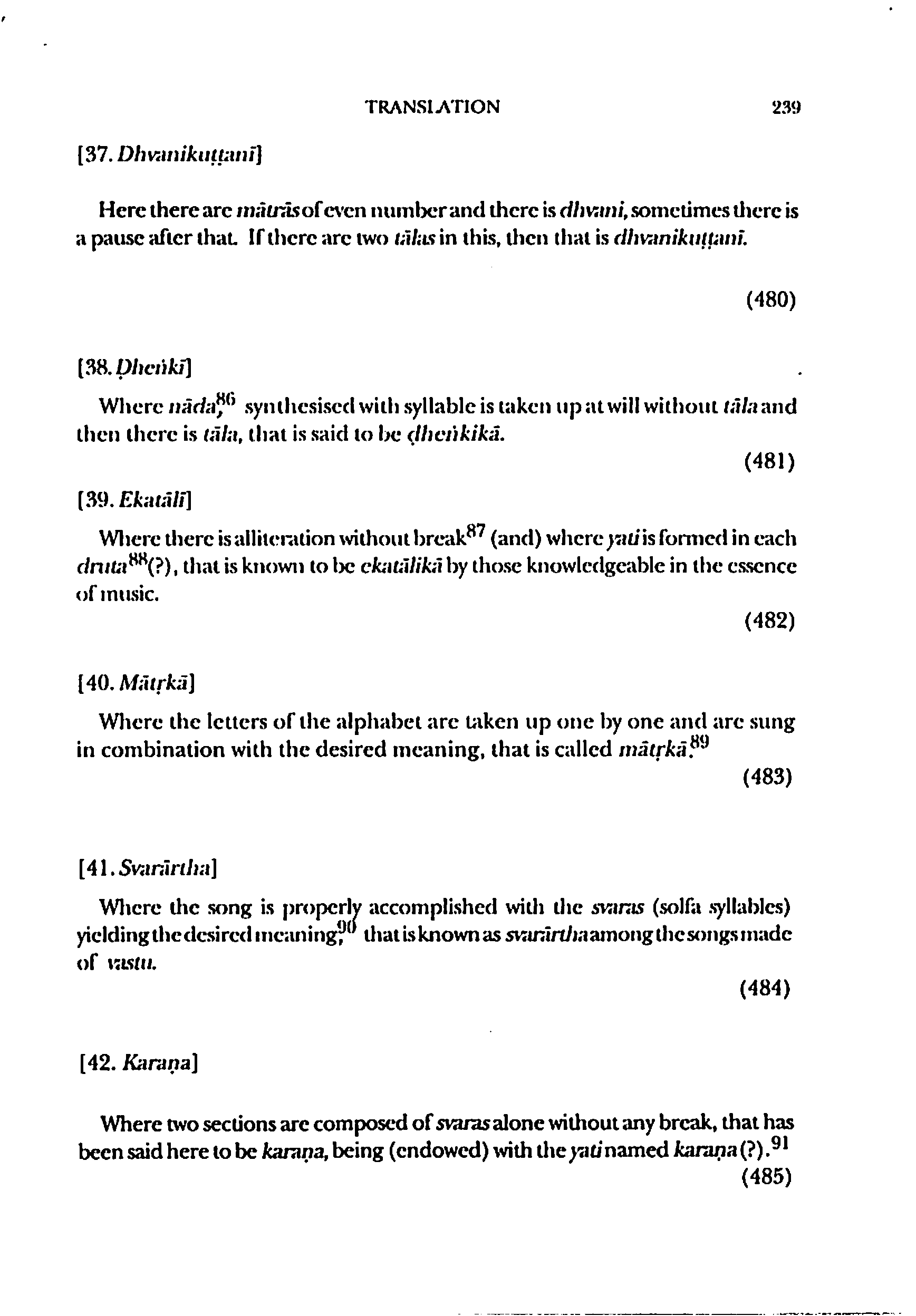
मात्रा[:]समा ध्वनिश्चात्र विरामोऽनन्तरं क्वचित् ।
(त?न) अस्या द्वौ यदि तालौ स्तस्तदा सा ध्वनिकुट्टनी ॥४८०॥ अस्यैव यदि तालोऽसौ तदा (ति?नी)
[३८. ढेङ्की]
स्वेच्छया गृह्यते यत्र नादोऽक्षरसमन्वितः।
(ये?स्वे) तालशून्यस्ततस्तालो ढेङ्किका सा प्रकीर्तिता ॥४८१॥ देक्क्कि
[३९. एकताली]
निरन्तरमनुप्रासो यतिर्यत्र द्वते द्वते ।
क्रियते गीततत्त्वज्ञैः सा स्मृता त्वेकतालिका ॥2 ४८२॥
[४०. मातृका]
४८आदाय गीयते यस्यामेकैकं मातृकाक्षरम् ।
इष्टेनार्थेन संयोज?्य मातृका सा प्रकीर्तिता ॥3 ४८३॥
वाञ्छितार्थस्वरैरेव यत्र सम्यक् प्रगीयते ।
वस्त्वात्मकेषु गीतेषु स स्वरार्थ इति स्मृतः ॥4 ४८४॥
[४२. करणम्]
निरन्तरं स्वरैरेव यत्र ४९खण्डद्वयं भवेत् ।
तदत्र करणं प्रोक्तं5 यत्या तु ५०करणाख्यया[?] ॥४८५॥ कारणं का
English — Sharma (translation)
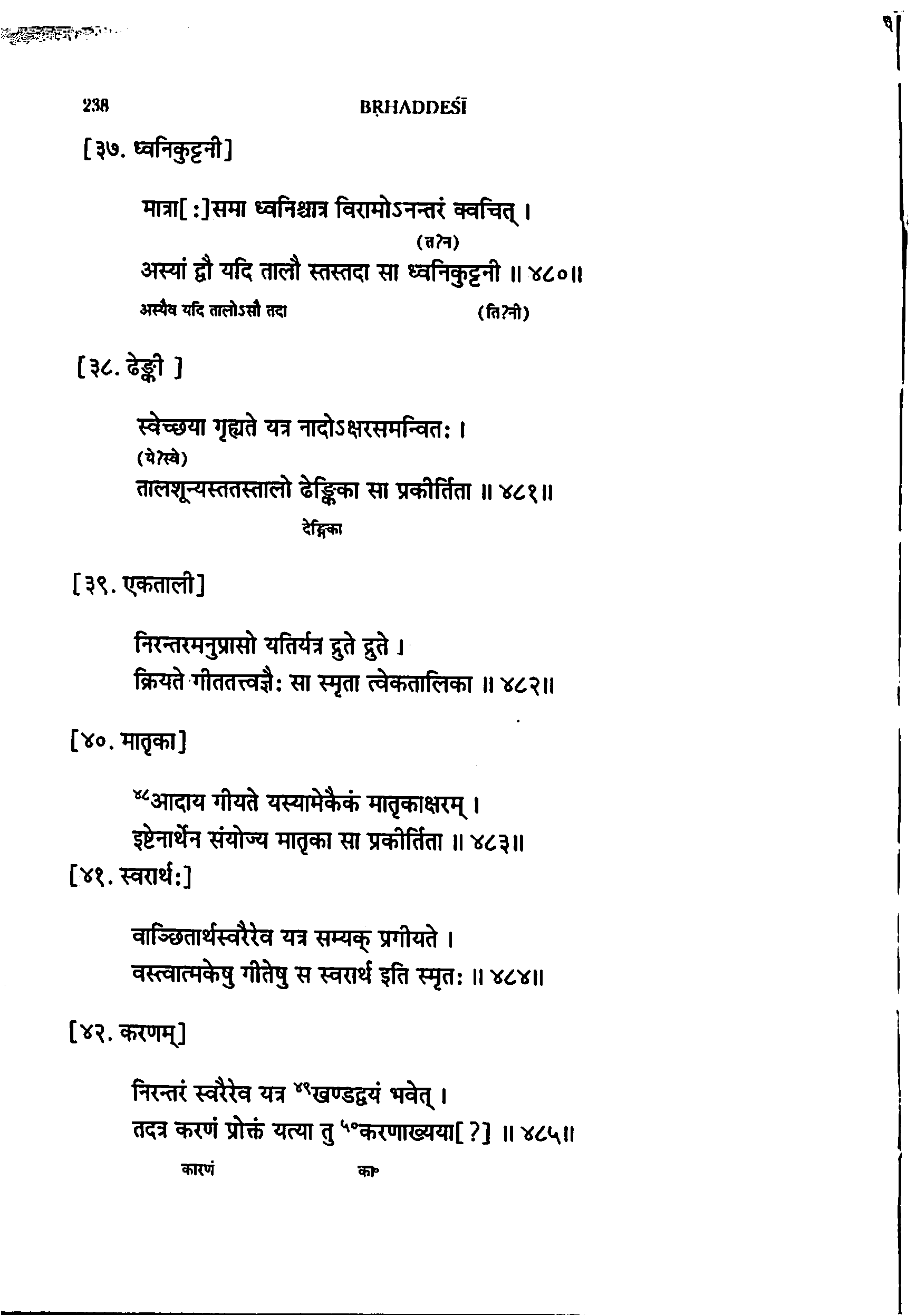
, Here there are mātrās of even number and there is dhvuni, sometimes there is a pause after that. If there are two tālas in this, then that is dhvanikuṭṭanī.
(480)
[38.Dheńki]
Where <math>n\bar{a}da_{*}^{86}</math> synthesised with syllable is taken up at will without <math>t\bar{a}la</math> and then there is tāla, that is said to be dhenkikā.
(481)
[39. Ekatālī]
Where there is alliteration without break <math>^{87}</math> (and) where yati is formed in each druta88(?), that is known to be ekatālikā by those knowledgeable in the essence of music1.
(482)
[40. Mātṛkā]
Where the letters of the alphabet are taken up one by one and are sung in combination with the desired meaning8, that is called mātṛkā.389
(483)
Where the song is properly accomplished with the svaras (solfa syllables) yielding the desired meaning, that is known as svarārtha among the songs made of vastu.4
(484)
[42. Karana]
Where two sections are composed of svaras alone without any break, that has been said here to be karaṇa5, being (endowed) with the yati named karaṇa (?)10.91
(485)
1.[attribution]Ekatālikā is recognized by those knowledgeable in the essence of music (gītatattva)क्रियते गीततत्त्वज्ञैः
2.[definition]Ekatālikā is characterized by continuous alliteration and yati formed at each drutaनिरन्तरमनुप्रासो यतिर्यत्र द्वते द्वते । क्रियते गीततत्त्वज्ञैः सा स्मृता त्वेकतालिका ॥
3.[definition]Mātṛkā involves taking alphabet letters one by one and singing them combined with desired meaningआदाय गीयते यस्यामेकैकं मातृकाक्षरम् । इष्टेनार्थेन संयोज?्य मातृका सा प्रकीर्तिता ॥
4.[definition]Svarārtha occurs in vastu-songs where svaras yield the desired meaning through proper performanceवाञ्छितार्थस्वरैरेव यत्र सम्यक् प्रगीयते । वस्त्वात्मकेषु गीतेषु स स्वरार्थ इति स्मृतः ॥
5.[definition]Karaṇa is composition where two sections are made of svaras alone without any breakनिरन्तरं स्वरैरेव यत्र खण्डद्वयं भवेत् । तदत्र करणं प्रोक्तं
6.[definition]Dhvanikuṭṭanī is characterized by even-numbered mātrās, dhvani, and two tālasमात्रा[:]समा ध्वनिश्चात्र विरामोऽनन्तरं क्वचित् । अस्या द्वौ यदि तालौ स्तस्तदा सा ध्वनिकुट्टनी
7.[definition]Dheńkikā is nāda synthesized with syllable, taken at will without tāla, then followed by tālaस्वेच्छया गृह्यते यत्र नादोऽक्षरसमन्वितः। तालशून्यस्ततस्तालो ढेङ्किका सा प्रकीर्तिता ॥
8.[relation] Both Mātṛkā and Svarārtha involve the combination of language elements with meaningइष्टेनार्थेन संयोज?्य
1.[attribution] Ekatālikā is recognized by those knowledgeable in the essence of music (gītatattva)by those knowledgeable in the essence of music
3.[definition] Mātṛkā involves taking alphabet letters one by one and singing them combined with desired meaningWhere the letters of the alphabet are taken up one by one and are sung in combination with the desired meaning, that is called mātṛkā.
4.[definition] Svarārtha occurs in vastu-songs where svaras yield the desired meaning through proper performanceWhere the song is properly accomplished with the svaras (solfa syllables) yielding the desired meaning, that is known as svarārtha among the songs made of vastu.
5.[definition] Karaṇa is composition where two sections are made of svaras alone without any breakWhere two sections are composed of svaras alone without any break, that has been said here to be karaṇa
6.[definition] Dhvanikuṭṭanī is characterized by even-numbered mātrās, dhvani, and two tālasHere there are mātrās of even number and there is dhvuni, sometimes there is a pause after that. If there are two tālas in this, then that is dhvanikuṭṭanī.
8.[relation]Both Mātṛkā and Svarārtha involve the combination of language elements with meaningin combination with the desired meaning
9.[relation]Both Dheńki and Dhvanikuṭṭanī involve the structural element of tāla in their compositionWhere nar{a}da_{*}^{86} synthesised with syllable is taken up at will without tar{a}la and then there is tāla
10.[structural]Karaṇa is endowed with a specific yati also named karaṇabeing (endowed) with the yati named karaṇa (?)