Source scans · vol_II_p127
recto · open full
scan recto
verso · open full
scan verso
Bṛhaddeśī · Volume II
pp. 236–237folio 127
Devanāgarī
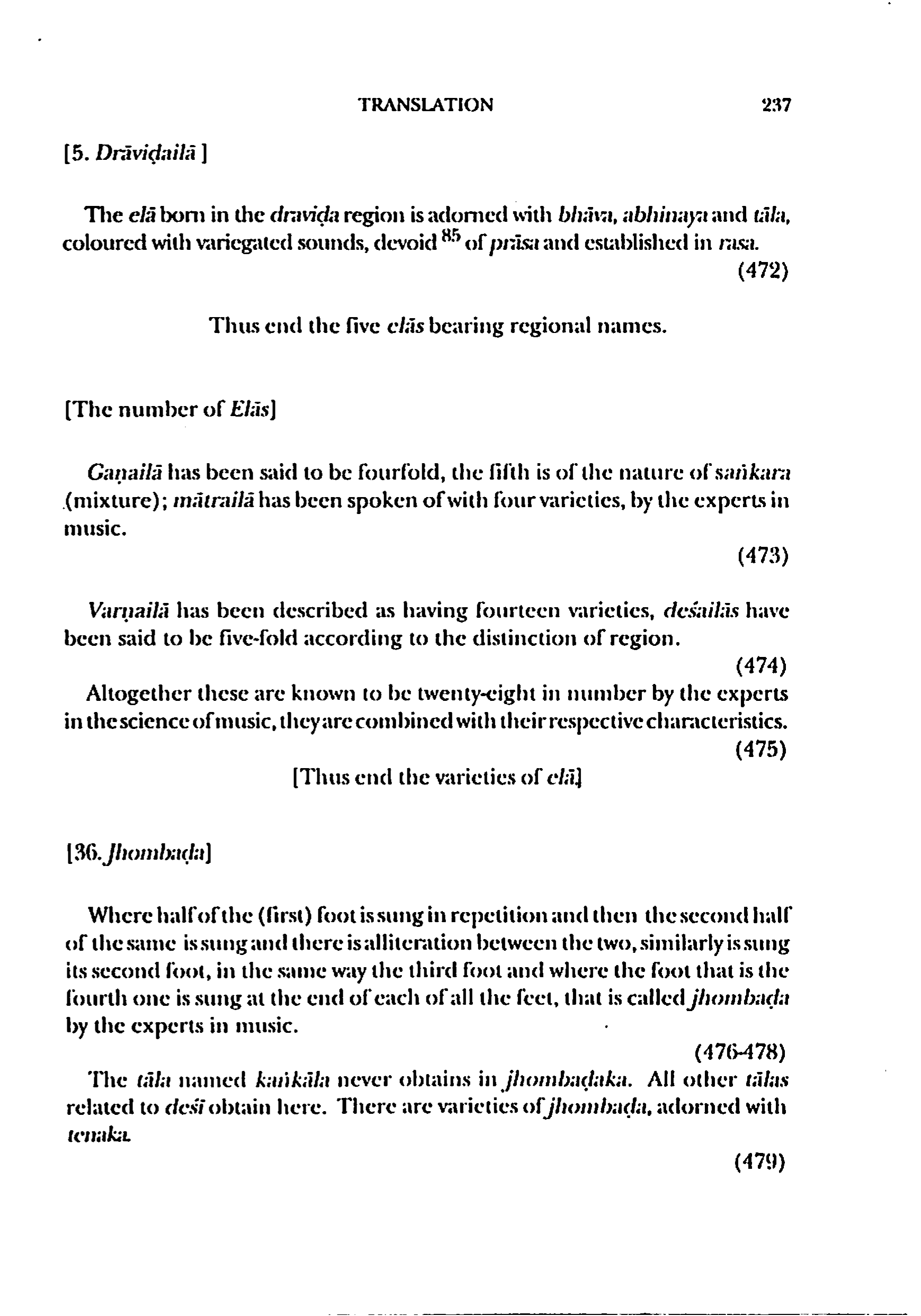
भावाभिनयतालाढ्या विचित्रध्वनिरञ्जिता1
प्रासहीना रसस्था च४७ एला द्रविडदेशजा10 ॥४७२॥
॥ इति देशाख्यैलापञ्चकम् ॥
[एलासङ्खया]
गणैला तु चतुर्धोक्ता(यत?तु) चतु(थॉं?धॉं) का पञ्चमी सङ्करात्मका3
मात्रैला तु चतुर्भेदै: कथिता गीतकोविदै:4 ॥४७३॥
चतुर्दशविभेदेन वर्णेला परिगीयते5
पञ्चधा देशभेदेन देशैला:(शैलरश?देशै)ला: समुदीरिता:6 ॥४७४॥
एकत्र मिलितास्त्वेता अष्टाविंशतिसंख्यया ।
विज्ञाता(वि)ज्ञाता गीतशास्त्रज्ञै: स्वस्वलक्षणसंयुता: ॥४७५॥ भी (:स्वस्व)
[इत्येलाभेदा:]
[३६. झोम्बड:]
आवृत्त्या यत्र पादार्धं गीत्वा तदनुगीयते ।
आ(वि?वृ)त्या (धं?धं) अर्धं द्वितीयमस्यापि<b>पादस्य</b> प्रासस्तु स्याद् द्वयोरिप ॥४७६॥
एवमेव द्वितीयोऽपि अस्य पाद: प्रगीयते ।
एवं तृतीयपादश्च(द्वि?तृ) पादो यश्च चतुर्थक: ॥४७७॥
प्रत्येकं सर्वपादानामन्तेऽसौ यत्र गीयते ।
स तु झोम्बडको नाम गीतज्ञैरिभधीयते ॥४७८॥
कङ्कालो नाम तालशतारश नैव झोम्बडके॰को भवेत्8
अन्ये तु देशिसम्बन्धास्तालाःदेशी॰ सर्वे भवन्ति हि ॥
तेनकालङ्कृताताना + भेदा झोम्बडस्य•डेस्य भवन्ति हि12 ॥४७९॥
English — Sharma (translation)
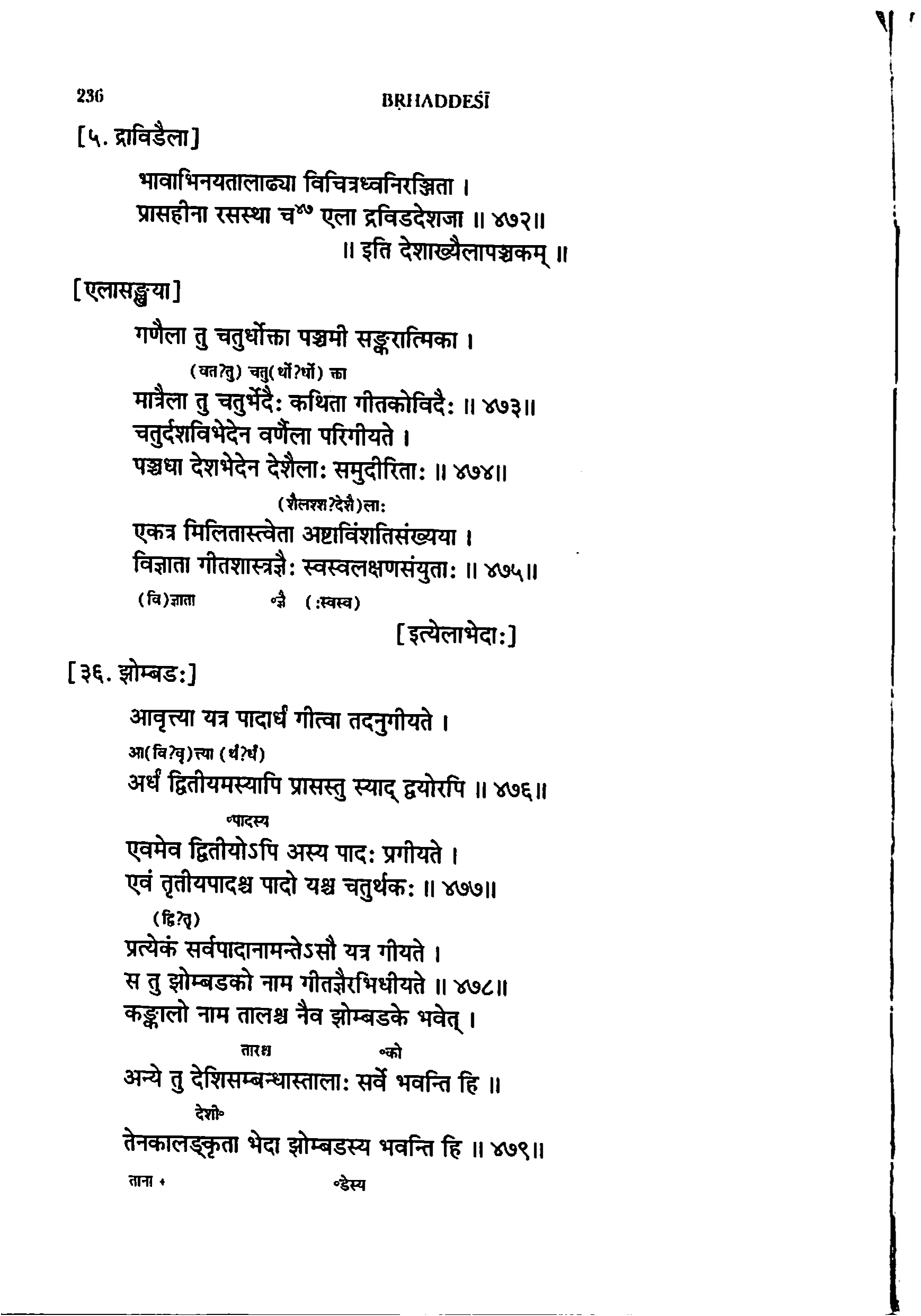
The elā born in the draviḍa region is adorned with bhāva, abhinaya and tāla, coloured with variegated sounds, devoid <math>^{85}</math> of prāsa and established in rasa.
(472)
Thus end the five clās bearing regional names.
[The number of Elās]
Ganailā has been said to be fourfold, the fifth is of the nature of sankara (mixture)3; mātrailā has been spoken of with four varieties, by the experts in music.4
(473)
Varņailā has been described as having fourteen varieties5, deśailās have been said to be five-fold according to the distinction of region.6
(474)
Altogether these are known to be twenty-eight in number by the experts in the science of music7, they are combined with their respective characteristics.
(475)
[Thus end the varieties of elā]
[36. Jhombada]
Where half of the (first) foot is sung in repetition and then the second half of the same is sung and there is alliteration between the two2, similarly is sung its second foot, in the same way the third foot and where the foot that is the fourth one is sung at the end of each of all the feet, that is called jhombada by the experts in music. <math>(476-478)</math> The tāla named kankāla never obtains in jhombadaka.8 All other tālas related to desi obtain here.9 There are varieties of jhombada, adorned with tenaka.12
(479)
1.[definition] Drāvidailā is born in the draviḍa region and is characterized by bhāva, abhinaya, and tālaभावाभिनयतालाढ्या विचित्रध्वनिरञ्ज?िता
3.[enumeration] Ganailā has been said to be fourfold, with a fifth variety of sankara (mixture) natureगणैला तु चतुर्धोक्ता पञ्चमी सङ्करात्मका
4.[enumeration] Mātrailā has been spoken of with four varieties by experts in musicमात्रैला तु चतुर्भेदैः कथिता गीतकोविदैः
5.[enumeration] Varņailā has been described as having fourteen varietiesचतुर्दशविभेदेन वर्णेला परिगीयते
6.[enumeration] Deśailās have been said to be five-fold according to the distinction of regionपञ्चधा देशभेदेन देशैलाः समुदीरिताः
8.[relation] The tāla named kankāla never obtains in jhombadakaकङ्कालो नाम तालश नैव झोम्बडके भवेत्
9.[relation] All tālas related to deśī obtain in jhombadaअन्ये तु देशिसम्बन्धास्ताला सर्वे भवन्ति हि
10.[structural]Drāvidailā is devoid of prāsa and established in rasaप्रासहीना रसस्था च एला द्रविडदेशजा
12.[structural] Jhombada has varieties that are adorned with tenakaतेनकालङ्कृता भेदा झोम्बडस्य भवन्ति हि
1.[definition]Drāvidailā is born in the draviḍa region and is characterized by bhāva, abhinaya, and tālaThe elā born in the draviḍa region is adorned with bhāva, abhinaya and tāla
2.[definition]Jhombada is defined by repetition of half of the first foot followed by singing the second half with alliteration between the twoWhere half of the (first) foot is sung in repetition and then the second half of the same is sung and there is alliteration between the two
3.[enumeration]Ganailā has been said to be fourfold, with a fifth variety of sankara (mixture) natureGanailā has been said to be fourfold, the fifth is of the nature of sankara (mixture)
4.[enumeration]Mātrailā has been spoken of with four varieties by experts in musicmātrailā has been spoken of with four varieties, by the experts in music.
5.[enumeration]Varņailā has been described as having fourteen varietiesVarņailā has been described as having fourteen varieties
6.[enumeration]Deśailās have been said to be five-fold according to the distinction of regiondeśailās have been said to be five-fold according to the distinction of region.
7.[enumeration]All varieties of elā together are known to be twenty-eight in number by experts in the science of musicAltogether these are known to be twenty-eight in number by the experts in the science of music
8.[relation]The tāla named kankāla never obtains in jhombadakaThe tāla named kankāla never obtains in jhombadaka.
9.[relation]All tālas related to deśī obtain in jhombadaAll other tālas related to desi obtain here.
11.[structural]Jhombada is constructed such that at the end of each of all four feet, a refrain is sungwhere the foot that is the fourth one is sung at the end of each of all the feet, that is called jhombada
12.[structural]Jhombada has varieties that are adorned with tenakaThere are varieties of jhombada, adorned with tenaka.