Source scans · vol_II_p169
recto · open full
scan recto
verso · open full
scan verso
Bṛhaddeśī · Volume II
pp. 0–320folio 169
Bṛhaddeśī
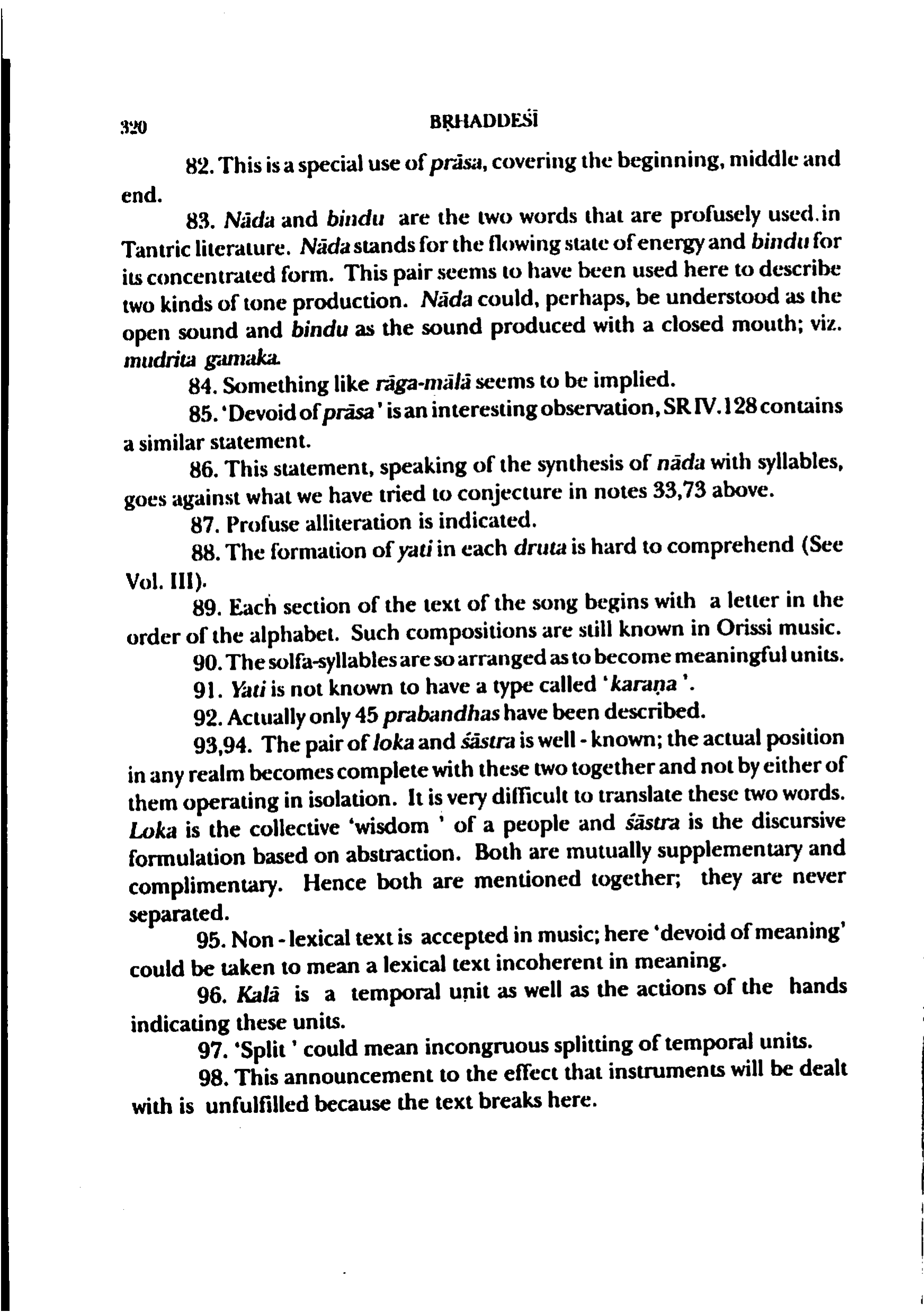
82. This is a special use of prāsa, covering the beginning, middle and end. 83. Nāda and bindu are the two words that are profusely used in Tantric literature. Nāda stands for the flowing state of energy and bindu for its concentrated form. This pair seems to have been used here to describe two kinds of tone production. Nāda could, perhaps, be understood as the open sound and bindu as the sound produced with a closed mouth; viz. mudrita gamaka. 84. Something like rāga-mālā seems to be implied. 85. 'Devoid of prāsa' is an interesting observation, SR IV.128 contains a similar statement. 86. This statement, speaking of the synthesis of nāda with syllables, goes against what we have tried to conjecture in notes 33,73 above. 87. Profuse alliteration is indicated. 88. The formation of yati in each druta is hard to comprehend (See Vol. III). 89. Each section of the text of the song begins with a letter in the order of the alphabet. Such compositions are still known in Orissi music. 90. The solfa-syllables are so arranged as to become meaningful units. 91. Yati is not known to have a type called 'karana'. 92. Actually only 45 prabandhas have been described. 93,94. The pair of loka and śāstra is well - known; the actual position in any realm becomes complete with these two together and not by either of them operating in isolation. It is very difficult to translate these two words. Loka is the collective 'wisdom' of a people and śāstra is the discursive formulation based on abstraction. Both are mutually supplementary and complimentary. Hence both are mentioned together; they are never separated. 95. Non-lexical text is accepted in music; here 'devoid of meaning' could be taken to mean a lexical text incoherent in meaning. 96. Kalā is a temporal unit as well as the actions of the hands indicating these units. 97. 'Split' could mean incongruous splitting of temporal units. 98. This announcement to the effect that instruments will be dealt with is unfulfilled because the text breaks here.
translation
. - .
1.[citation]Nāda and bindu are a paired terminology widely used in Tantric literatureNāda and bindu are the two words that are profusely used in Tantric literature.
2.[definition]Nāda stands for the flowing state of energy in Tantric philosophyNāda stands for the flowing state of energy and bindu for its concentrated form.
3.[definition]Bindu represents the concentrated form of energy in Tantric philosophyNāda stands for the flowing state of energy and bindu for its concentrated form.
4.[definition]Mudrita gamaka represents sound produced with a closed mouth, contrasted with open soundNāda could, perhaps, be understood as the open sound and bindu as the sound produced with a closed mouth; viz. mudrita gamaka.
5.[definition]Loka represents the collective wisdom of a peopleLoka is the collective 'wisdom' of a people and śāstra is the discursive formulation based on abstraction.
6.[definition]Śāstra is the discursive formulation based on abstractionLoka is the collective 'wisdom' of a people and śāstra is the discursive formulation based on abstraction.
7.[definition]Kalā functions as both a temporal unit and as hand actions indicating these unitsKalā is a temporal unit as well as the actions of the hands indicating these units.
8.[relation]Nāda and bindu describe two kinds of tone production in musicThis pair seems to have been used here to describe two kinds of tone production.
9.[relation]Loka and śāstra form a paired conceptual framework where both are mutually supplementary and complementaryBoth are mutually supplementary and complimentary. Hence both are mentioned together; they are never separated.
10.[structural]Prāsa has a special use that covers the beginning, middle and end of musical passagesThis is a special use of prāsa, covering the beginning, middle and end.
11.[structural]The formation of yati in each druta is difficult to comprehendThe formation of yati in each druta is hard to comprehend (See Vol. III).
12.[structural]Only 45 prabandhas have been described in the BrihaddesiActually only 45 prabandhas have been described.