Source scans · vol_II_p168
recto · open full
scan recto
verso · open full
scan verso
Bṛhaddeśī · Volume II
pp. 318–319folio 168
Bṛhaddeśī
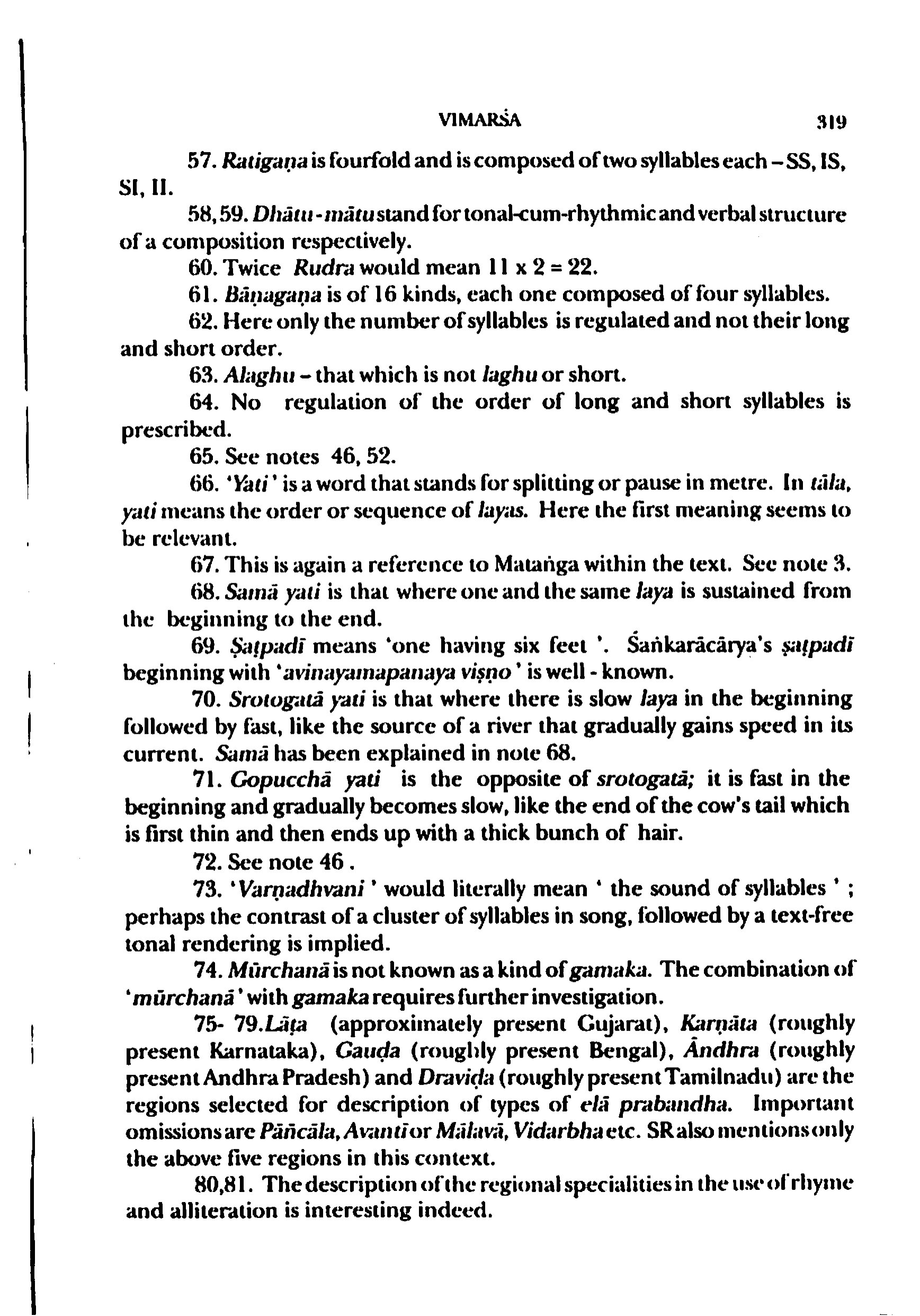
35. Pāncālī rīti is the poetical style which uses neither too long, nor too short compounds. 36. Candragana is another name for bhagana, SII. 37. Svargaņa is another name for nagaņa, III. 38. Ārabhaţī is the third among the four vṛttis of drama, characterised by forceful movement of the limbs. 39. Lātīyā rīti is the poetical style, characterised by very lean compounds. 40. Analagaņa stands for ragaņa, SIS. 41. Vāyugaņa stands for sagaņa, IIS. 42. Sāttvatī is the second among the four vṛttis of drama, characterised by the predominance of sāttvika abhinaya. 43. Gauḍī rīti is a poetic style characterised by profuse use of long compounds. 44. Ambara-gaņa stands for tagaņa, SSI. 45. Mārtaṇḍagaṇa stands for jagaṇa, ISI. 46. Mūrchanā is used in a different sense here and not in the usual sense of a series of intervals. It is the name of a technique of the right hand on the viņā with pressed string(s) (cf SR V1.84). Here it seems to indicate some special way of sound-production by the voice. 47. Vaidarbhî rīti is a poetic style characterised by the absence or very sparse use of compounds. 48. Bhāratī is the first among the four vṛttis of drama, characterised by the predominance of verbal expression. 49. Vārāhī is one form of Sakti. Its mention here indicates the desire to make desī music a part of spiritual culture. 50. Bhūmigaņa stands for magaņa, SSS. 51. Jalagaņa stands for yagaņa, ISS. 52. See note 46 above for mūrchanā. Bindu is also one of the techniques of the right hand on the viņā that is not open-stringed (SR VI. 78 cd, 79 ab). Here it must signify a vocal technique for producing a similar (damped) tone. 53. Sthita is a synonym of vilambita; it could be taken here to mean slow. 54. 'Vallabha' seems to stand for an earlier authority. 55. 'Rudra' symbolises the number eleven, because eleven Rudras are well-known. 56. Ten mātrās are to be indicated here; hence Rudra does not fit into the context.
translation
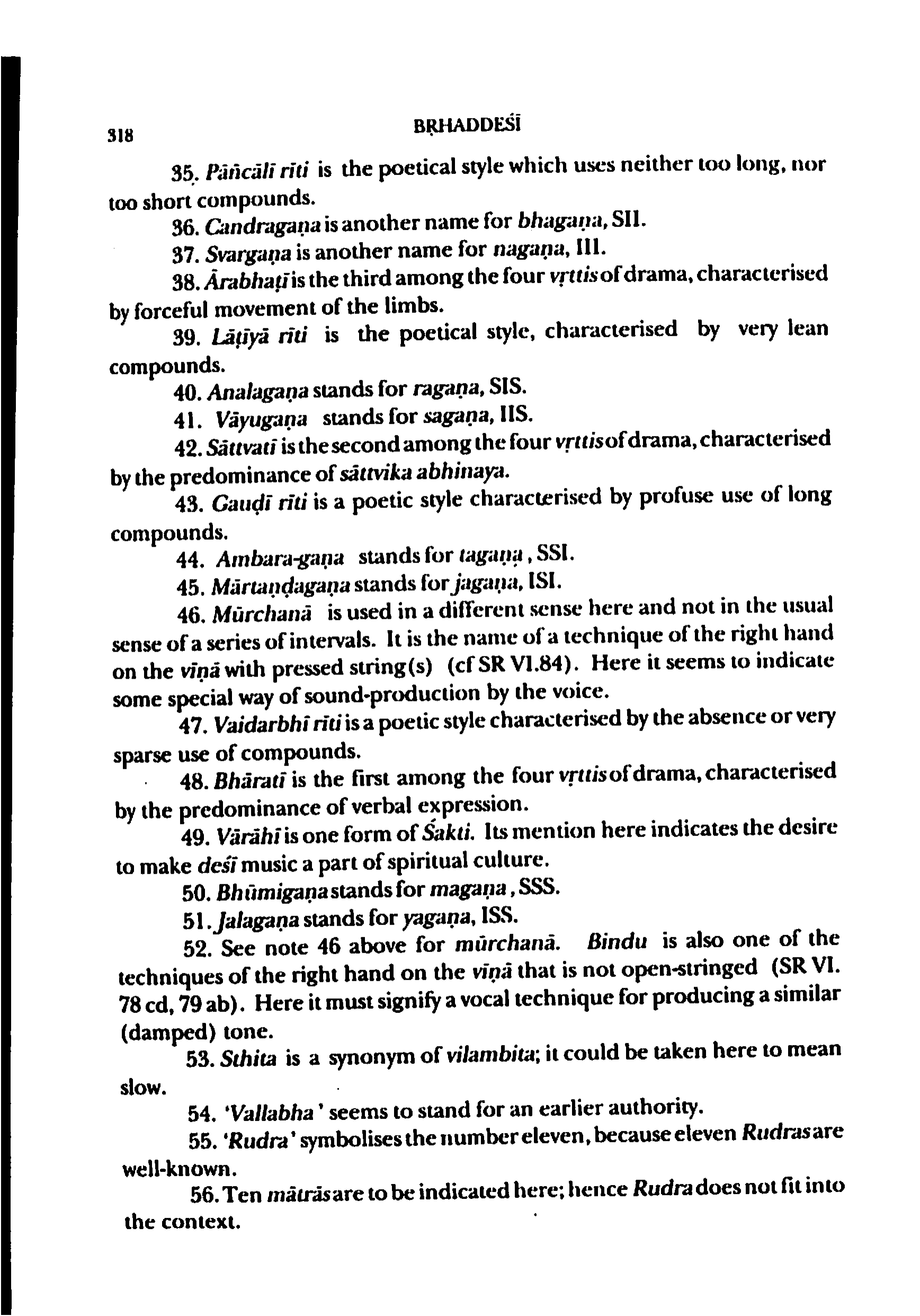
57. Ratigana is fourfold and is composed of two syllables each – SS, IS, SI, II. 58, 59. Dhātu-mātu stand for tonal-cum-rhythmic and verbal structure of a composition respectively. 60. Twice Rudra would mean <math>11 \times 2 = 22</math>. 61. Bāṇagaṇa is of 16 kinds, each one composed of four syllables. 62. Here only the number of syllables is regulated and not their long and short order. 63. Alaghu - that which is not laghu or short. 64. No regulation of the order of long and short syllables is prescribed. 65. See notes 46, 52. 66. 'Yati' is a word that stands for splitting or pause in metre. In tāla, yati means the order or sequence of layas. Here the first meaning seems to be relevant. 67. This is again a reference to Matanga within the text. See note 3. 68. Samā yati is that where one and the same laya is sustained from the beginning to the end. 69. Şaţpadī means 'one having six feet '. Śaṅkarācārya's şaţpadī beginning with 'avinayamapanaya viṣṇo' is well - known. 70. Srotogatā yati is that where there is slow laya in the beginning followed by fast, like the source of a river that gradually gains speed in its current. Samā has been explained in note 68. 71. Gopucchā yati is the opposite of srotogatā; it is fast in the beginning and gradually becomes slow, like the end of the cow's tail which is first thin and then ends up with a thick bunch of hair. 72. See note 46. 73. 'Varṇadhvani' would literally mean 'the sound of syllables'; perhaps the contrast of a cluster of syllables in song, followed by a text-free tonal rendering is implied. 74. Mūrchanā is not known as a kind of gamaka. The combination of 'mūrchanā' with gamaka requires further investigation. 75- 79. Lāţa (approximately present Gujarat), Karṇāta (roughly present Karnataka), Gauda (roughly present Bengal), Andhra (roughly present Andhra Pradesh) and Dravida (roughly present Tamilnadu) are the regions selected for description of types of elā prabandha. Important omissions are Pāṇcāla, Avantī or Mālavā, Vidarbha etc. SR also mentions only the above five regions in this context. 80,81. The description of the regional specialities in the use of rhyme and alliteration is interesting indeed.
1.[definition]Pāncālī rīti is a poetical style that avoids both excessively long and excessively short compoundsPāncālī rīti is the poetical style which uses neither too long, nor too short compounds.
2.[definition]Candragana is an alternative name for bhaganaCandragana is another name for bhagana, SII.
3.[definition]Ārabhaţī is the third of four vṛttis of drama, characterized by forceful limb movementsĀrabhaţī is the third among the four vṛttis of drama, characterised by forceful movement of the limbs.
4.[definition]Lātīyā rīti is a poetical style marked by minimal use of compoundsLātīyā rīti is the poetical style, characterised by very lean compounds.
5.[definition]Sāttvatī is the second among the four vṛttis of drama, defined by predominance of sāttvika abhinayaSāttvatī is the second among the four vṛttis of drama, characterised by the predominance of sāttvika abhinaya.
6.[definition]Gauḍī rīti is a poetic style characterized by extensive use of long compoundsGauḍī rīti is a poetic style characterised by profuse use of long compounds.
7.[definition]Mūrchanā in this text denotes a vocal technique for sound-production, not the usual interval seriesMūrchanā is used in a different sense here and not in the usual sense of a series of intervals. It is the name of a technique of the right hand on the viņā with pressed string(s) (cf SR V1.84). Here it seems to indicate some special way of sound-production by the voice.
8.[definition]Vaidarbhî rīti is a poetic style marked by absent or sparse use of compoundsVaidarbhî rīti is a poetic style characterised by the absence or very sparse use of compounds.
9.[definition]Bhāratī is the first among the four vṛttis of drama, characterized by predominance of verbal expressionBhāratī is the first among the four vṛttis of drama, characterised by the predominance of verbal expression.
10.[definition]Bindu is a right-hand technique on the viņā producing damped tones, with a vocal equivalent in singingBindu is also one of the techniques of the right hand on the viņā that is not open-stringed (SR VI. 78 cd, 79 ab). Here it must signify a vocal technique for producing a similar (damped) tone.
11.[definition]Yati refers to splits or pauses in metre; in tāla context, it denotes the order or sequence of layas'Yati' is a word that stands for splitting or pause in metre. In tāla, yati means the order or sequence of layas. Here the first meaning seems to be relevant.
12.[definition]Samā yati is characterized by sustained uniform laya from beginning to endSamā yati is that where one and the same laya is sustained from the beginning to the end.
13.[definition]Srotogatā yati begins with slow laya and accelerates to fast, resembling a river's increasing currentSrotogatā yati is that where there is slow laya in the beginning followed by fast, like the source of a river that gradually gains speed in its current.
14.[definition]Gopucchā yati is the inverse of srotogatā, beginning fast and gradually slowing, like a cow's tail taperingGopucchā yati is the opposite of srotogatā; it is fast in the beginning and gradually becomes slow, like the end of the cow's tail which is first thin and then ends up with a thick bunch of hair.
15.[relation]Vārāhī is one form of Śakti, mentioned to integrate deśī music into spiritual cultureVārāhī is one form of Sakti. Its mention here indicates the desire to make desī music a part of spiritual culture.