Source scans · vol_I_p086
recto · open full
scan recto
verso · open full
scan verso
Bṛhaddeśī · Volume I
pp. 154–155folio 086
Bṛhaddeśī
It is notable here that Simhabhūpāla, commenting on the above passage of SR has said that the order should be known as sūksma, atisūksma etc. alone, although SR has reversed the order. He does not point out the reversal contained in S R, but affirms the order given in BrD without citing its authority at that point. He does quote Matanga in the next line. 17. Guhā (lit. cave) is generally associated with the 'cavity of the heart', but here it seems to be associated with the navel, the first 'point' in the production of nāda.
Section III ( Śruti )
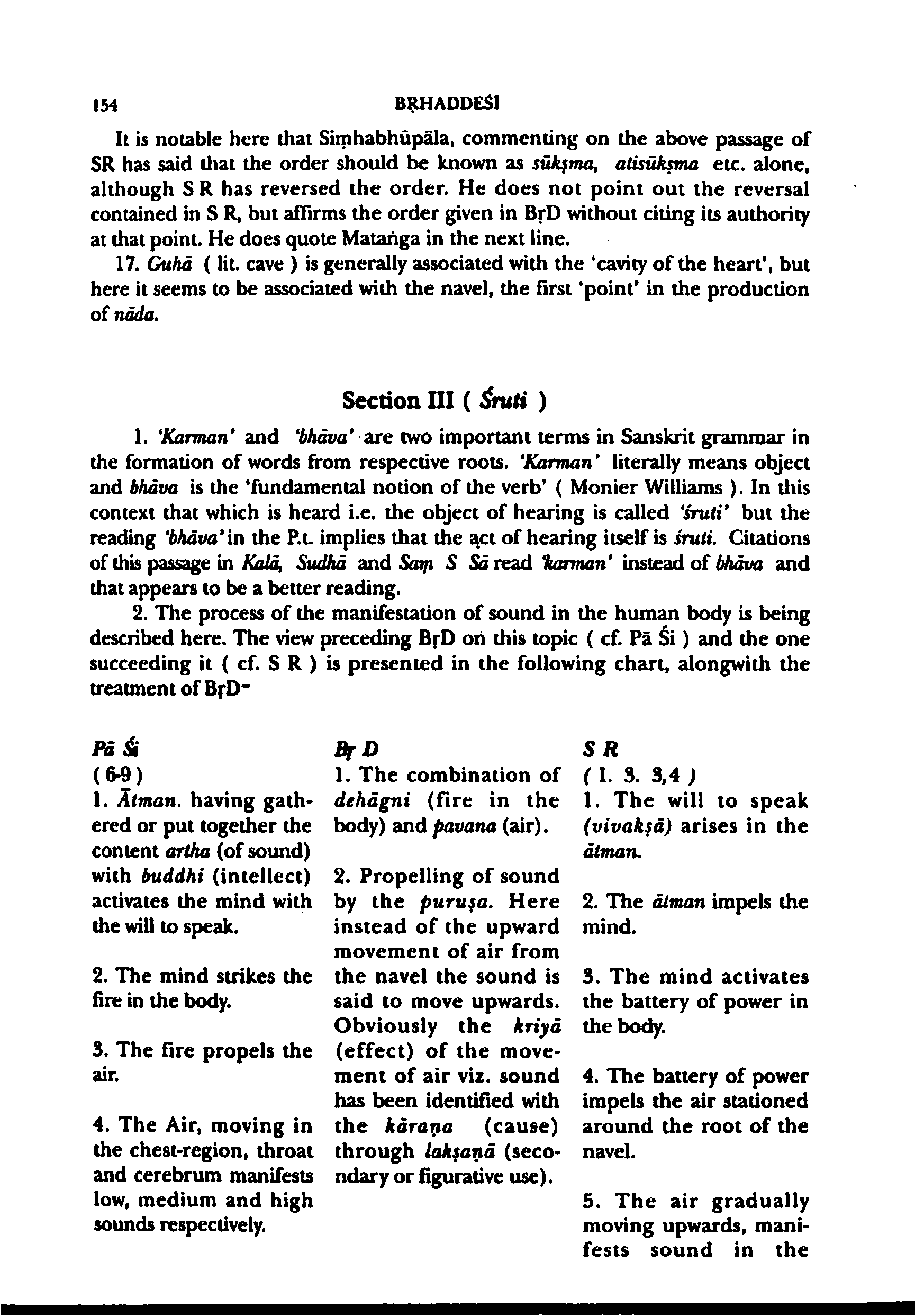
1. 'Karman' and 'bhāva' are two important terms in Sanskrit grammar in the formation of words from respective roots. 'Karman' literally means object and bhāva is the 'fundamental notion of the verb' (Monier Williams). In this context that which is heard i.e. the object of hearing is called 'sruti' but the reading 'bhāva' in the P.t. implies that the act of hearing itself is śruti. Citations of this passage in Kalā, Sudhā and Sam S Sā read karman' instead of bhāva and that appears to be a better reading. 2. The process of the manifestation of sound in the human body is being described here. The view preceding BrD on this topic (cf. Pā Ši) and the one succeeding it (cf. SR) is presented in the following chart, alongwith the treatment of BrD- Pā Ši SR B_T D (6-9) 1. The combination of (I. 3. 3,4) 1. Atman. having gath- dehāgni (fire in the 1. The will to speak ered or put together the body) and pavana (air). (vivakṣā) arises in the content artha (of sound) ālman. with buddhi (intellect) 2. Propelling of sound activates the mind with by the puruşa. Here 2. The atman impels the instead of the upward the will to speak. mind. movement of air from 2. The mind strikes the the navel the sound is 3. The mind activates fire in the body. said to move upwards. the battery of power in Obviously the kriyā the body. (effect) of the move- 3. The fire propels the air. ment of air viz. sound 4. The battery of power has been identified with impels the air stationed 4. The Air, moving in around the root of the the kāraņa (cause) the chest-region, throat through lakşanā (seco- navel. and cerebrum manifests ndary or figurative use). low, medium and high 5. The air gradually sounds respectively. moving upwards, mani- fests sound in the
translation
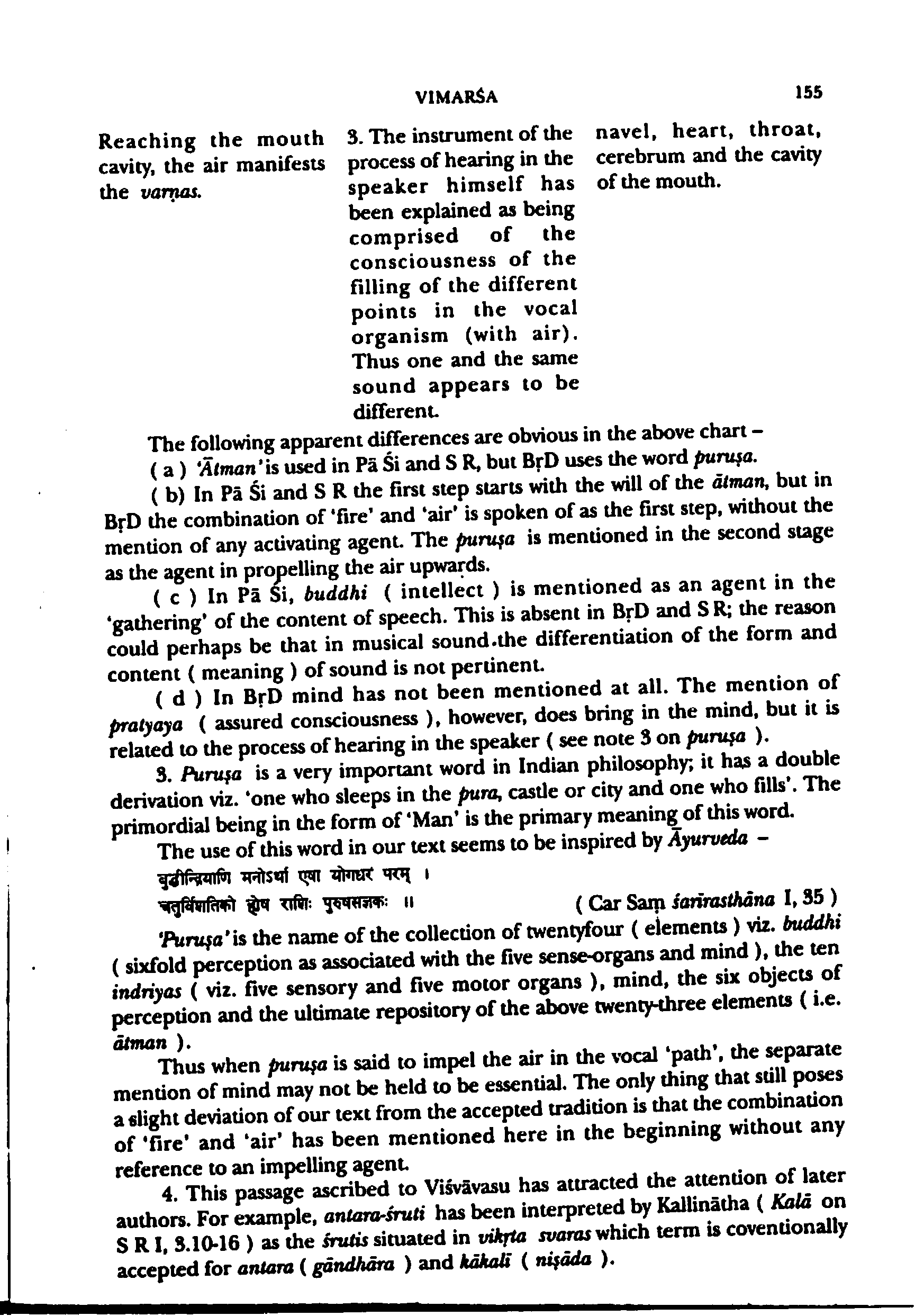
VIMARŠA 3. The instrument of the navel, heart, throat, Reaching the mouth cerebrum and the cavity process of hearing in the cavity, the air manifests speaker himself has of the mouth. the varnas. been explained as being comprised of the consciousness of the filling of the different points in the vocal organism (with air). Thus one and the same sound appears to be different. The following apparent differences are obvious in the above chart - (a) 'Atman' is used in Pā Ši and SR, but BrD uses the word puruşa. (b) In Pā Śi and SR the first step starts with the will of the ātman, but in BrD the combination of 'fire' and 'air' is spoken of as the first step, without the mention of any activating agent. The purusa is mentioned in the second stage as the agent in propelling the air upwards. (c) In Pā Ši, buddhi (intellect) is mentioned as an agent in the 'gathering' of the content of speech. This is absent in BrD and SR; the reason could perhaps be that in musical sound the differentiation of the form and content ( meaning ) of sound is not pertinent. (d) In BrD mind has not been mentioned at all. The mention of pratyaya (assured consciousness), however, does bring in the mind, but it is related to the process of hearing in the speaker5 ( see note 3 on puruşa ). 3. Puruşa is a very important word in Indian philosophy; it has a double derivation viz. 'one who sleeps in the pura, castle or city and one who fills'. The primordial being in the form of 'Man' is the primary meaning of this word. The use of this word in our text seems to be inspired by Ayurveda -
बुद्धीन्द्रियाणि मनोऽर्धा एवा योगधर परम् ।
(Car Sam śanrasthana I, 35)
चतुर्विंगतिको होष राशि पुरुषसज्ञकः ॥
'Puruşa' is the name of the collection of twentyfour ( elements ) viz. buddhi ( sixfold perception as associated with the five sense-organs and mind ), the ten indriyas (viz. five sensory and five motor organs), mind, the six objects of perception and the ultimate repository of the above twenty-three elements (i.e. ātman ). Thus when purusa is said to impel the air in the vocal 'path', the separate mention of mind may not be held to be essential. The only thing that still poses a slight deviation of our text from the accepted tradition is that the combination of 'fire' and 'air' has been mentioned here in the beginning without any reference to an impelling agent. 4. This passage ascribed to Viśvāvasu has attracted the attention of later authors. For example, antara-śruti has been interpreted by Kallinātha (Kalā on SRI, 3.10-16) as the śrutis situated in vikṛta svaras1 which term is coventionally accepted for antara (gāndhāra) and kākalī (niṣāda).7
1.[attribution]antara-śruti has been interpreted by Kallinātha as the śrutis situated in vikṛta svarasantara-śruti has been interpreted by Kallinātha (Kalā on SRI, 3.10-16) as the śrutis situated in vikṛta svaras
2.[attribution]Simhabhūpāla commented on SR stating that the order should be known as sūksma, atisūksma etc., while affirming BrD's orderSimhabhūpāla, commenting on the above passage of SR has said that the order should be known as sūksma, atisūksma etc. alone, although SR has reversed the order.
3.[attribution]Matanga is quoted by Simhabhūpāla as an authority regarding the order of sound manifestationHe does quote Matanga in the next line.
4.[definition]Guhā is generally associated with the cavity of the heart, but in this context seems to be associated with the navel as the first point in nāda productionGuhā (lit. cave) is generally associated with the 'cavity of the heart', but here it seems to be associated with the navel, the first 'point' in the production of nāda.
5.[relation]pratyaya (assured consciousness) relates to the process of hearing in the speaker in BrD's accountThe mention of pratyaya (assured consciousness), however, does bring in the mind, but it is related to the process of hearing in the speaker
6.[relation]gāndhāra is identified as antara (a vikṛta svara) according to Kallinātha's interpretationantara-śruti has been interpreted by Kallinātha (Kalā on SRI, 3.10-16) as the śrutis situated in vikṛta svaras which term is coventionally accepted for antara (gāndhāra) and kākalī (niṣāda).
7.[relation]kākalī (niṣāda) is identified as a vikṛta svara where antara-śrutis are situatedwhich term is coventionally accepted for antara (gāndhāra) and kākalī (niṣāda).
8.[relation]puruşa in BrD is used as the agent that impels the mind or activates the vocal process, distinct from ātman2. The puruşa impels the mind.
9.[relation]dehāgni (fire in the body) combines with pavana (air) as the first step in sound manifestation according to Pā Ši1. The combination of dehāgni (fire in the body) and pavana (air).
10.[relation]kriyā (effect) of upward air movement in Pā Ši is identified with sound through lakşanā (figurative use)Obviously the kriyā (effect) of the move- ment of air viz. sound has been identified with
11.[structural]vivakṣā (the will to speak) arises in the ātman as the first step in sound manifestation according to BrD1. The will to speak (vivakṣā) arises in the ālman.
12.[structural]varnas are manifested by air moving through the navel, heart, throat, and cerebrum reaching the mouth cavity4. The Air, moving in the kāraņa (cause) through lakşanā (seco- ndary or figurative use). navel. 4. The Battery of power impels the air stationed around the root of the chest-region, throat and cerebrum manifests low, medium and high sounds respectively.
13.[structural]lakşanā (secondary or figurative use) is employed in explaining how air manifests sound in vocal resonance pointsthrough lakşanā (seco- ndary or figurative use).