Balavan (strong svara) is contrasted with weak sparse svaras in describing sparseness and abundance
"The weakness (abala) of a sparse svara and the abundance of the balavan(strong) svara"
VIMARŚA
<sup>299</sup>
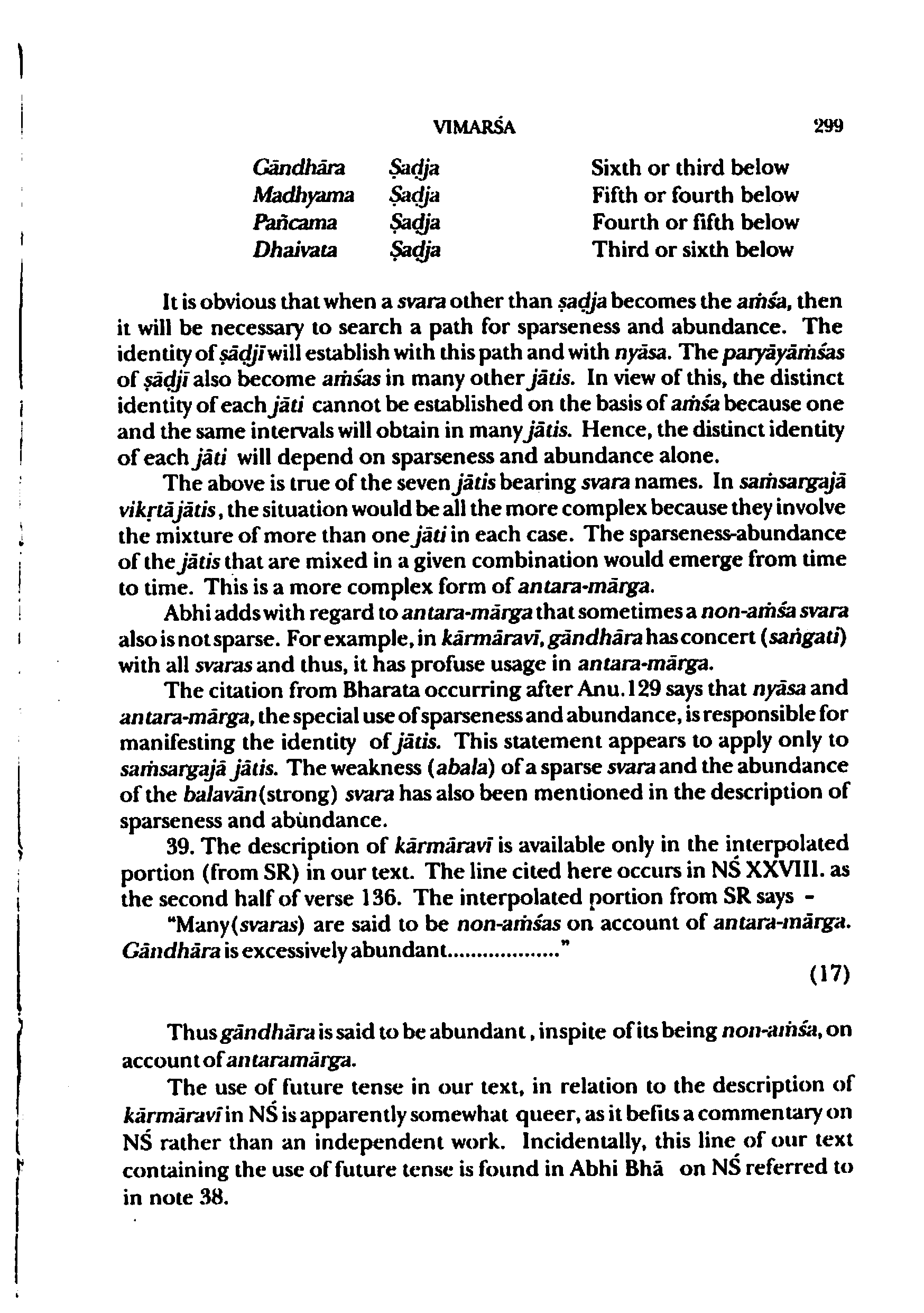
Sixth or third below
Gändhāra
Şadja
Madhyama
Fifth or fourth below
Şadja
Fourth or fifth below
Pañcama
Şadja
Dhaivata
Third or sixth below
Şadja
It is obvious that when a svara other than sadja becomes the amsa, then
it will be necessary to search a path for sparseness and abundance. The
identity of sadjī will establish with this path and with nyasa. The paryayamsas
of ṣāḍjī also become amsás in many other jātis. In view of this, the distinct
identity of each jāti cannot be established on the basis of aṁśa because one
and the same intervals will obtain in many jātis. Hence, the distinct identity
of each jāti will depend on sparseness and abundance alone.
The above is true of the seven jātis bearing svara names. In samsargajā
vikṛtā jātis, the situation would be all the more complex because they involve
the mixture of more than one jāti in each case. The sparseness-abundance
of the jātis that are mixed in a given combination would emerge from time
to time. This is a more complex form of antara-mārga.
Abhi adds with regard to antara-mārga that sometimes a non-aṁśa svara
also is not sparse. For example, in kārmāravī, gāndhāra has concert (sangati)
with all svaras and thus, it has profuse usage in antara-mārga.
The citation from Bharata occurring after Anu. 129 says that nyāsa and
antara-mārga, the special use of sparseness and abundance, is responsible for
manifesting the identity of jātis. This statement appears to apply only to
samsargajā jātis. The weakness (abala) of a sparse svara and the abundance
of the balavan(strong) svara has also been mentioned in the description of
sparseness and abundance.
39. The description of kārmāravī is available only in the interpolated
portion (from SR) in our text. The line cited here occurs in NS XXVIII. as
the second half of verse 136. The interpolated portion from SR says -
"Many(svaras) are said to be non-amsas on account of antara-marga.
Gāndhāra is excessively abundant......
(17)
Thus gāndhāra is said to be abundant, inspite of its being non-aṁśa, on
account of antaramārga.
The use of future tense in our text, in relation to the description of
kārmāravī in NS is apparently somewhat queer, as it befits a commentary on
NS rather than an independent work. Incidentally, this line of our text
containing the use of future tense is found in Abhi Bhā on NŚ referred to
in note <sup>38</sup>.