Sometimes the state of audūvita comes into being with the omission of two anuvādin svaras
"Sometimes the state of auduvita comes into being with (the omission of) two55 anuvādin svaras"
<sup>61</sup>
TRANSLATION
Audūvita is with five svaras; its lakṣaṇa (description) is fivefold, it is
(101)
numbered thirty-five,<sup>33</sup> as explained by the ācāryas (teachers).
(Anu. <sup>42</sup>)
With (the omission of) șadja, rșabha, pañcama and nișāda the șādava
(mūrchanās) of ṣaḍja-grāma (come into being). Those devoid of ṣaḍja, ṛṣabha and
gandhara are şadavas in madhyama-grama.
(Anu. <sup>43</sup>)
The state of auduvita (comes into being) on account of the omission of
(two) samvadins,34 because of this statement the general rule is that the state of
auduvita is attained through two samvadin svaras. Sometimes the state of
auduvita comes into being with (the omission of) two55 anuvādin svaras, this is
also a general rule. Sometimes the state of anuvadin does come into existence
with (the omission) of pañcama-ṛṣabha in ṣaḍja-grāma (and) that of dhaivata-
rşabha in madhyama-grāma.
The auduvitas in şadja-grāma are devoid of pañcama-şadja, two (svaras) that
are comprised of two śrutis (each) (viz. gandhāra and niṣāda) and pañcama-
(102)
rşabha.
The pentatonic tānas in madhyama-grāma are verily devoid of dhaivata-ṛṣabha
and two (svaras) comprised of two śrutis (each) (viz. niṣāda and gāndhāra).
(103)
(Anu. <sup>44</sup>)
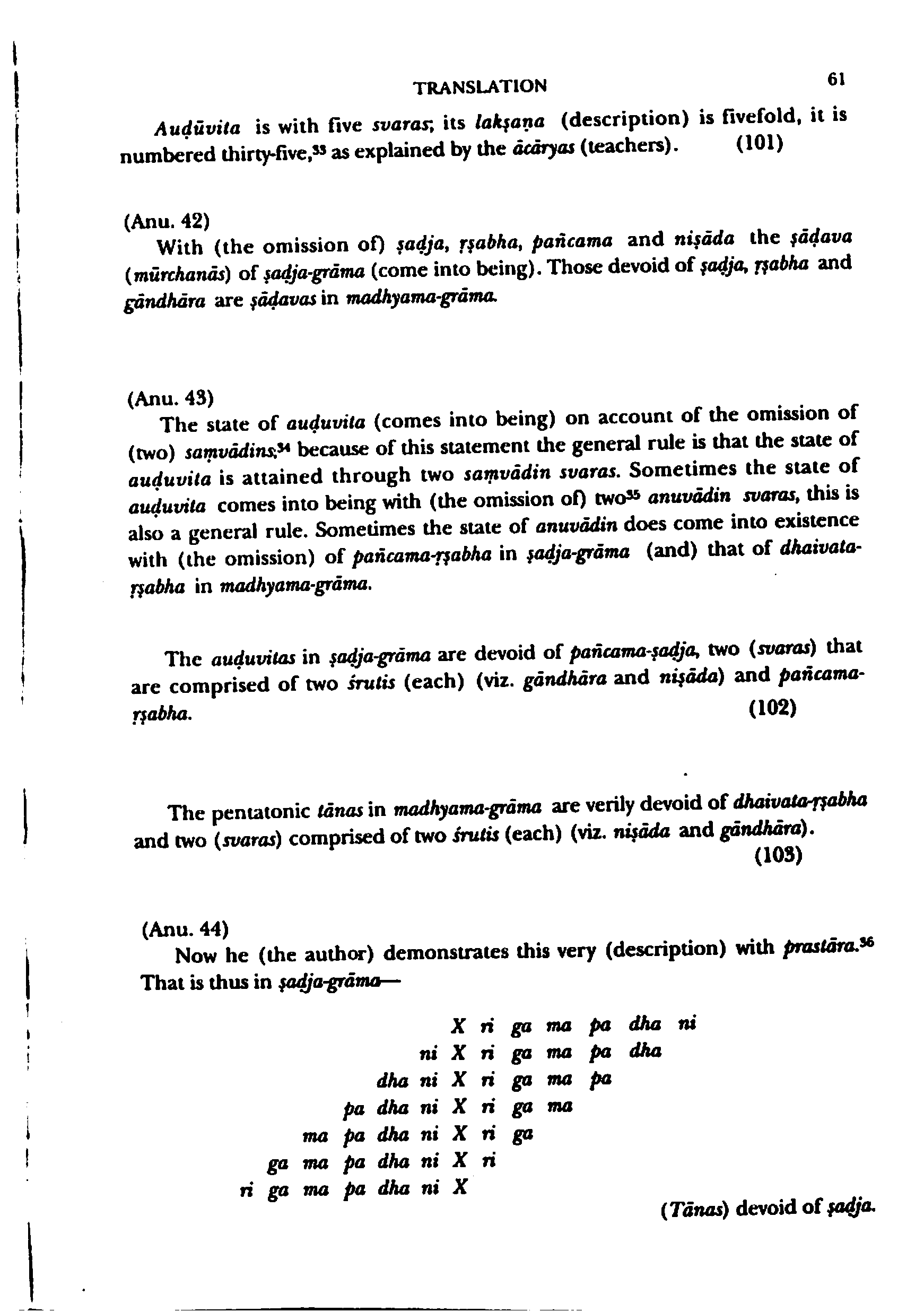
Now he (the author) demonstrates this very (description) with prastara.36
That is thus in sadja-grāma—
X ri ga ma pa dha ni
ni X ri ga ma pa dha
dha ni X ri ga ma pa
pa dha ni X ri ga ma
ma pa dha ni X ri ga
ga ma pa dha ni X ri
ri ga ma pa dha ni X
(Tānas) devoid of şadja.