1: <b>VIMARŚA</b>
2: 307
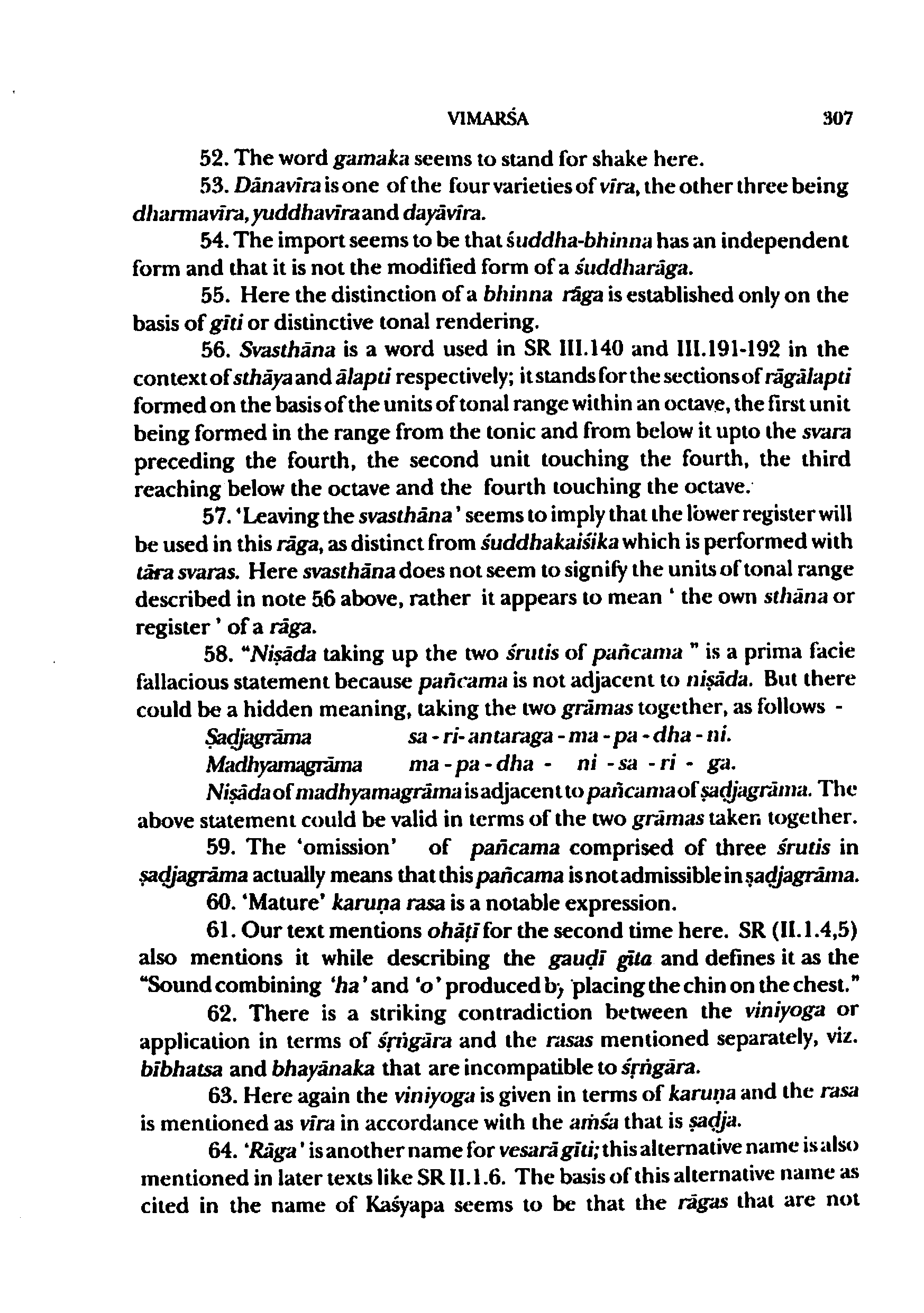
3: 52. The word gamaka seems to stand for shake here.
4: 53. Dānavīra is one of the four varieties of vīra, the other three being
5: dharmavīra, yuddhavīra and dayāvīra.
6: 54. The import seems to be that śuddha-bhinna has an independent
7: form and that it is not the modified form of a suddharaga.
8: 55. Here the distinction of a bhinna raga is established only on the
9: basis of giti or distinctive tonal rendering.
10: 56. Syasthāna is a word used in SR III.140 and III.191-192 in the
11: context of sthāya and ālapti respectively; it stands for the sections of rāgālapti
12: formed on the basis of the units of tonal range within an octave, the first unit
13: being formed in the range from the tonic and from below it upto the svara
14: preceding the fourth, the second unit touching the fourth, the third
15: reaching below the octave and the fourth touching the octave.
16: 57. 'Leaving the svasthana' seems to imply that the lower register will
17: be used in this rāga, as distinct from śuddhakaiśika which is performed with
18: tāra svaras. Here svasthāna does not seem to signify the units of tonal range
19: described in note 56 above, rather it appears to mean ' the own sthana or
20: register' of a raga.
21: 58. "Niṣāda taking up the two śrutis of pañcama" is a prima facie
22: fallacious statement because pañcama is not adjacent to niṣāda. But there
23: could be a hidden meaning, taking the two grāmas together, as follows -
24: Şadjagrāma sa - ri- antaraga - ma - pa - dha - ni.
25: Madhyamagrāma ma - pa - dha - ni - sa - ri - ga.
26: Niṣāda of madhyamagrāma is adjacent to pañcama of ṣadjagrāma. The
27: above statement could be valid in terms of the two grāmas taken together.
28: 59. The 'omission' of pancama comprised of three śrutis in
29: ṣaḍjagrāma actually means that this pañcama is not admissible in ṣaḍjagrāma.
30: 60. 'Mature' karuṇa rasa is a notable expression.
31: 61. Our text mentions ohāṭī for the second time here. SR (II.1.4,5)
32: also mentions it while describing the gaudi gita and defines it as the
33: "Sound combining 'ha' and 'o' produced b, placing the chin on the chest."
34: 62. There is a striking contradiction between the viniyoga or
35: application in terms of śringāra and the rasas mentioned separately, viz.
36: bībhatsa and bhayānaka that are incompatible to śṛṅgāra.
37: 63. Here again the viniyoga is given in terms of karuņa and the rasa
38: is mentioned as vīra in accordance with the amśa that is ṣaḍja.
39: 64. 'Rāga' is another name for vesarā gīti; this alternative name is also
40: mentioned in later texts like SR II.1.6. The basis of this alternative name as
41: cited in the name of Kasyapa seems to be that the ragas that are not
Crop image (token + contexte)
Pas de crop disponible (Layer B n'a pas tourne sur ce token).
Page complete
Cote token (RIGHT) — line ?, token surligne en jaune
Contexte semantique (LEFT)
<b>BRHADDESI</b>
306
if it is composed of three śrutis then relationship with madhyamagrāma is
established.
41. Nirvahana is the fifth among the five sandhis of drama (See note
39). This juncture embodies the achievement of the fruit.
42. Citra (lit. variegated) is a variety of pūrvaranga which has dance
also as one of its components; the one devoid of dance being called śuddha
(lit. pure ) (vide NŚ IV.15,16). It could not be said definitely whether or not
citrain our text here refers to pūrvaranga, but nothing else seems to be plausible.
43. NŚ V speaks of twenty - two angas of pūrvaranga, the first eleven
to be performed behind the 'curtain' and the next eleven to be performed
after the opening of the 'curtain'.
44. This sentence does not occur in the available text of NS. It does,
however, embody a valuable comment on the concept of jāti embodying
melodic abstraction which is so comprehensive as to cover all melodic
phenomena.
45. Bhinna would normally mean split, but here it has been taken to
mean 'different', explained by us as 'modified'.
46. Vādin is the point of reference for establishing samvāda, vivāda
and anuvāda relationships.
47. The relationship of bhinna-şadja with śuddha ṣāḍava by way of the
former being a variety of the latter is notable, because usually each
grāmarāga is said to be born of one or more jātis. Here also şadjodīcyavatī
is said to be the progenitor and the relationship with śuddha ṣāḍava is over
and above the relationship with jāti. It is to be remembered that śuddha
ṣāḍava is said to be born of the modified state of madhyamā jāti.
48. This is another instance of the mention of a bhinna rāga's
relationship with a śuddha rāga. See note 47.
49. Does this mention of niṣāda imply that both kākalī and niṣāda
have to be used? Perhaps so. Bharata's prescription of the use of antara-
kākalī being permissible only in ascent (NS XXVIII. 35) and not in
descent, implies that gandhara and niṣada could be used in descent when
antara and kākalī are used in ascent. Really speaking, antara and
gāndhāra as well as niṣāda and kākalī are not independent svaras, but are
two states each of gandhara and niṣāda and hence their use in one and
the same tonal structure should not amount to the use of nine svaras (cf.S
Rāj. II.1.1.365).
50. There is no noun in this verse that is qualified by the adjectives
sūkṣma, atisūkṣma and vakra; hence we have added 'phrases' within brackets.
51. The modification inherent in bhinnakaisikamadhyama as distinct
from śuddhakaiśikamadhyama is that whereas the latter is born of two jātis, the
former is born of only one of them.
306
if it is composed of three śrutis then relationship with madhyamagrāma is
established.
41. Nirvahana is the fifth among the five sandhis of drama (See note
39). This juncture embodies the achievement of the fruit.
42. Citra (lit. variegated) is a variety of pūrvaranga which has dance
also as one of its components; the one devoid of dance being called śuddha
(lit. pure ) (vide NŚ IV.15,16). It could not be said definitely whether or not
citrain our text here refers to pūrvaranga, but nothing else seems to be plausible.
43. NŚ V speaks of twenty - two angas of pūrvaranga, the first eleven
to be performed behind the 'curtain' and the next eleven to be performed
after the opening of the 'curtain'.
44. This sentence does not occur in the available text of NS. It does,
however, embody a valuable comment on the concept of jāti embodying
melodic abstraction which is so comprehensive as to cover all melodic
phenomena.
45. Bhinna would normally mean split, but here it has been taken to
mean 'different', explained by us as 'modified'.
46. Vādin is the point of reference for establishing samvāda, vivāda
and anuvāda relationships.
47. The relationship of bhinna-şadja with śuddha ṣāḍava by way of the
former being a variety of the latter is notable, because usually each
grāmarāga is said to be born of one or more jātis. Here also şadjodīcyavatī
is said to be the progenitor and the relationship with śuddha ṣāḍava is over
and above the relationship with jāti. It is to be remembered that śuddha
ṣāḍava is said to be born of the modified state of madhyamā jāti.
48. This is another instance of the mention of a bhinna rāga's
relationship with a śuddha rāga. See note 47.
49. Does this mention of niṣāda imply that both kākalī and niṣāda
have to be used? Perhaps so. Bharata's prescription of the use of antara-
kākalī being permissible only in ascent (NS XXVIII. 35) and not in
descent, implies that gandhara and niṣada could be used in descent when
antara and kākalī are used in ascent. Really speaking, antara and
gāndhāra as well as niṣāda and kākalī are not independent svaras, but are
two states each of gandhara and niṣāda and hence their use in one and
the same tonal structure should not amount to the use of nine svaras (cf.S
Rāj. II.1.1.365).
50. There is no noun in this verse that is qualified by the adjectives
sūkṣma, atisūkṣma and vakra; hence we have added 'phrases' within brackets.
51. The modification inherent in bhinnakaisikamadhyama as distinct
from śuddhakaiśikamadhyama is that whereas the latter is born of two jātis, the
former is born of only one of them.
Voir figures de la page (diagrammes / tables)
Pas de figure detectee sur cette page (Surya layout n'a rien identifie).
Pourquoi flagué
- Tres proche d'un mot connu du dico Sanskrit (1 lettre de difference)
Vu par
OCR Surya Translitterateur Dico Sanskrit IA visuelle
Raisonnement IA visuelle
(aucun reasoning Layer B disponible)