1: VIMARŚA
2: 297
3: 35. Lack of regulation i.e. scope for free will in rendering is a
4: characteristic of desi, but the import of 'sruti' is not clear. It could, perhaps,
5: stand for 'aural appearance'.
6: 36. See citation in the name of Nărada under Anu. 28 in chapter one
7: of our text Vol. I. 'Svarāntara' literally means a different svara; its relation
8: with the number four of svaras could thus be explained. The first three svaras
9: are repeated as the last three of a heptad. The fourth known as madhyama
10: comes in-between these two triads. Hence the fourth adds a 'different or
11: new svara'. This could be the reason for giving the name svarantara to a
12: group of four svaras. This name is relevant only for the first triad + the
13: fourth, but its secondary application could be related to any group of four
14: svaras.
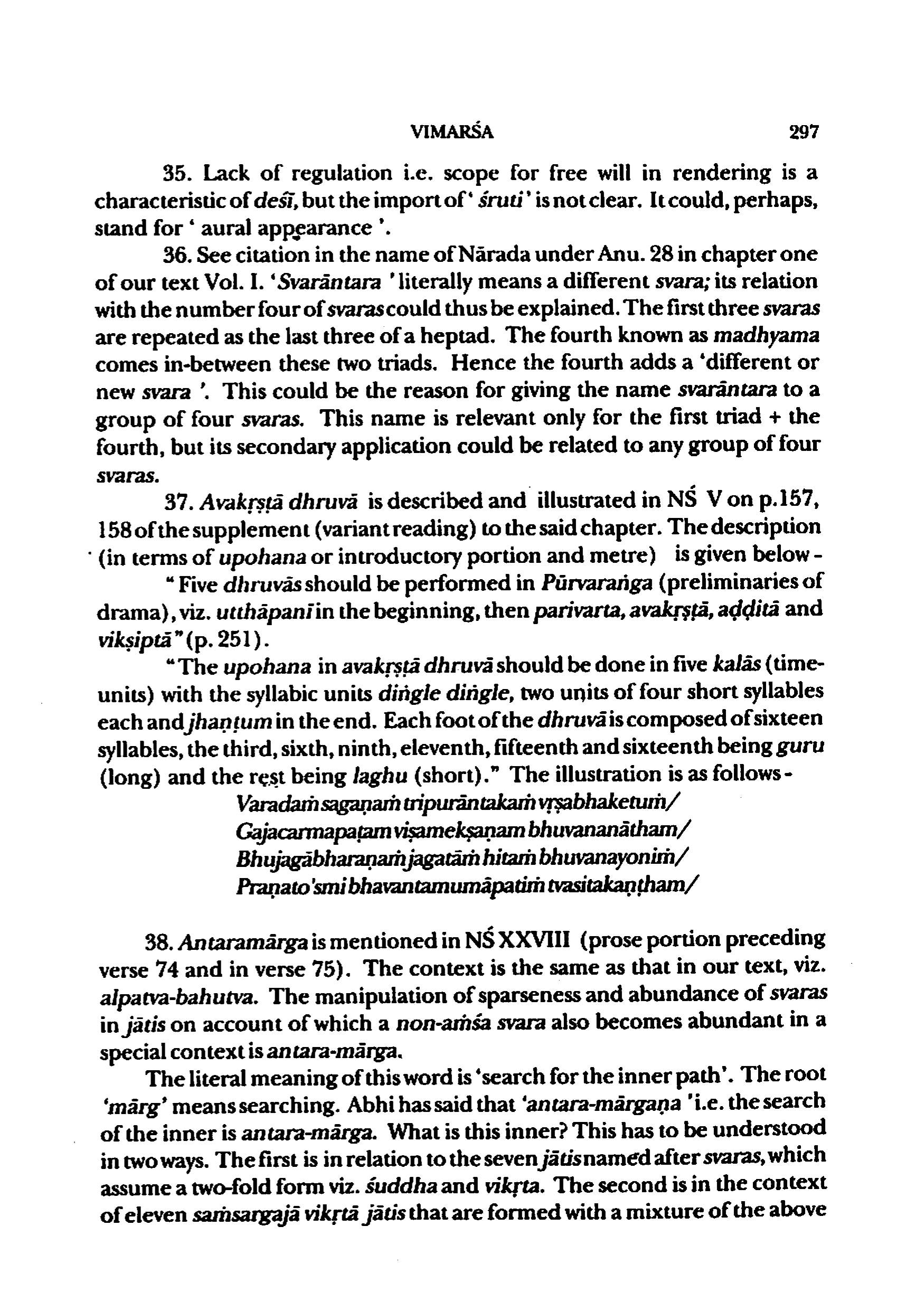
15: 37. Avakṛṣṭā dhruvā is described and illustrated in NS V on p.157,
16: 158 of the supplement (variant reading) to the said chapter. The description
17: ' (in terms of upohana or introductory portion and metre) is given below -
18: "Five dhruvās should be performed in Pūrvaranga (preliminaries of
19: drama), viz. utthāpanī in the beginning, then parivarta, avakṛṣṭā, aḍḍitā and
20: <i>vikşiptă”</i> (p. 251).
21: "The upohana in avakṛṣṭā dhruvā should be done in five kalās (time-
22: units) with the syllabic units dingle dingle, two units of four short syllables
23: each and jhantum in the end. Each foot of the dhruva is composed of sixteen
24: syllables, the third, sixth, ninth, eleventh, fifteenth and sixteenth being guru
25: (long) and the rest being laghu (short)." The illustration is as follows-
26: Varadam saganam tripurāntakam vṛṣabhaketum/
27: Gajacarmapaṭamviṣamekṣaṇambhuvananātham/
28: Bhujagābharaṇaṁjagatāṁhitaṁbhuvanayoniṁ/
29: Praṇato'smi bhavantamumāpatim tvasitakantham/
30: 38. Antaramārga is mentioned in NŚ XXVIII (prose portion preceding
31: verse 74 and in verse 75). The context is the same as that in our text, viz.
32: alpatva-bahutva. The manipulation of sparseness and abundance of svaras
33: in jātis on account of which a non-amsa svara also becomes abundant in a
34: special context is antara-mārga.
35: The literal meaning of this word is 'search for the inner path'. The root
36: 'mārg' means searching. Abhi has said that 'antara-mārgaņa 'i.e. the search
37: of the inner is antara-marga. What is this inner? This has to be understood
38: in two ways. The first is in relation to the seven jātis named after svaras, which
39: assume a two-fold form viz. śuddha and vikṛta. The second is in the context
40: of eleven samsargajā vikṛtā jātis that are formed with a mixture of the above
Crop image (token + contexte)
Pas de crop disponible (Layer B n'a pas tourne sur ce token).
Page complete
Cote token (RIGHT) — line ?, token surligne en jaune
Contexte semantique (LEFT)
296
BRHADDEŚĪ
24. The eighth vidārī of gāndhārī reads in SR — nidha pani mā mapari
gā gā gā gā. 'Ni' is the fifth of 'ga' and perhaps the same is being referred
to. As regards nidha nisa, this phrase occurs five times in the prastara given
in SR and the 'sa' in each case bears a vertical stroke on top, indicating its
tāra position. Really speaking, the tāra should begin from the octave of 'ga'.
25. Gati literally means gait, here it means the extent i.e. the point
beyond which movement is not permissible or is not considered proper.
26. Mṛdu (soft, gentle) as a synonym of mandra (low) is very
significant, since it implies that the low svaras have a typical softness or
gentleness about them.
27. Bahuvrihi (lit. possessing much rice) is "a relative or adjective
compound in which, as in the word bahuvrihi itself (cf. tatpurușa), the last
member loses its character of a substantive and together with the first
member serves to qualify a noun " (Monier Williams ). The compound
tatpurușa is a "class of compounds (formed like the word tat-purușa 'his
servant') in which the last member is qualified by the first without losing
(as the last member of bahuvrihi compounds) its grammatical independence
(whether as noun or adjective or participle)." (ibid). The classic example
for these two compounds is 'indrasatru' which could be split and interpreted
in two ways - viz. 'indrasya śatru' = 'the enemy of Indra' and 'indrah śatruh
yasya sah' = 'he whose enemy is Indra'. Here 'mandragati' has three
adjectives; viz. amśaparā, nyāsaparā and apanyāsaparā interpreted as bahuvrīhi
compounds, meaning that which is followed by amsa or nyāsa or apanyāsa.
It is notable that mandra begins with the svara immediately below the amsa.
Hence the above statement would mean that the lowest limit of mandra
could extend upto the lower octave of amsa or nyasa or apanyasa.
t
28,29. The notation given here forms the first vidārī of the prastāra
of dhaivatī as given in SR; here 'ma' is the apanyasa and it forms the mandra
as it comes below dhaivata which is the amsa.
30. The operation of nyāsa in the mandra range could be seen in the
sixth vidārī of dhaivatī, which ends with the lower 'dha'.
31. The hexatonic jātis are fourteen in number and their amsas are
forty-seven.
32. The pentatonic jātis are ten in number and their amsas are thirty.
(Also see note no. I above ).
33,34. Deśī is basically regional; here it is also said to be related to
ethnic groups which are illustrated with eight names. This is the first
reference to ethnic groups in Sangītaśāstra in extant texts.
1
BRHADDEŚĪ
24. The eighth vidārī of gāndhārī reads in SR — nidha pani mā mapari
gā gā gā gā. 'Ni' is the fifth of 'ga' and perhaps the same is being referred
to. As regards nidha nisa, this phrase occurs five times in the prastara given
in SR and the 'sa' in each case bears a vertical stroke on top, indicating its
tāra position. Really speaking, the tāra should begin from the octave of 'ga'.
25. Gati literally means gait, here it means the extent i.e. the point
beyond which movement is not permissible or is not considered proper.
26. Mṛdu (soft, gentle) as a synonym of mandra (low) is very
significant, since it implies that the low svaras have a typical softness or
gentleness about them.
27. Bahuvrihi (lit. possessing much rice) is "a relative or adjective
compound in which, as in the word bahuvrihi itself (cf. tatpurușa), the last
member loses its character of a substantive and together with the first
member serves to qualify a noun " (Monier Williams ). The compound
tatpurușa is a "class of compounds (formed like the word tat-purușa 'his
servant') in which the last member is qualified by the first without losing
(as the last member of bahuvrihi compounds) its grammatical independence
(whether as noun or adjective or participle)." (ibid). The classic example
for these two compounds is 'indrasatru' which could be split and interpreted
in two ways - viz. 'indrasya śatru' = 'the enemy of Indra' and 'indrah śatruh
yasya sah' = 'he whose enemy is Indra'. Here 'mandragati' has three
adjectives; viz. amśaparā, nyāsaparā and apanyāsaparā interpreted as bahuvrīhi
compounds, meaning that which is followed by amsa or nyāsa or apanyāsa.
It is notable that mandra begins with the svara immediately below the amsa.
Hence the above statement would mean that the lowest limit of mandra
could extend upto the lower octave of amsa or nyasa or apanyasa.
t
28,29. The notation given here forms the first vidārī of the prastāra
of dhaivatī as given in SR; here 'ma' is the apanyasa and it forms the mandra
as it comes below dhaivata which is the amsa.
30. The operation of nyāsa in the mandra range could be seen in the
sixth vidārī of dhaivatī, which ends with the lower 'dha'.
31. The hexatonic jātis are fourteen in number and their amsas are
forty-seven.
32. The pentatonic jātis are ten in number and their amsas are thirty.
(Also see note no. I above ).
33,34. Deśī is basically regional; here it is also said to be related to
ethnic groups which are illustrated with eight names. This is the first
reference to ethnic groups in Sangītaśāstra in extant texts.
1
Voir figures de la page (diagrammes / tables)
Pas de figure detectee sur cette page (Surya layout n'a rien identifie).
Pourquoi flagué
- Tres proche d'un mot connu du dico Sanskrit (1 lettre de difference)
Vu par
OCR Surya Translitterateur Dico Sanskrit IA visuelle
Raisonnement IA visuelle
(aucun reasoning Layer B disponible)