Source scans · vol_I_p013
recto · open full
scan recto
verso · open full
scan verso
Bṛhaddeśī · Volume I
pp. 8–9folio 013
Devanāgarī (Bṛhaddeśī)
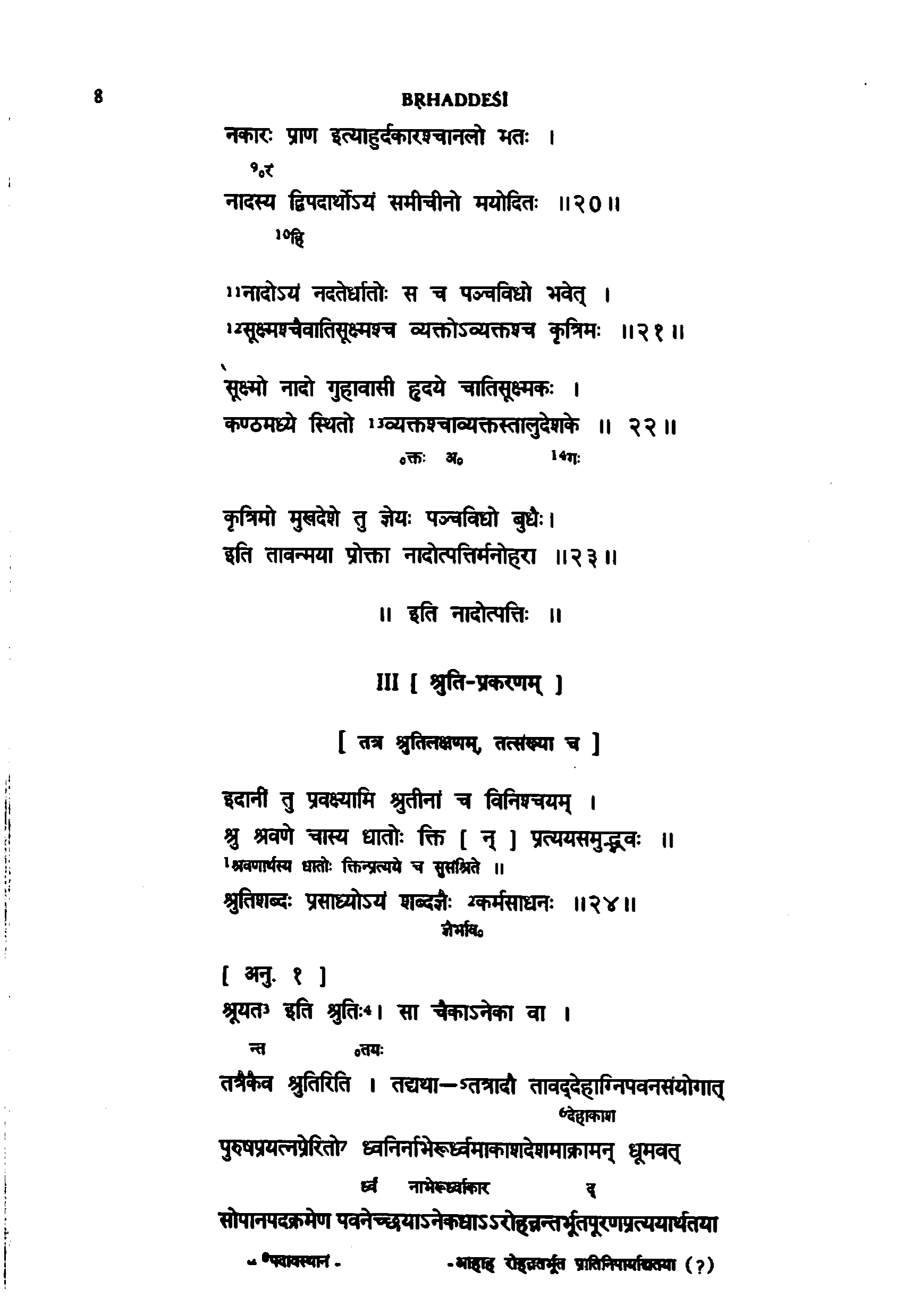
नकारः%र प्राण इत्याहुर्दकारश्चानलो भतः ।
नादस्य द्विपदार्थोऽयं10हि समीचीनो मयोदितः ॥२०॥
ग्गनादोऽयं नदतेर्धातोः स च पञ्चविधो भवेत् ।
12सूक्ष्मश्चैवातिसूक्ष्मश्च व्यक्तोऽव्यक्तश्च कृत्रिमः ॥२१॥ सूक्ष्मो नादो गुहावासी9 हृदये चातिसूक्ष्मकः
कण्ठमध्ये स्थितो8॰क्तः अ॰ । ३२॥
1471:
कृत्रिमो मुखदेशे तु ज्ञेयः पञ्चविद्यो बुधैः।
इति तावन्मया प्रोक्ता नादोत्पत्तिर्मनोहरा।। इति नादोत्पत्तिः ॥२३॥ П III [ श्रुति-प्रकरणम् ]
[तत्र श्रुतिलक्षणम्, तत्संख्या च]
---------------------------------------
इदानी तु प्रवक्ष्यामि श्रुतीनां च विनिश्चयम् ।
श्रु श्रवणे चास्य धातोः क्ति [ न् ] प्रत्ययसमुद्भवः ॥
1 अवणार्पस्य धातोः क्तिन्प्रत्यये च सुसक्रिते ॥
श्रुतिशब्दः प्रसाध्योऽयं शब्दज्ञैःनेर्मावः य्कर्मसाधनः ॥२४॥
[अनु. १]
श्र्यतःन्त इति श्रुति4•तयः । सा चैकाऽनेका वा ।
तत्रैकैव श्रुतिरिति । तद्यथा-श्तत्रादौ तावद्देहाग्निपवनसंयोगात्<b>‘देहाकाश</b> पुरुषप्रयत्नप्रेरितोर्घ"पदावस्थान - ध्वनिर्नाभेरूध्वमाकाशदेशमाक्रामन् धूमवत् नामेरूध्वकार ₹ सोपानपदक्रमेण पवनेच्छयाऽनेकधाऽऽरोह्नन्नर्न्यूतपूरणप्रत्ययार्थतया - भाइह् रोइद्स्तर्भृत प्रातिनिपार्याखतया (?)
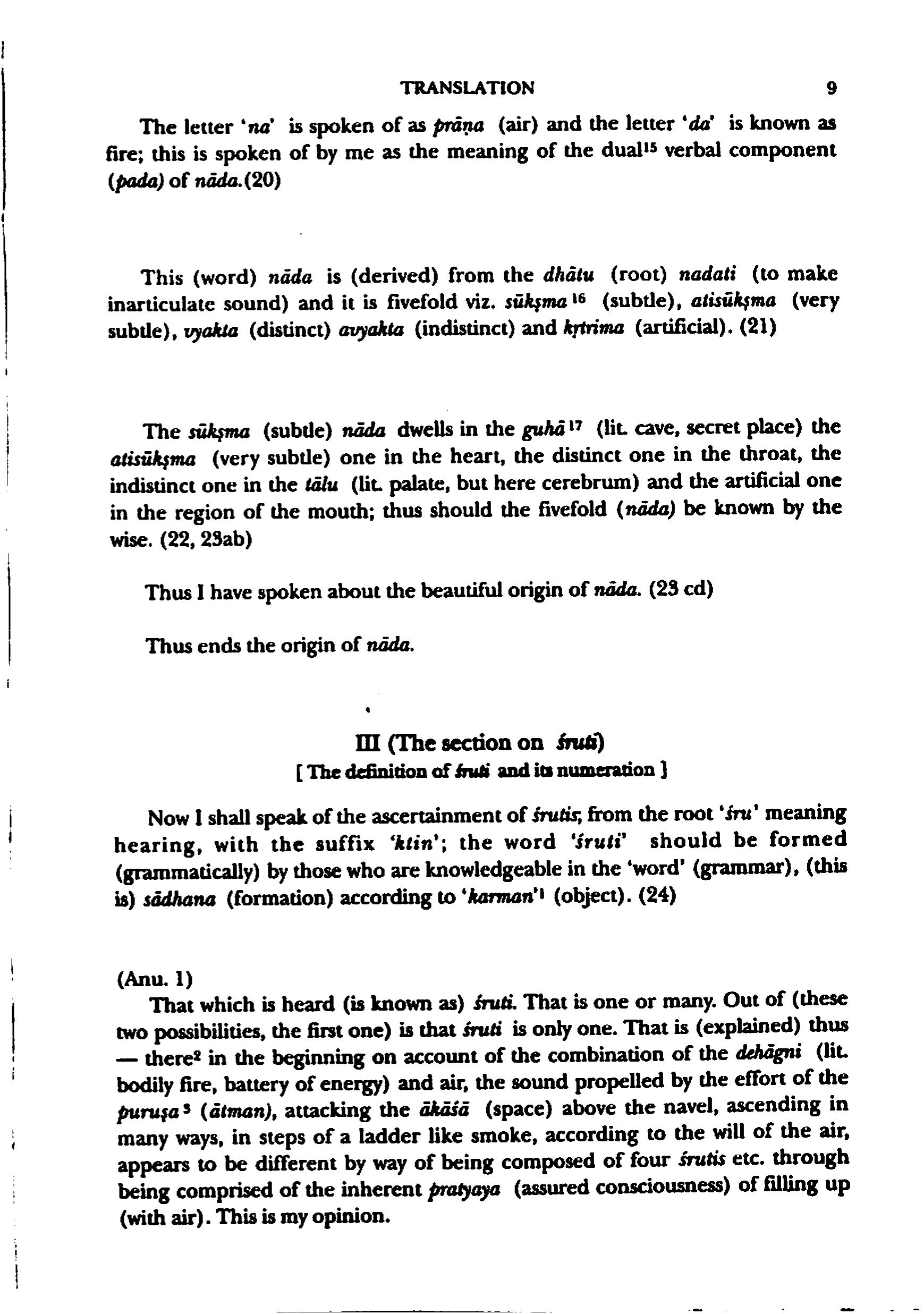
English — Sharma (translation)
The letter 'na' is spoken of as prana (air) and the letter 'da' is known as fire; this is spoken of by me as the meaning of the dual15 verbal component (pada) of nāda.(20) This (word) nāda is (derived) from the dhātu (root) nadati (to make inarticulate sound)5 and it is fivefold viz. sūksma 16 (subtle), atisūksma (very subtle), vyakta (distinct) avyakta (indistinct) and kṛtrima (artificial). (21) The sūksma (subtle) nāda dwells in the guhā 17 (lit. cave, secret place) the atisūksma (very subtle) one in the heart, the distinct one in the throat, the indistinct one in the tālu (lit. palate, but here cerebrum) and the artificial one in the region of the mouth8; thus should the fivefold (nāda) be known by the wise. (22, 23ab) Thus I have spoken about the beautiful origin of nāda. (23 cd) Thus ends the origin of nada.1 III (The section on sruti)13 [The definition of fruti and its numeration]2 Now I shall speak of the ascertainment of śrutis; from the root 'śru' meaning hearing, with the suffix 'ktin'3; the word 'sruti' should be formed (grammatically) by those who are knowledgeable in the 'word' (grammar), (this is) sādhana (formation) according to 'karman'ı (object). (24) (Anu. 1) That which is heard (is known as) śruti.4 That is one or many. Out of (these two possibilities, the first one) is that śruti is only one. That is (explained) thus — there? in the beginning on account of the combination of the dehāgni (lit. bodily fire, battery of energy) and air, the sound propelled by the effort of the puruşa s (ātman)11, attacking the ākāśā (space) above the navel, ascending in many ways, in steps of a ladder like smoke, according to the will of the air, appears to be different by way of being composed of four śrutis etc. through being comprised of the inherent pratyaya (assured consciousness) of filling up (with air)12. This is my opinion.
1.[definition]Nādottpatti is the origin or generation of nādaइति तावन्मया प्रोक्ता नादोत्पत्तिर्मनोहरा ॥२३॥ ।। इति नादोत्पत्ति
2.[definition]Śrutilakṣaṇam concerns the definition and characterization of śruti[ तत्र श्रुतिलक्षणम्, तत्संख्या च ]
3.[definition] Śruti is etymologically derived from the root 'śru' meaning hearing, with the suffix 'ktin'श्रु श्रवणे चास्य धातो क्ति [ न् ] प्रत्ययसमुद्भवः
4.[definition] Śruti is defined as that which is heardश्र्यतः इति श्रुति
5.[definition] Nāda is derived from the root nadati meaning 'to make inarticulate sound'ग्गनादोऽयं नदतेर्धातो स च पञ्चविधो भवेत्
8.[relation] The five varieties of nāda have distinct anatomical locations: subtle in the cave/secret place, very subtle in the heart, distinct in the throat, indistinct in the palate, artificial in the mouth regionसूक्ष्मो नादो गुहावासी हृदये चातिसूक्ष्मकः कण्ठमध्ये स्थितो
9.[relation] Guhā (cave or secret place) is the anatomical location of subtle nādaसूक्ष्मो नादो गुहावासी
13.[structural]Śruti-prakaraṇam is a section of the text dealing with śrutiIII [ श्रुति-प्रकरणम् ]
1.[definition] Nādottpatti is the origin or generation of nādaThus I have spoken about the beautiful origin of nāda. (23 cd) Thus ends the origin of nada.
2.[definition] Śrutilakṣaṇam concerns the definition and characterization of śruti[The definition of fruti and its numeration]
3.[definition]Śruti is etymologically derived from the root 'śru' meaning hearing, with the suffix 'ktin'from the root 'śru' meaning hearing, with the suffix 'ktin'
4.[definition]Śruti is defined as that which is heardThat which is heard (is known as) śruti.
5.[definition]Nāda is derived from the root nadati meaning 'to make inarticulate sound'This (word) nāda is (derived) from the dhātu (root) nadati (to make inarticulate sound)
6.[enumeration]Nāda is fivefold, consisting of subtle, very subtle, distinct, indistinct, and artificial varietiesThis (word) nāda is (derived) from the dhātu (root) nadati (to make inarticulate sound) and it is fivefold viz. sūksma 16 (subtle), atisūksma (very subtle), vyakta (distinct) avyakta (indistinct) and kṛtrima (artificial). (21)
7.[enumeration]Nāda has a dual verbal component consisting of the letter 'na' (air/prāṇa) and the letter 'da' (fire/anala)The letter 'na' is spoken of as prana (air) and the letter 'da' is known as fire; this is spoken of by me as the meaning of the dual15 verbal component (pada) of nāda.(20)
8.[relation]The five varieties of nāda have distinct anatomical locations: subtle in the cave/secret place, very subtle in the heart, distinct in the throat, indistinct in the palate, artificial in the mouth regionThe sūksma (subtle) nāda dwells in the guhā 17 (lit. cave, secret place) the atisūksma (very subtle) one in the heart, the distinct one in the throat, the indistinct one in the tālu (lit. palate, but here cerebrum) and the artificial one in the region of the mouth
9.[relation]Guhā (cave or secret place) is the anatomical location of subtle nādaThe sūksma (subtle) nāda dwells in the guhā 17 (lit. cave, secret place)
10.[relation]Tālu (palate or cerebrum) is the location where indistinct nāda is situatedthe indistinct one in the tālu (lit. palate, but here cerebrum)
11.[relation]Dehāgni (bodily fire or battery of energy) is one of the fundamental components in the origination of sound, combined with airthere? in the beginning on account of the combination of the dehāgni (lit. bodily fire, battery of energy) and air, the sound propelled by the effort of the puruşa s (ātman)
12.[relation]Pratyaya (assured consciousness) is an inherent quality that enables the differentiation of sound through being filled with airthrough being comprised of the inherent pratyaya (assured consciousness) of filling up (with air)
13.[structural] Śruti-prakaraṇam is a section of the text dealing with śrutiIII (The section on sruti)