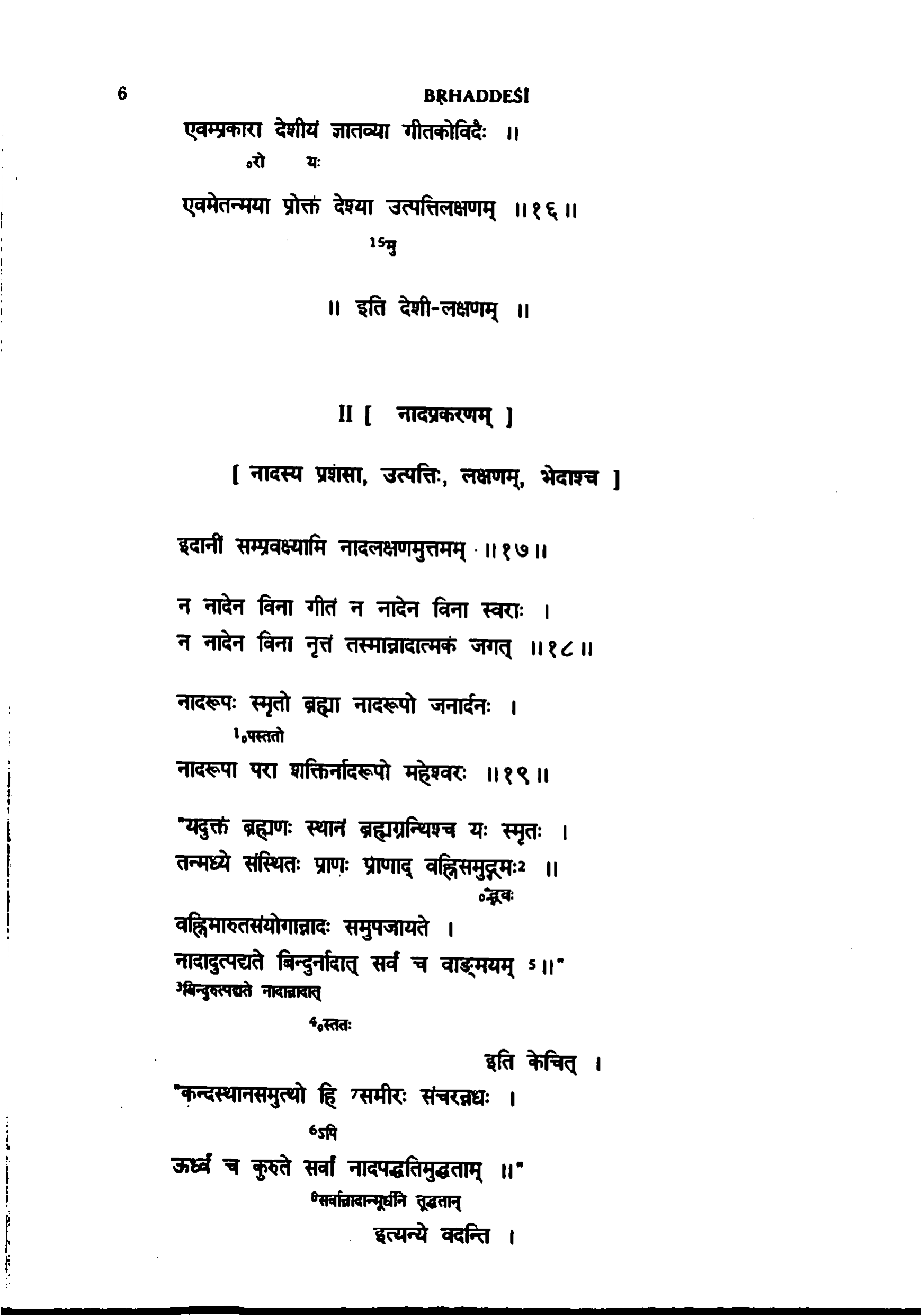
This desi should be known in this way by the experts in gita (music, lit. song).
(16cd)
Thus I have spoken about the origin and definition of desi.50 (16 ef)
Thus ends the definition of desi.
II [ Section on Nada ]13
,
[The glory, origin, definition and kinds of nāda]
Now, I speak about the principal definition of nāda.1 (17)
There is no gita? (song, music) wiithout nāda,
there are no svaras (musical
notes) without nada5, there is no nṛtta 3 (dance) without nada, hence the world4
is of the essence of nāda. (18)
Brahmā
5 is known to be of the form of nāda (
nāda-rūpa),
Janārdana6
(Viṣṇu) is of the form of nāda,
Parā Sakti? is of the form of nāda (and)
Maheśvara is of the form of nāda.8 (19)
That which is spoken of as the location (Sthāna) of Brahmā and which is
known as brahma-granthi2,9 prāṇa 10 is seated in it, vahni 11 (fire) arises from
prāņa;
nāda is born of the combination of vahni (fire) and māruta (air)8.
"
From nāda is formed bindu9 12 and from nāda all vānmaya 15 (whatever is
made of speech or language) (is born)".
This is the opinion of some (authorities).
ļ
"The air arising from the location of kanda,14 (and) moving about up and
down, produces the intense course of nada."
So say others.