Source scans · vol_I_p014
recto · open full
scan recto
verso · open full
scan verso
Bṛhaddeśī · Volume I
pp. 10–11folio 014
Devanāgarī (Bṛhaddeśī)
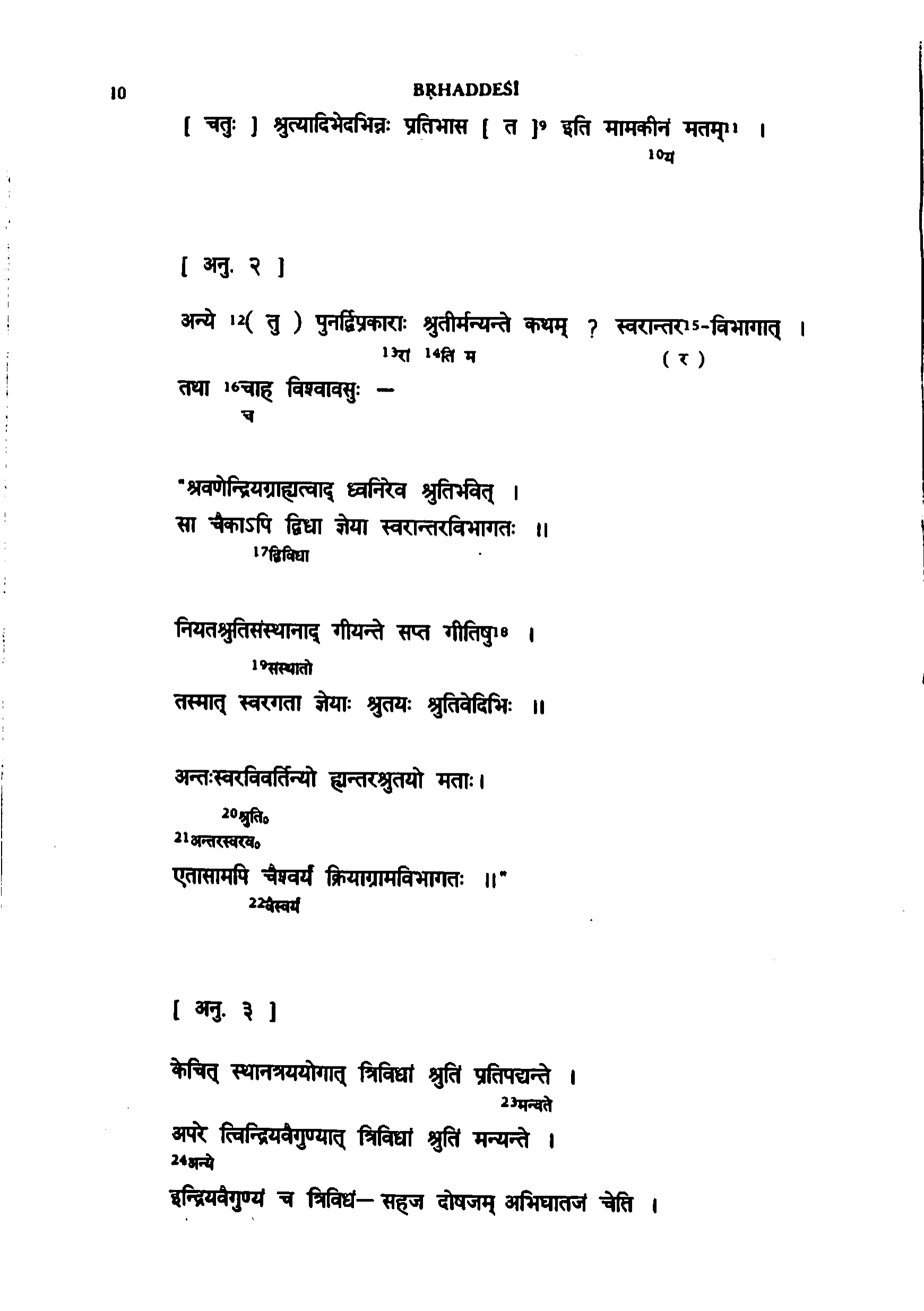
[ चतु ] श्रुत्यादिभेदभिन्नः प्रतिभास [ त ] ९ इति मामकीनं मतम् ।
10य
[अनु. २]
अन्ये 12( तु ) पुनर्द्धिप्रकारा श्रुतीर्मन्यन्ते कथम् ? स्वरान्तर15-विभागात् ।
13रा 14ति म ( T ) तथा 16चाह विश्वावसु — च "श्रवणेन्द्रियग्राह्यत्वाद् ध्वनिरेव श्रुतिभवित् ।4 सा चैकाऽपि द्विधा ज?ेया स्वरान्तरविभागतः ॥7 17द्विविधा नियतश्रुतिसंस्थानाद् गीयन्ते सप्त गीतिषु। ।14 į 19सस्थातो
तस्मात् स्वरगता ज?्ञेया श्रुतयः श्रुतिवेदिभि ॥
अन्तःस्वरविवर्तिन्यो ह्यन्तरश्रुतयो मता।3 20श्रुति。 21अन्तरस्वरव० एतासामपि चैश्वर्य क्रियाग्रामविभागतः ॥11* 22वेस्वर्य
[अनु. ३]
केचित् स्थानत्रययोगात् त्रिविधा श्रुति प्रतिपद्यन्ते ।
23मन्वते अपरे त्विन्द्रियवैगुण्यात् त्रिविधा श्रुति मन्यन्ते ।10 24अन्ये इन्द्रियवैगुण्यं च त्रिविधं— सहज दोषजम् अभिघातजं चेति ।8
English — Sharma (translation)
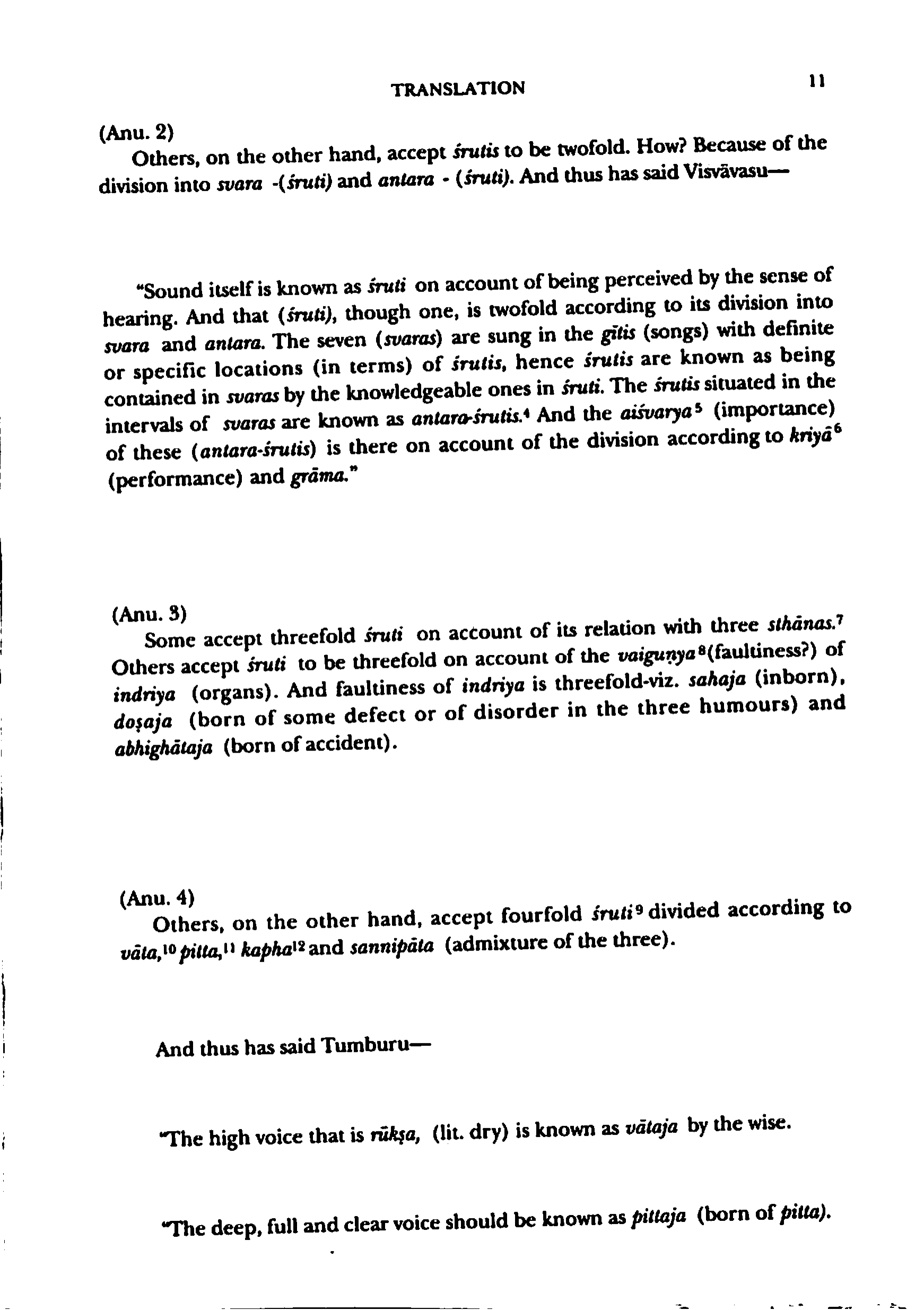
(Anu. 2) Others, on the other hand, accept śrutis to be twofold. How? Because of the division into svara -(śruti) and antara - (śruti). And thus has said Visvāvasu- "Sound itself is known as śruti on account of being perceived by the sense of hearing.4 And that (śruti), though one, is twofold according to its division into svara and antara.7 The seven (svaras) are sung in the gitis (songs) with definite or specific locations (in terms) of srutis, hence srutis are known as being contained in svaras by the knowledgeable ones in śruti.14 The śrutis situated in the intervals of svaras are known as antara-śrutis.3 And the aiśvarya (importance) of these (antara-śrutis) is there on account of the division according to kriyâ6 (performance) and grāma.11" (Anu. 3) Some accept threefold śruti on account of its relation with three sthanas.7 Others accept śruti to be threefold on account of the vaigunya 8 (faultiness?) of indriya (organs).10 And faultiness of indriya is threefold-viz. sahaja (inborn), doșaja (born of some defect or of disorder in the three humours) and abhighātaja (born of accident).8 (Anu. 4) Others, on the other hand, accept fourfold śruti9 divided according to vāta,10 pitta,11 kapha12 and sannipāta (admixture of the three).9 And thus has said Tumburu- "The high voice that is rūkṣa, (lit. dry) is known as vātaja by the wise.5 "The deep, full and clear voice should be known as pittaja (born of pitta).6 . -
3.[definition] Antara-śrutis are śrutis situated in the intervals between svarasअन्तःस्वरविवर्तिन्यो ह्यन्तरश्रुतयो मता।
4.[definition] Śruti is sound itself, known through perception by the sense of hearingश्रवणेन्द्रियग्राह्यत्वाद् ध्वनिरेव श्रुतिभवित् ।
7.[enumeration] Śruti is twofold, divided into svara-śruti and antara-śrutiसा चैकाऽपि द्विधा ज?ेया स्वरान्तरविभागतः ॥
8.[enumeration] Faultiness of organs is threefold: sahaja (inborn), doșaja (born of humoral disorder), and abhighātaja (born of accident)इन्द्रियवैगुण्यं च त्रिविधं— सहज दोषजम् अभिघातजं चेति ।
10.[relation] Some accept threefold śruti classification on account of vaigunya (faultiness) of indriya (organs)अपरे त्विन्द्रियवैगुण्यात् त्रिविधा श्रुति मन्यन्ते ।
11.[relation] The importance of antara-śrutis derives from division according to kriyā and grāmaएतासामपि चैश्वर्य क्रियाग्रामविभागतः ॥
12.[relation] Kriyā (performance) is a basis for division in the classification of śrutisएतासामपि चैश्वर्य क्रियाग्रामविभागतः ॥
13.[relation] Grāma is a basis for division in the classification of śrutisएतासामपि चैश्वर्य क्रियाग्रामविभागतः ॥
14.[structural] Seven svaras are sung in gitis with definite locations in terms of śrutis, containing śrutisनियतश्रुतिसंस्थानाद् गीयन्ते सप्त गीतिषु। ।
1.[attribution]Visvāvasu is cited as an authority on the twofold division of śrutiAnd thus has said Visvāvasu
2.[attribution]Tumburu is cited as an authority on the fourfold śruti classification based on humoral qualitiesAnd thus has said Tumburu
3.[definition]Antara-śrutis are śrutis situated in the intervals between svarasThe śrutis situated in the intervals of svaras are known as antara-śrutis.
4.[definition]Śruti is sound itself, known through perception by the sense of hearingSound itself is known as śruti on account of being perceived by the sense of hearing.
5.[definition]High voice that is rūkṣa (dry) is known as vātajaThe high voice that is rūkṣa, (lit. dry) is known as vātaja by the wise.
6.[definition]Deep, full and clear voice is known as pittajaThe deep, full and clear voice should be known as pittaja (born of pitta).
7.[enumeration]Śruti is twofold, divided into svara-śruti and antara-śrutiAnd that (śruti), though one, is twofold according to its division into svara and antara.
8.[enumeration]Faultiness of organs is threefold: sahaja (inborn), doșaja (born of humoral disorder), and abhighātaja (born of accident)And faultiness of indriya is threefold-viz. sahaja (inborn), doșaja (born of some defect or of disorder in the three humours) and abhighātaja (born of accident).
9.[enumeration]Śruti is fourfold according to division into vāta, pitta, kapha, and sannipātaOthers, on the other hand, accept fourfold śruti divided according to vāta, pitta, kapha and sannipāta (admixture of the three).
10.[relation]Some accept threefold śruti classification on account of vaigunya (faultiness) of indriya (organs)Others accept śruti to be threefold on account of the vaigunya (faultiness?) of indriya (organs).
11.[relation]The importance of antara-śrutis derives from division according to kriyā and grāmaAnd the aiśvarya (importance) of these (antara-śrutis) is there on account of the division according to kriyâ (performance) and grāma.
12.[relation]Kriyā (performance) is a basis for division in the classification of śrutisAnd the aiśvarya (importance) of these (antara-śrutis) is there on account of the division according to kriyâ (performance) and grāma.
13.[relation]Grāma is a basis for division in the classification of śrutisAnd the aiśvarya (importance) of these (antara-śrutis) is there on account of the division according to kriyâ (performance) and grāma.
14.[structural]Seven svaras are sung in gitis with definite locations in terms of śrutis, containing śrutisThe seven (svaras) are sung in the gitis (songs) with definite or specific locations (in terms) of srutis, hence srutis are known as being contained in svaras by the knowledgeable ones in śruti.