Source scans · vol_I_p015
recto · open full
scan recto
verso · open full
scan verso
Bṛhaddeśī · Volume I
pp. 12–13folio 015
Devanāgarī
BRHADDES!
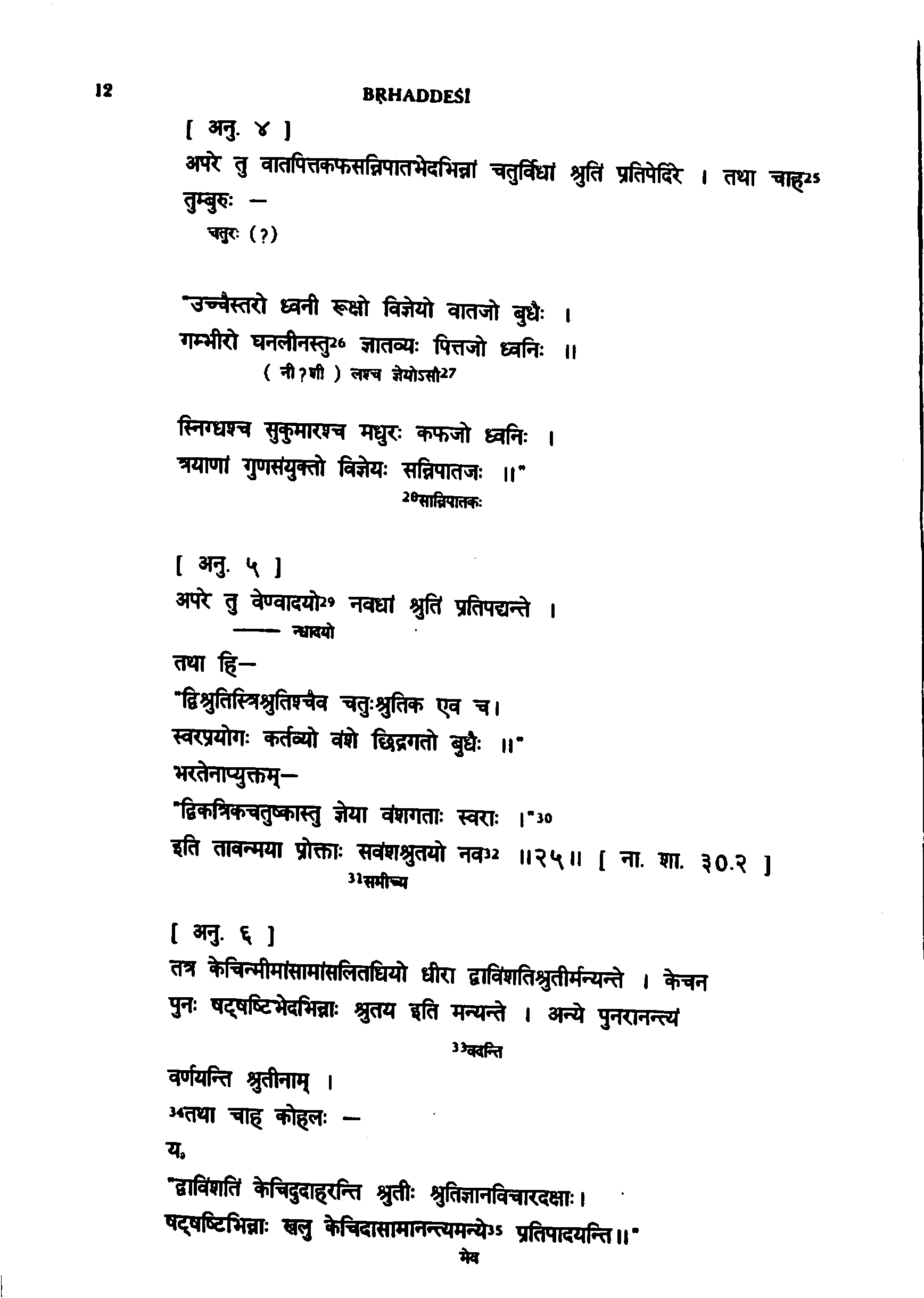
[अनु. ४]
अपरे तु वातिपत्तकफसिन्नपातभेदभिन्ना चतुर्विधा श्रुति प्रतिपेदिरे । तथा चाह्र²5 तुम्बुरु — चतुरः (?)
"उच्चैस्तरो ध्वनी रूक्षो विज?्ञेयो वातजो बुधै ।
गम्भीरो घनलीनस्तु26 ज?्ञातव्यः पित्तजो ध्वनि ॥
( नी ? घी ) लक्ष्च ज?्ञेयोऽसी27 स्निग्धश्च सुकुमारश्च मधुरः कफजो ध्वनि ।3 त्रयाणा गुणसंयुक्तो विज?्ञेयः सन्निपातजः ॥" 28साद्मिपातकः
[अनु. ५]
अपरे तु वेण्वादयो॰ नवधा श्रुति प्रतिपद्यन्ते ।5 — न्धावयो तथा हि—
"द्विश्रुतिस्त्रिश्रुतिश्चैव चतुःश्रुतिक एव च।
स्वरप्रयोगः कर्तव्यो वंशे छिद्रगतो बुधै ॥7" भरतेनाप्युक्तम्—1 "द्विकत्रिकचतुष्कास्तु ज?्ञेया वंशगता स्वरा ।6"30 इति तावन्मया प्रोक्ता सर्वशश्रुतयो नव832 ॥२५॥ [ ना. शा. ३०.२ ] 31समीच्य
[अनु. ६]
तत्र केचिन्मीमांसामांसलितिधयो धीरा द्वाविशतिश्रुतीर्मन्यन्ते । केचन पुनः षट्षिष्टिभेदिभिन्ना श्रुतय इति मन्यन्ते ।4 अन्ये पुनरानन्त्यं 33वदन्ति
वर्णयन्ति श्रुतीनाम् ।
अतथा चाह कोहलः —2 य,
"द्वाविंशति केचिदुदाहरन्ति श्रुती श्रुतिज?्ञानविचारदक्षा।
षद्षष्टिभिन्ना खलु केचिदासामानन्त्यमन्ये प्रतिपादयन्ति॥" मेव
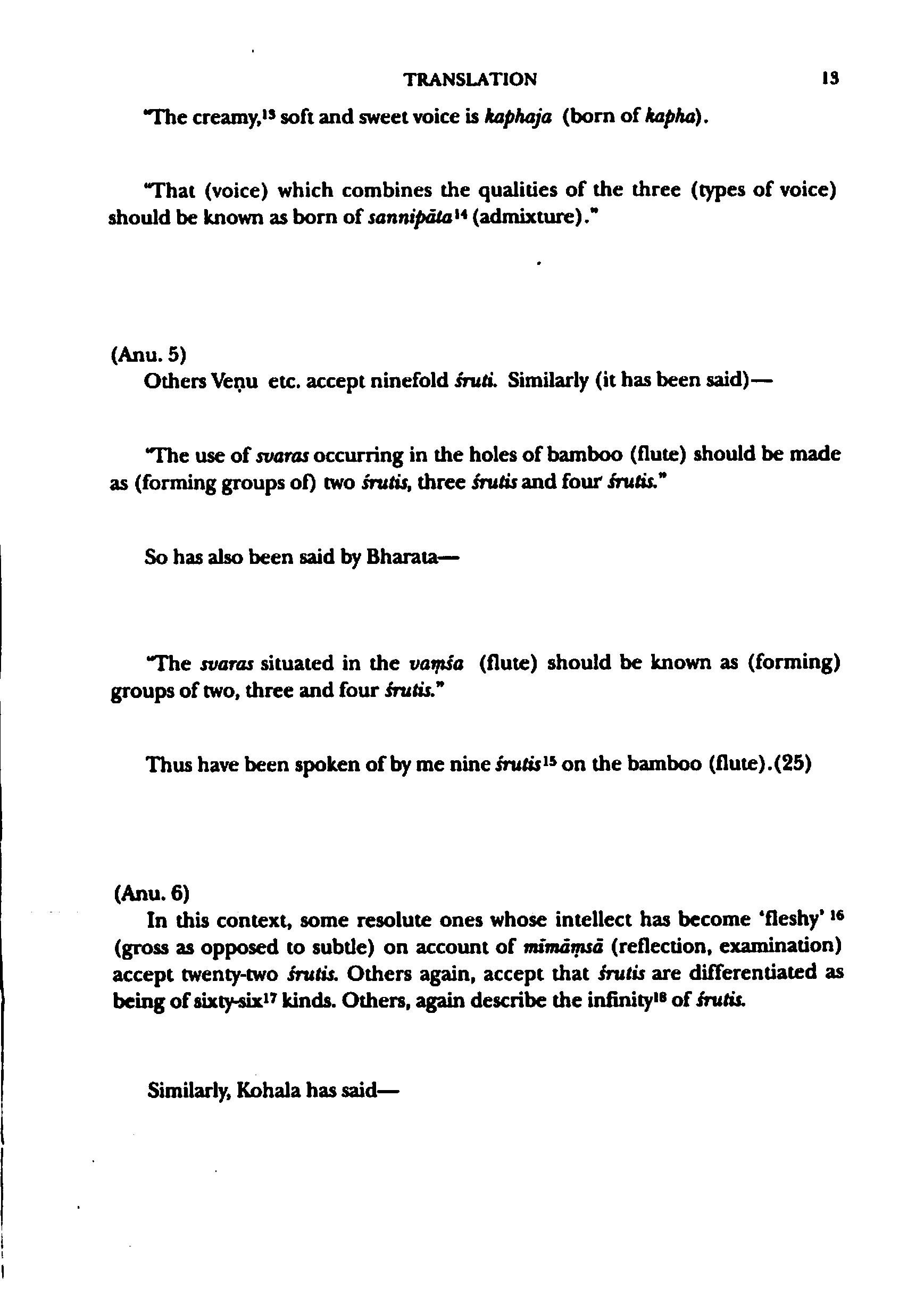
English — Sharma (translation)
"The creamy,13 soft and sweet voice is kaphaja (born of kapha).3 "That (voice) which combines the qualities of the three (types of voice) should be known as born of sannipāta14 (admixture)." (Anu. 5) Others Venu etc. accept ninefold śruti.5 Similarly (it has been said)— "The use of svaras occurring in the holes of bamboo (flute) should be made as (forming groups of) two srutis, three srutis and four srutis.7" So has also been said by Bharata— "The svaras situated in the vamsa (flute) should be known as (forming) groups of two, three and four śrutis."1 Thus have been spoken of by me nine śrutis 15 on the bamboo (flute).(25)8 (Anu. 6) In this context, some resolute ones whose intellect has become 'fleshy' 16 (gross as opposed to subtle) on account of mimansa (reflection, examination) accept twenty-two śrutis. Others again, accept that śrutis are differentiated as being of sixty-six17 kinds. Others, again describe the infinity18 of śrutis. Similarly, Kohala has said—2
1.[citation] Bharata is cited as an authority on the classification of svaras in the vamsaभरतेनाप्युक्तम्—
2.[citation] Kohala is cited as an authority on theories of śruti classificationअतथा चाह कोहलः —
3.[definition] Kaphaja voice is characterized by creamy, soft, and sweet qualitiesस्निग्धश्च सुकुमारश्च मधुरः कफजो ध्वनि ।
4.[enumeration] There are multiple competing theories about the number of śrutis: twenty-two, sixty-six, or infiniteतत्र केचिन्मीमांसामांसलितिधयो धीरा द्वाविशतिश्रुतीर्मन्यन्ते । केचन पुनः षट्षिष्टिभेदिभिन्ना श्रुतय इति मन्यन्ते ।
5.[relation] Venu and other instruments accept ninefold śrutiअपरे तु वेण्वादयो॰ नवधा श्रुति प्रतिपद्यन्ते ।
6.[structural] Svaras in the vamsa (flute) should be known as forming groups of two, three and four śrutisद्विकत्रिकचतुष्कास्तु ज?्ञेया वंशगता स्वरा ।
7.[structural] The use of svaras in holes of bamboo flute forms groups of two, three and four śrutisद्विश्रुतिस्त्रिश्रुतिश्चैव चतुःश्रुतिक एव च। स्वरप्रयोगः कर्तव्यो वंशे छिद्रगतो बुधै ॥
8.[structural] Nine śrutis are associated with the bamboo flute (vamsa)इति तावन्मया प्रोक्ता सर्वशश्रुतयो नव
1.[citation]Bharata is cited as an authority on the classification of svaras in the vamsaSo has also been said by Bharata— "The svaras situated in the vamsa (flute) should be known as (forming) groups of two, three and four śrutis."
2.[citation]Kohala is cited as an authority on theories of śruti classificationSimilarly, Kohala has said—
3.[definition]Kaphaja voice is characterized by creamy, soft, and sweet qualitiesThe creamy,13 soft and sweet voice is kaphaja (born of kapha).
4.[enumeration]There are multiple competing theories about the number of śrutis: twenty-two, sixty-six, or infinitesome resolute ones whose intellect has become 'fleshy' 16 (gross as opposed to subtle) on account of mimansa (reflection, examination) accept twenty-two śrutis. Others again, accept that śrutis are differentiated as being of sixty-six17 kinds. Others, again describe the infinity1
5.[relation]Venu and other instruments accept ninefold śrutiOthers Venu etc. accept ninefold śruti.
6.[structural]Svaras in the vamsa (flute) should be known as forming groups of two, three and four śrutisThe svaras situated in the vamsa (flute) should be known as (forming) groups of two, three and four śrutis.
7.[structural]The use of svaras in holes of bamboo flute forms groups of two, three and four śrutisThe use of svaras occurring in the holes of bamboo (flute) should be made as (forming groups of) two srutis, three srutis and four srutis.
8.[structural]Nine śrutis are associated with the bamboo flute (vamsa)Thus have been spoken of by me nine śrutis 15 on the bamboo (flute).(25)