Source scans · vol_I_p017
recto · open full
scan recto
verso · open full
scan verso
Bṛhaddeśī · Volume I
pp. 4–78folio 017
Devanāgarī (Bṛhaddeśī)
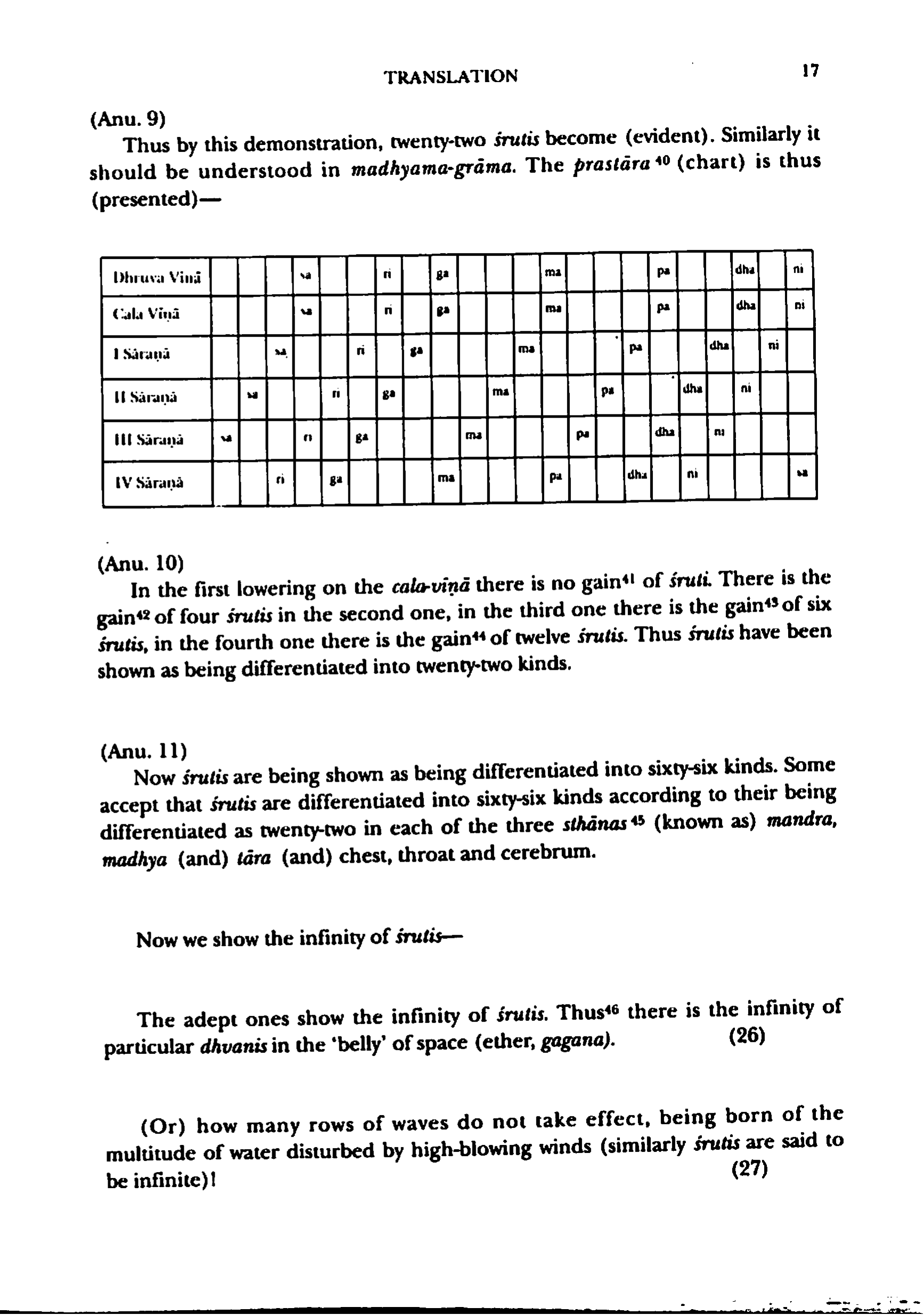
[अनु. ९]
एवमनेन 47[ नि ] दर्शनेन द्वाविंशतिश्रुतयो भवन्ति।
एवं मध्यमग्रामे द्रष्टव्यम्।
प्रस्तारो यथा-2 भुव-यीगा7 Ŕ η Ħ Ħ प u A पसर्वन्य Ř η q u Ħ प्र. सार्णा Ř स A η घ P u हि. सरफा Ř ग स A ¥ q Ĥ ч q तृ. सारप्र Ŕ Ħ ग ध. सरणा R Ĥ ų ų स
[अनु. १०]
चलवीणाया प्रथमापकर्षे श्रुतिलाभो नास्ति। द्वितीये ४६चतुःश्रुतिलाभः।
तृतीये षट्श्रुतिलाभः। चतुर्थे द्वादशश्रुतिलाभः।10 एवं द्वाविंशतिभेदभिन्ना
श्रुत्यो दर्शिता।
[अनु. ११]
इदानी षट्षष्टिभेदभिन्ना श्रुतयः कथ्यन्ते। मन्द्रमध्यतारेषु उरःकण्ठशिरस्सु त्रिषु स्थानेषु प्रत्येकं द्वाविंशतिप्रकारतया भिद्यमानेषु4 (का?कं)
श्रुतयो हि षट्षष्टिभेदभिन्ना भवन्तीति केचिन्मन्यन्ते।
अधुना श्रुतीनामानन्त्यं दर्शयामः—
आनन्त्यं तु श्रुतीना चऽ० दर्शयन्ति विपश्चितः ।
49हि तु51 सूचयन्ति यथा ध्वनिविशेषाणामानन्त्यं गगनोदरे ॥२६॥8 52₀ममान
उत्ताल53-पवनोद्वेग-जलराशिसमुद्भवा।
५४कियत्यः प्रतिपद्यन्ते न तरङ्गपरम्परा ॥२७॥ 55द्वता 56इमत्यः
।। इति श्रुतीनामानन्त्यं दर्शितम् ।।
English — Sharma (translation)
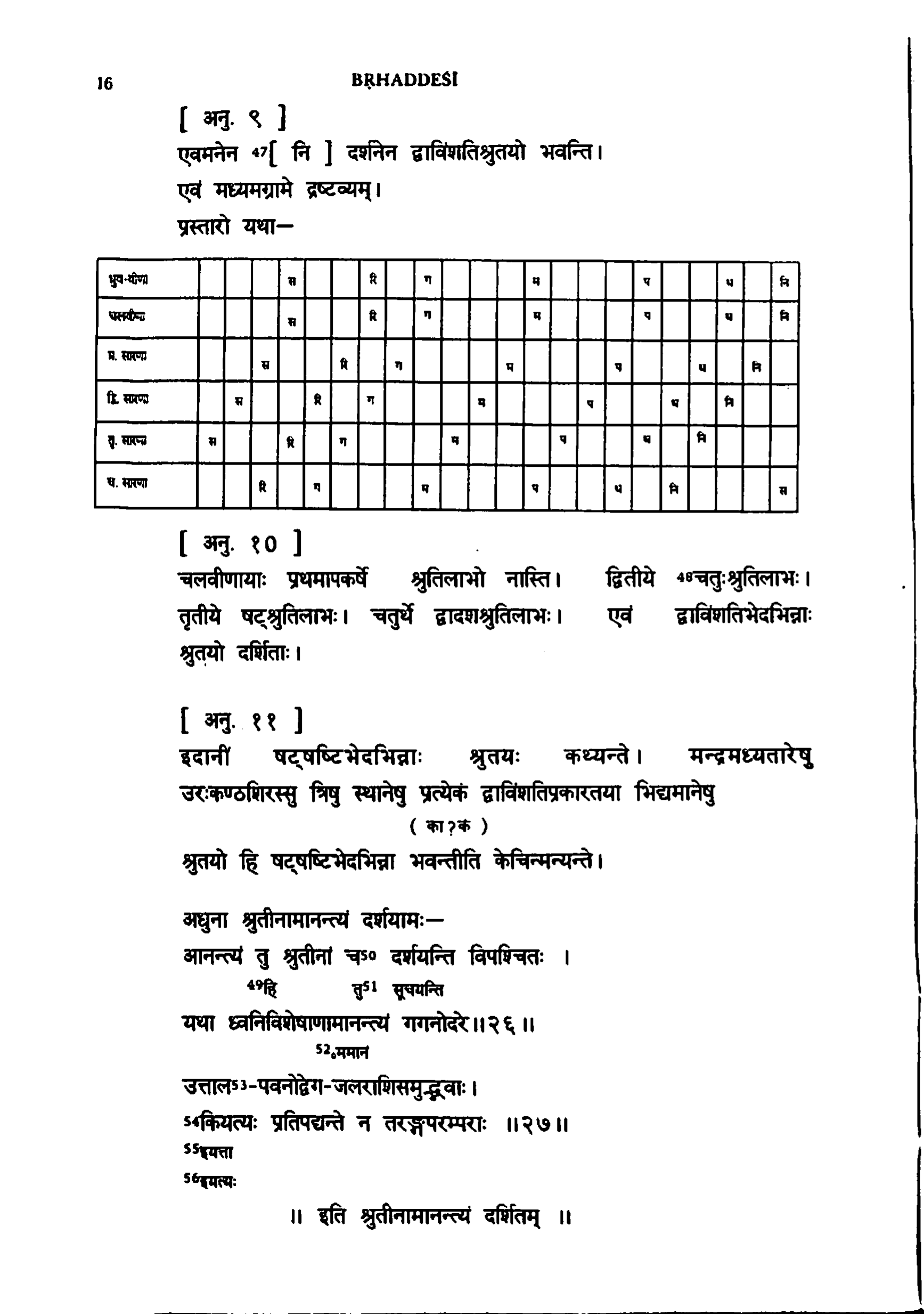
(Anu. 9) Thus by this demonstration, twenty-two śrutis become (evident).1 Similarly it should be understood in madhyama-grāma.5 The prastāra 40 (chart) is thus
table
prastāra — madhyama-grāma śruti-distribution across 6 vīṇā configurations
configurationc1c2c3c4c5c6c7c8c9c10c11c12c13c14
Dhruva Vināvangamapadhani
Cala Vināvangamapadhani
I Sāraṇāvangamapadhani
II Sāraṇāvangamapadhani
III Sāraṇāvangamapadhani
IV Sāraṇāngamapadhaniva
— The prastāra (chart) is thus (presented)—
In the first lowering on the cala-viņā there is no gain41 of śruti. There is the gain42 of four śrutis in the second one, in the third one there is the gain43 of six śrutis, in the fourth one there is the gain44 of twelve śrutis. Thus śrutis have been shown as being differentiated into twenty-two kinds. (Anu. 11) Now śrutis are being shown as being differentiated into sixty-six kinds. Some accept that śrutis are differentiated into sixty-six kinds according to their being differentiated as twenty-two in each of the three sthanas 45 (known as) mandra,
The adept ones show the infinity of śrutis. Thus46 there is the infinity of
(26)
particular dhvanis in the 'belly' of space (ether, gagana). (Or) how many rows of waves do not take effect, being born of the multitude of water disturbed by high-blowing winds (similarly śrutis are said to
(27)
be infinite)!
1.[attribution]Brihaddesi systematically demonstrates the theory of śrutis through grāma systems and their instrumental manifestationsएवमनेन नि दर्शनेन द्वाविंशतिश्रुतयो भवन्ति।
2.[definition]Prastāra is a chart or systematic presentation used to demonstrate śrutis in different grāmasप्रस्तारो यथा-
3.[definition]Sthanas are three registers known as mandra, madhya, and tāra, corresponding to chest, throat, and cerebrumमन्द्रमध्यतारेषु उरःकण्ठशिरस्सु त्रिषु स्थानेषु
4.[enumeration]Śrutis are differentiated into sixty-six kinds: twenty-two in each of three sthanasइदानी षट्षष्टिभेदभिन्ना श्रुतयः कथ्यन्ते। मन्द्रमध्यतारेषु उरःकण्ठशिरस्सु त्रिषु स्थानेषु प्रत्येकं द्वाविंशतिप्रकारतया भिद्यमानेषु
5.[relation]Madhyama-grāma should be understood similarly to the demonstration of śrutis shown in Śaḍja-grāmaएवं मध्यमग्रामे द्र्ष्टव्यम्।
6.[relation]The infinity of śrutis is shown through analogy to the infinite number of sound variations in spaceआनन्त्यं तु श्रुतीना चऽ० दर्शयन्ति विपश्चितः । तु सूचयन्ति यथा ध्वनिविशेषाणामानन्त्यं गगनोदरे
7.[relation] Dhruva Vinā is an instrument presented in the prastāra chart for demonstrating śrutisभुव-यीगा
8.[structural]Dhvanis (particular sounds) are infinite in number, compared to waves in waterयथा ध्वनिविशेषाणामानन्त्यं गगनोदरे ॥२६॥
9.[structural]Through the demonstration of grāma systems, twenty-two śrutis become evidentएवमनेन नि दर्शनेन द्वाविंशतिश्रुतयो भवन्ति।
10.[structural]Cala-viņā is an instrument where śrutis are gained through successive lowerings: none in first, four in second, six in third, twelve in fourthचलवीणाया प्रथमापकर्षे श्रुतिलाभो नास्ति। द्वितीये चतुःश्रुतिलाभः। तृतीये षट्श्रुतिलाभः। चतुर्थे द्वादशश्रुतिलाभः।
1.[attribution] Brihaddesi systematically demonstrates the theory of śrutis through grāma systems and their instrumental manifestationsThus by this demonstration, twenty-two śrutis become (evident).
5.[relation] Madhyama-grāma should be understood similarly to the demonstration of śrutis shown in Śaḍja-grāmaSimilarly it should be understood in madhyama-grāma.
7.[relation]Dhruva Vinā is an instrument presented in the prastāra chart for demonstrating śrutisDhruva Vinã
9.[structural] Through the demonstration of grāma systems, twenty-two śrutis become evidentThus by this demonstration, twenty-two śrutis become (evident).