Source scans · vol_I_p018
recto · open full
scan recto
verso · open full
scan verso
Bṛhaddeśī · Volume I
pp. 18–614folio 018
Devanāgarī (Bṛhaddeśī)
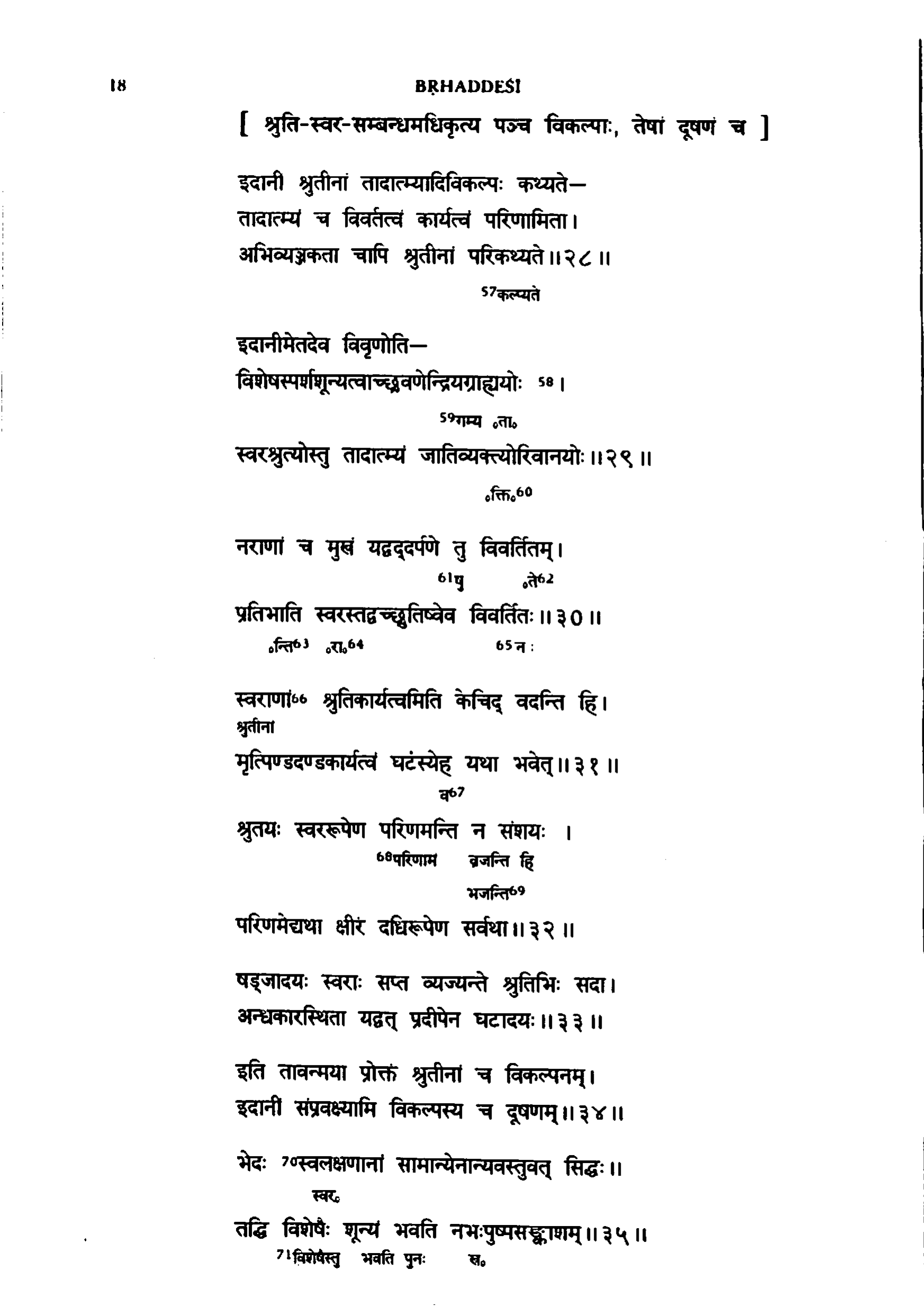
[श्रुति-स्वर-सम्बन्धमधिकृत्य पञ्च विकल्पाः, तेषां दूषणं च]
इदानी श्रुतीनां तादात्म्यादिविकल्पः कथ्यते— तादातम्यं च विवर्तत्वं कार्यत्वं परिणामिता। अभिव्यञ्जकता चापि श्रुतीनां परिकथ्यते957कल्प्यते ॥२८॥ इदानीमेतदेव विवृणोति—
विशेषस्पर्शशून्यत्वाच्छ्रवणेन्द्रियग्राह्ययो107ः 58।
59गम्य ०ताः स्वरश्रुत्योस्तु तादात्म्यं जातिव्यक्त्योरिवानयो1॥२९॥ هُ (10
नराणां च मुखं यद्वद्दर्पणे तु विवर्तितम्ुते6≥
प्रतिभाति स्वरस्तद्वच्छुतिष्वेव विवर्तितः॥३०॥ ०न्ति63 ०रा6465 ल :
स्वराणांश्रुतीना श्रुतिकार्यत्वमिति केचिद् वदन्ति हि।
मृत्पिण्डदण्डकार्यत्वं घटंस्येहव67 यथा भवेत्।।३१।।
श्रुतयः स्वररूपेण परिणमन्ति68परिणाम न संशयः ।
व्रजन्तिभजन्ति ५९ हि
परिणमेद्यथा क्षीरं दिधरूपेण सर्वथा।।३२।।
षड्जादयः स्वराः सप्त व्यज्यन्ते श्रुतिभिः सदा।
अन्धकारस्थिता यद्वत् प्रदीपेन घटादयः ॥३३॥ इति तावन्मया प्रोक्तं श्रुतीनां च विकल्पनम्।
इदानी संप्रवक्ष्यामि विकल्पस्य च दूषणम्12।।३४।।
भेदः ७०स्वलक्षणानांस्वर् सामान्येनान्यवस्तुवत् सिद्धः।।
तिद्धं विशेषैः शून्यं भवति नभःपुष्पसङ्काशम्॥३५॥ 71विशेषस्तु भवति पुनःस₀
English — Sharma (translation)
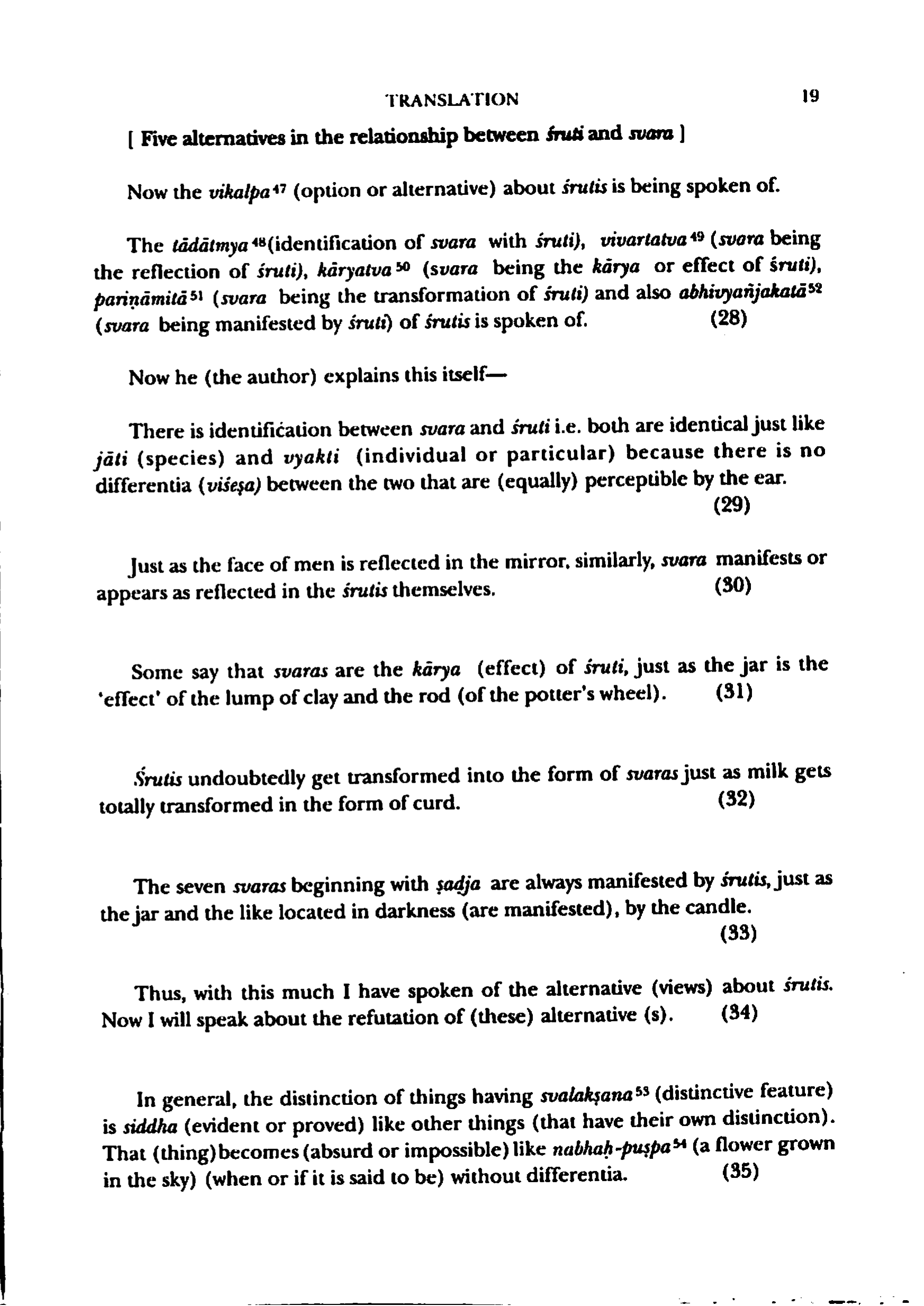
[Five alternatives in the relationship between sruti and svara]
Now the vikalpa47 (option or alternative) about śrutis is being spoken of. The tādātmya 48 (identification of svara with śruti), vivartatva 49 (svara being the reflection of śruti), kāryatva 50 (svara being the kārya or effect of śruti), pariņāmitā51 (svara being the transformation of śruti) and also abhivyañjakatā52
(28)
(svara being manifested by śruti) of śrutis is spoken of. Now he (the author) explains this itself— There is identification between svara and śruti i.e. both are identical just like jāti (species) and vyakti (individual or particular)1 because there is no differentia (viśeșa) between the two that are (equally) perceptible by the ear.10
(29)
Just as the face of men is reflected in the mirror, similarly, svara manifests or
(30)
appears as reflected in the śrutis themselves. Some say that svaras are the kārya (effect) of śruti, just as the jar is the
(31)
'effect' of the lump of clay and the rod (of the potter's wheel). Srutis undoubtedly get transformed into the form of svaras just as milk gets
(32)
totally transformed in the form of curd. The seven svaras beginning with sadja are always manifested by śrutis, just as the jar and the like located in darkness (are manifested), by the candle.2
(33)
Thus, with this much I have spoken of the alternative (views) about śrutis.
(34)
Now I will speak about the refutation of (these) alternative (s).12
In general, the distinction of things having svalakşana 53 (distinctive feature) is siddha (evident or proved) like other things (that have their own distinction).11 That (thing) becomes (absurd or impossible) like nabhaḥ-puṣpa54 (a flower grown
(35)
in the sky) (when or if it is said to be) without differentia.
1.[definition] Identification theory posits that svara and śruti are identical, just as species and individuals are identicalस्वरश्रुत्योस्तु तादात्म्यं ज?ातिव्यक्त्योरिवानयो
2.[definition] Manifestation theory posits that the seven svaras are always manifested by śrutis, as objects in darkness are manifested by candlelightषड्ज?ादयः स्वरा सप्त व्यज्यन्ते श्रुतिभि सदा। अन्धकारस्थिता यद्वत् प्रदीपेन घटादयः
5.[definition] Effect theory holds that svaras are effects (kārya) of śruti, comparable to how a jar is the effect of clay and potter's rodस्वराणा श्रुतिकार्यत्वमिति केचिद् वदन्ति हि। श्रुतीना मृत्पिण्डदण्डकार्यत्वं घटंस्येह यथा भवेत्
7.[definition] Differentia (viśeșa) is the distinctive feature that would separate or distinguish two entitiesविशेषस्पर्शशून्यत्वाच्छ्रवणेन्द्रियग्राह्ययो
8.[definition] Nabhaḥ-puṣpa (a flower grown in the sky) is invoked as an example of an absurd or impossible entityतिद्धं विशेषै शून्यं भवति नभःपुष्पसङ्काशम्
9.[enumeration] Five alternative theories exist regarding the relationship between śruti and svaraतादातम्यं च विवर्तत्वं कार्यत्वं परिणामिता। अभिव्यञ्जकता चापि श्रुतीना परिकथ्यते
10.[relation] The identification of svara and śruti is justified by the absence of differentia between them as perceived by the earविशेषस्पर्शशून्यत्वाच्छ्रवणेन्द्रियग्राह्ययो
12.[structural] The author (Mātaṅga) will now present refutations of these five alternative theoriesइति तावन्मया प्रोक्तं श्रुतीना च विकल्पनम्। इदानी संप्रवक्ष्यामि विकल्पस्य च दूषणम्
1.[definition]Identification theory posits that svara and śruti are identical, just as species and individuals are identicalThere is identification between svara and śruti i.e. both are identical just like jāti (species) and vyakti (individual or particular)
2.[definition]Manifestation theory posits that the seven svaras are always manifested by śrutis, as objects in darkness are manifested by candlelightThe seven svaras beginning with sadja are always manifested by śrutis, just as the jar and the like located in darkness (are manifested), by the candle.
3.[definition]Svalakşana refers to the distinctive feature or characteristic property of a thingthe distinction of things having svalakşana (distinctive feature) is siddha (evident or proved) like other things
4.[definition]Reflection theory states that svara manifests or appears as reflected in śrutis, analogous to how a face is reflected in a mirrorJust as the face of men is reflected in the mirror, similarly, svara manifests or (appears as reflected in the śrutis themselves.
5.[definition]Effect theory holds that svaras are effects (kārya) of śruti, comparable to how a jar is the effect of clay and potter's rodSome say that svaras are the kārya (effect) of śruti, just as the jar is the 'effect' of the lump of clay and the rod (of the potter's wheel).
6.[definition]Transformation theory asserts that śrutis undoubtedly get transformed into the form of svaras, as milk transforms into curdSrutis undoubtedly get transformed into the form of svaras just as milk gets totally transformed in the form of curd.
7.[definition]Differentia (viśeșa) is the distinctive feature that would separate or distinguish two entitiesThere is no differentia (viśeșa) between the two that are (equally) perceptible by the ear.
8.[definition]Nabhaḥ-puṣpa (a flower grown in the sky) is invoked as an example of an absurd or impossible entityThat (thing) becomes (absurd or impossible) like nabhaḥ-puṣpa (a flower grown in the sky)
9.[enumeration]Five alternative theories exist regarding the relationship between śruti and svaraThe tādātmya (identification of svara with śruti), vivartatva (svara being the reflection of śruti), kāryatva (svara being the kārya or effect of śruti), pariņāmitā (svara being the transformation of śruti) and also abhivyañjakatā (svara being manifested by śruti) of śrutis is sp
10.[relation]The identification of svara and śruti is justified by the absence of differentia between them as perceived by the earbecause there is no differentia (viśeșa) between the two that are (equally) perceptible by the ear.
11.[relation]Things possessing distinctive features have evident and proved distinctions, unlike impossible entitiesIn general, the distinction of things having svalakşana (distinctive feature) is siddha (evident or proved) like other things (that have their own distinction).
12.[structural]The author (Mātaṅga) will now present refutations of these five alternative theoriesThus, with this much I have spoken of the alternative (views) about śrutis. (34) Now I will speak about the refutation of (these) alternative (s).