Source scans · vol_I_p016
recto · open full
scan recto
verso · open full
scan verso
Bṛhaddeśī · Volume I
pp. 14–15folio 016
Devanāgarī (Bṛhaddeśī)
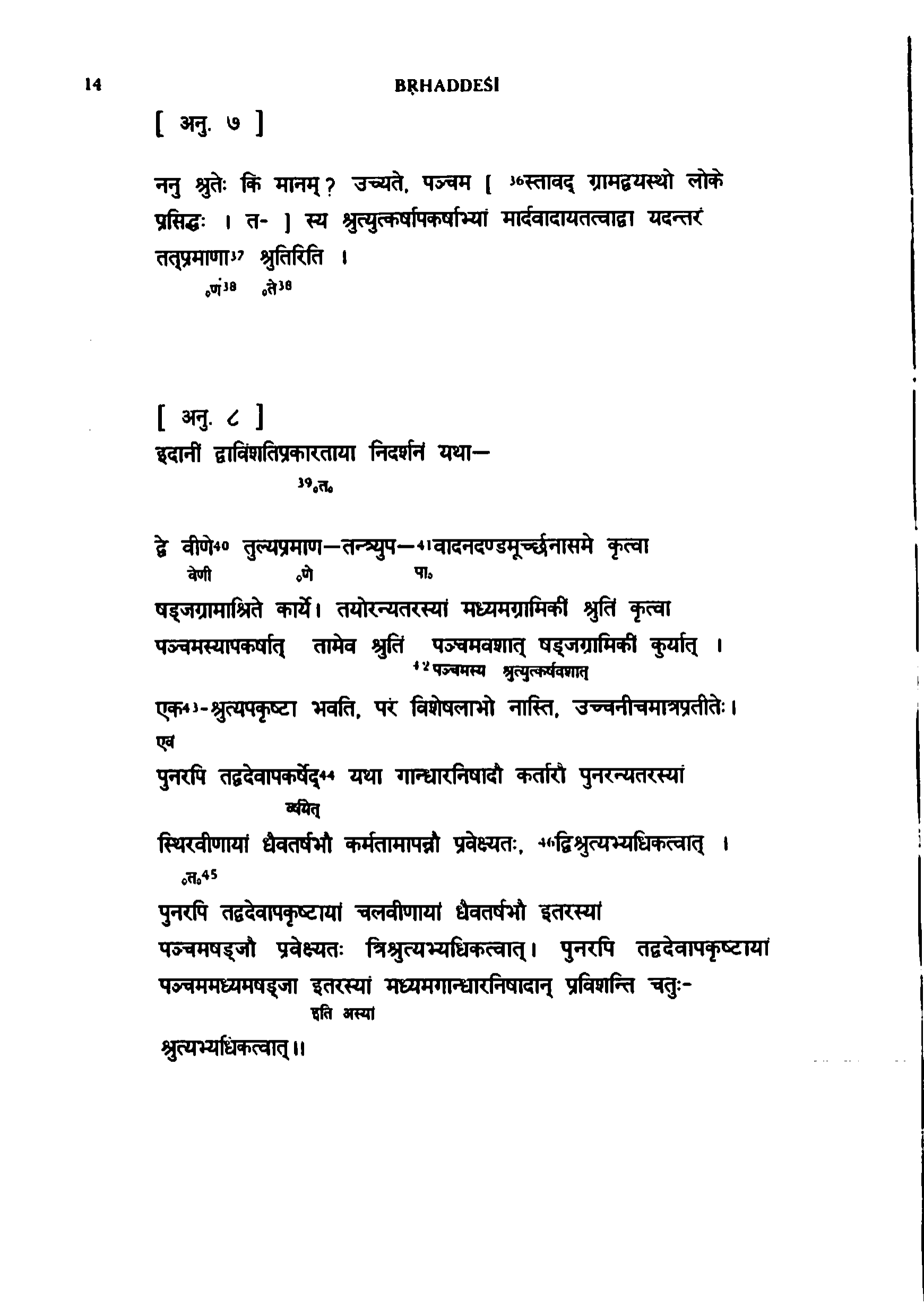
[अनु. ७]
ननु श्रुतेः कि मानम्? उच्यते, पञ्चम [ अस्तावद् ग्रामद्वयस्थो लोके प्रसिद्धः147 । त- ] स्य श्रुत्युत्कर्षापकर्षाभ्यां मार्दवादायतत्वाद्वा यदन्तरं
तत्प्रमाणाःुणं ३८ ूरो ३६ श्रुतिरिति ।
[अनु. ८]
इदानीं द्वाविंशतिप्रकारताया39ुत् निदर्शनं यथा-9 द्वे वीणे40वेणी तुल्यप्रमाण—तन्त्र्युप—41वादनदण्डमूर्च्छनासमे65पा०पो कृत्वा15 षड्जग्रामाश्रिते कार्ये। तयोरन्यतरस्यां मध्यमग्रामिकीं श्रुतिं कृत्वा
पञ्चमस्यापकर्षात् तामेव श्रुतिं पञ्चमवशात् षड्जग्रामिकीं कुर्यात् ।
4एव 2 पञ्चमस्य   श्रुत्युत्कर्यवशात्
एक - श्रुत्यपकृष्टा भवति, परं विशेषलाभो नास्ति, उच्चनीचमात्रप्रतीतेः।
पुनरपि तद्वदेवापकर्षेद्भव्ययित् यथा गान्धारनिषादौ कर्तारौ पुनरन्यतरस्यां
स्थिरवीणायां<sub>॰</sub>स<sub>॰</sub>45 धैवतर्षभौ कर्मतामापन्नौ प्रवेक्ष्यतः, अब्द्विश्रुत्यभ्यधिकत्वात् ।
पुनरपि तद्वदेवापकृष्टायां चलवीणायां धैवतर्षभौ इतरस्यां पञ्चमषड्जौ प्रवेक्ष्यतः त्रिश्रुत्यभ्यधिकत्वात्। पुनरपि तद्वदेवापकृष्टायां पञ्चममध्यमषड्जा इतरस्यांइति अस्या मध्यमगान्धारनिषादान् प्रविशन्ति चतुः-
श्रुत्यभ्यधिकत्वात्।।
English — Sharma (translation)
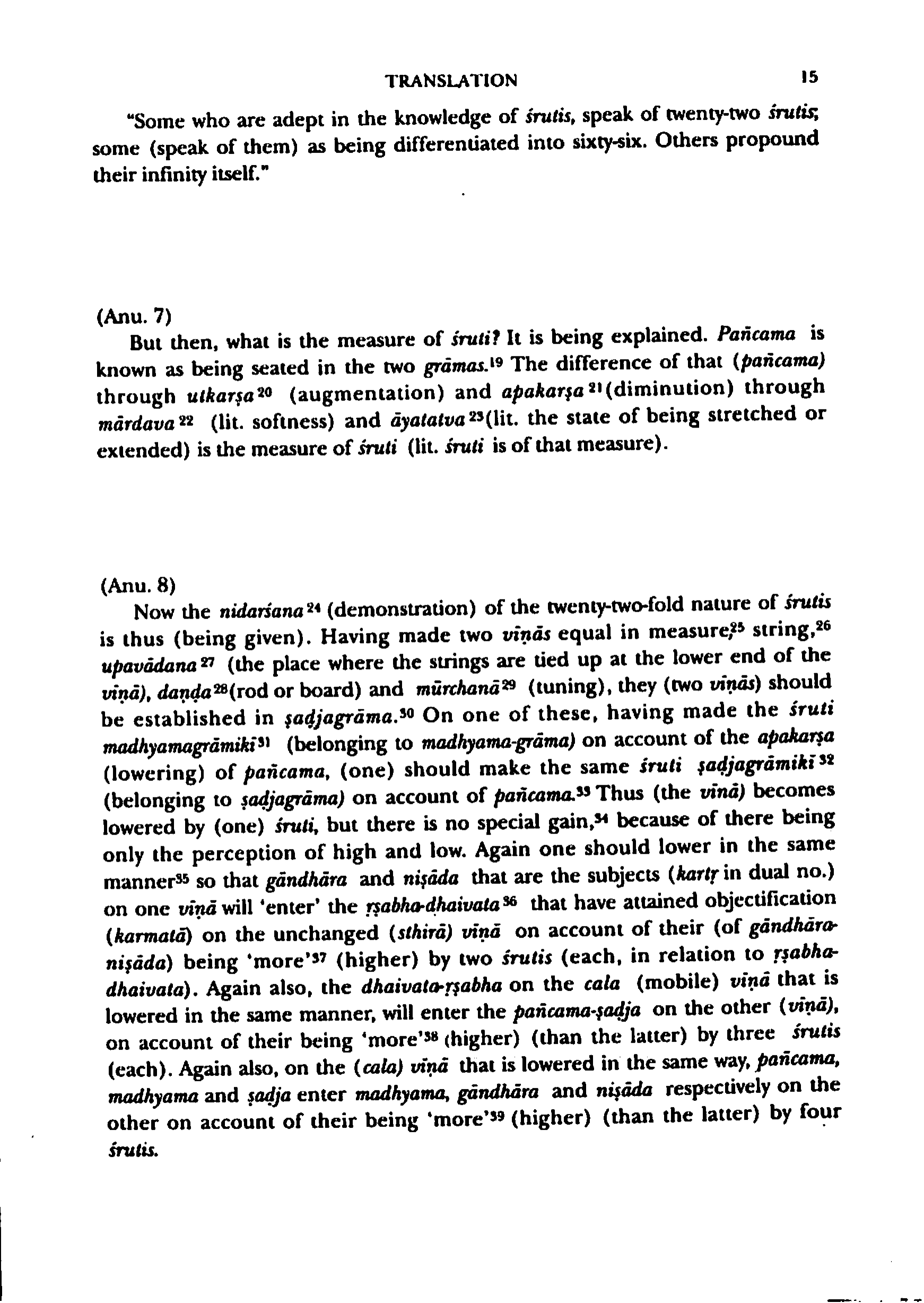
"Some who are adept in the knowledge of śrutis, speak of twenty-two śrutis; some (speak of them) as being differentiated into sixty-six. Others propound their infinity itself.8" (Anu. 7) But then, what is the measure of śruti? It is being explained. Pañcama is known as being seated in the two grāmas.14719 The difference of that (pañcama) through utkarşa 20 (augmentation) and apakarşa 21 (diminution)32 through mārdava 22 (lit. softness) and āyatatva 23 (lit. the state of being stretched or extended) is the measure of śruti11101 (lit. śruti is of that measure). (Anu. 8) Now the nidarsana 24 (demonstration) of the twenty-two-fold nature of srutis is thus (being given).9 Having made two viņās equal in measure,25 string,26 upavādana 27 (the place where the strings are tied up at the lower end of the viņā)5, daņļa28 (rod or board)6 and mūrchanā29 (tuning), they (two viņās) should be established in şadjagrāma.15450 On one of these, having made the śruti madhyamagrāmiki31 (belonging to madhyama-grāma) on account of the apakarşa (lowering) of pañcama, (one) should make the same śruti şadjagrāmikī 32 (belonging to sadjagrāma) on account of pañcama.35 Thus (the vinā) becomes lowered by (one) śruti, but there is no special gain,34 because of there being only the perception of high and low. Again one should lower in the same manner35 so that gāndhāra and niṣāda that are the subjects (kartṛ in dual no.) on one viņā will 'enter' the rabha-dhaivata 36 that have attained objectification (karmatā) on the unchanged (sthirā) viņā on account of their (of gāndhāra- niṣāda) being 'more's7 (higher) by two śrutis (each, in relation to ṛṣabha- dhaivata). Again also, the dhaivata-ṛṣabha on the cala (mobile) viṇā that is lowered in the same manner, will enter the pañcama-şadja on the other (viņā), on account of their being 'more's8 (higher) (than the latter) by three śrutis (each). Again also, on the (cala) viņā that is lowered in the same way, pañcama, madhyama and şadja enter madhyama, gandhara and nişada respectively on the other on account of their being 'more'39 (higher) (than the latter) by four śrulis.
5.[definition] Upavādana is the place where the strings are tied up at the lower end of the viņā.तन्त्र्युप—41वादनदण्डमूर्च्छनासमे
6.[definition] Daņļa is a rod or board component of the viņā.दण्डमूर्च्छनासमे
7.[enumeration] Two grāmas exist in which pañcama is situated.पञ्चम [ अस्तावद् ग्रामद्वयस्थो लोके प्रसिद्धः
9.[relation] A nidarsana (demonstration) of the twenty-two-fold nature of śrutis is being given.इदानी द्वाविंशतिप्रकारताया निदर्शनं यथा-
10.[relation] Mārdava (softness) is a property used to differentiate pañcama and measure śruti.मार्दवादायतत्वाद्वा यदन्तरं तत्प्रमाणा श्रुतिरिति
11.[relation] Āyatatva (the state of being stretched or extended) is a property used to differentiate pañcama and measure śruti.मार्दवादायतत्वाद्वा यदन्तरं तत्प्रमाणा श्रुतिरिति
14.[structural] Pañcama is known as being seated in the two grāmas.पञ्चम [ अस्तावद् ग्रामद्वयस्थो लोके प्रसिद्धः
15.[structural] Two viņās are made equal in measure, string, upavādana, daņļa and mūrchanā to establish them in şadjagrāma.द्वे वीणे40 तुल्यप्रमाण—तन्त्र्युप—41वादनदण्डमूर्च्छनासमे कृत्वा
1.[definition]Śruti is the measure of difference in pañcama through augmentation and diminution, or through softness and extension.The difference of that (pañcama) through utkarşa 20 (augmentation) and apakarşa 21 (diminution) through mārdava 22 (lit. softness) and āyatatva 23 (lit. the state of being stretched or extended) is the measure of śruti
2.[definition]Utkarşa is an augmentation of pañcama used to measure śruti differences.The difference of that (pañcama) through utkarşa 20 (augmentation) and apakarşa 21 (diminution)
3.[definition]Apakarşa is a diminution of pañcama used to measure śruti differences.The difference of that (pañcama) through utkarşa 20 (augmentation) and apakarşa 21 (diminution)
4.[definition]Mūrchanā is tuning, a process applied to viņās as part of establishing them.mūrchanā29 (tuning), they (two viņās) should be established in şadjagrāma.
5.[definition]Upavādana is the place where the strings are tied up at the lower end of the viņā.upavādana 27 (the place where the strings are tied up at the lower end of the viņā)
6.[definition]Daņļa is a rod or board component of the viņā.daņļa28 (rod or board)
7.[enumeration]Two grāmas exist in which pañcama is situated.Pañcama is known as being seated in the two grāmas.
8.[enumeration]Śrutis are conceived in multiple ways: some hold twenty-two śrutis, others differentiate them into sixty-six, and others propound their infinity.Some who are adept in the knowledge of śrutis, speak of twenty-two śrutis; some (speak of them) as being differentiated into sixty-six. Others propound their infinity itself.
9.[relation]A nidarsana (demonstration) of the twenty-two-fold nature of śrutis is being given.Now the nidarsana 24 (demonstration) of the twenty-two-fold nature of srutis is thus (being given).
10.[relation]Mārdava (softness) is a property used to differentiate pañcama and measure śruti.through mārdava 22 (lit. softness) and āyatatva 23 (lit. the state of being stretched or extended) is the measure of śruti
11.[relation]Āyatatva (the state of being stretched or extended) is a property used to differentiate pañcama and measure śruti.through mārdava 22 (lit. softness) and āyatatva 23 (lit. the state of being stretched or extended) is the measure of śruti
12.[relation]When lowered, gāndhāra and niṣāda from one viņā enter ṛṣabha-dhaivata on another unchanged viņā, due to being higher by two śrutis each.Again one should lower in the same manner35 so that gāndhāra and niṣāda that are the subjects (kartṛ in dual no.) on one viņā will 'enter' the rabha-dhaivata 36 that have attained objectification (karmatā) on the unchanged (sthirā) viņā on account of their (of gāndhāra- niṣāda) b
13.[relation]When lowered, pañcama, madhyama and śadja from one viņā enter madhyama, gāndhāra and niṣāda on another, due to being higher by four śrutis each.pañcama, madhyama and şadja enter madhyama, gandhara and nişada respectively on the other on account of their being 'more'39 (higher) (than the latter) by four śrutis.
14.[structural]Pañcama is known as being seated in the two grāmas.Pañcama is known as being seated in the two grāmas.
15.[structural]Two viņās are made equal in measure, string, upavādana, daņļa and mūrchanā to establish them in şadjagrāma.Having made two viņās equal in measure,25 string,26 upavādana 27 (the place where the strings are tied up at the lower end of the viņā), daņļa28 (rod or board) and mūrchanā29 (tuning), they (two viņās) should be established in şadjagrāma.