Source scans · vol_I_p020
recto · open full
scan recto
verso · open full
scan verso
Bṛhaddeśī · Volume I
pp. 22–23folio 020
Devanāgarī (Bṛhaddeśī)
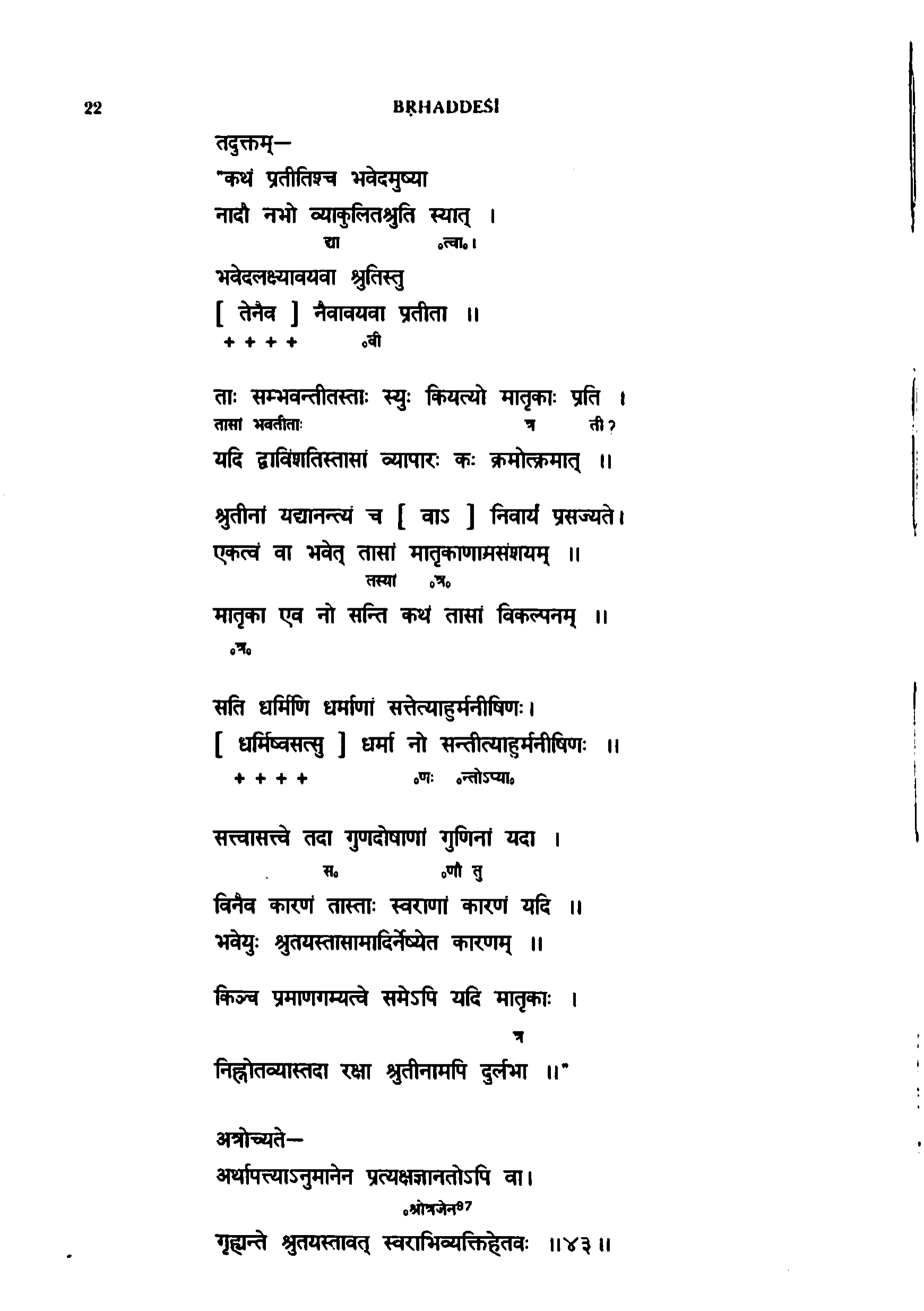
तदुक्तम्— "कथं प्रतीतिश्च भवेदमुष्या
नादौ नभो व्याकुलितश्रुतिरा स्यात्53ुत्वा, ।
भवेदलक्ष्यावयवा श्रुतिस्तु॰वी
[ तेनैव ] नैवावयवा प्रतीता ।।
ताः सम्भवन्तीतस्ताःतासा भवतीताः स्युः कियत्यो मातृकाः प्रतिती २
यदि द्वाविंशतिस्तासां व्यापारः कः क्रमोत्क्रमात्41
श्रुतीनां यद्यानन्त्यं च [ वाऽ ] निवार्यं प्रसज्यते।
एकत्वं वा भवेत् तासांतस्या मातृकाणामसंशयम् ॥
ুস্
मातृका एव नो सन्ति कथं तासां विकल्पनम्7
٥٣,
सित धर्मिणि धर्माणां सत्तेत्याहुर्मनीषिणः₀णः ₀न्तोऽप्या₃
[ धर्मिष्वसत्सु ] धर्मा नो सन्तीत्याहुर्मनीषिणः ।।
++++
सत्त्वासत्त्वे तदा गुणदोषाणां गुणिनां०णी तु यदा6
विनैव कारणं तास्ताः स्वराणां कारणं यदि ॥
भवेयुः श्रुतयस्तासामादिर्नेष्येत कारणम् ॥
किञ्च प्रमाणगम्यत्वे समेऽपि यदि मातृका2ः ।
निह्नोतव्यास्तदाअत्रोच्यते- रक्षा श्रुतीनामपि दुर्लभा ॥"
अर्थापत्त्याऽनुमानेन प्रत्यक्षज्ञानतोऽपि वा।
₀প্লাপ্রউন87 गृह्यन्ते श्रुतयस्तावत् स्वराभिव्यक्तिहेतवः9 118311
English — Sharma
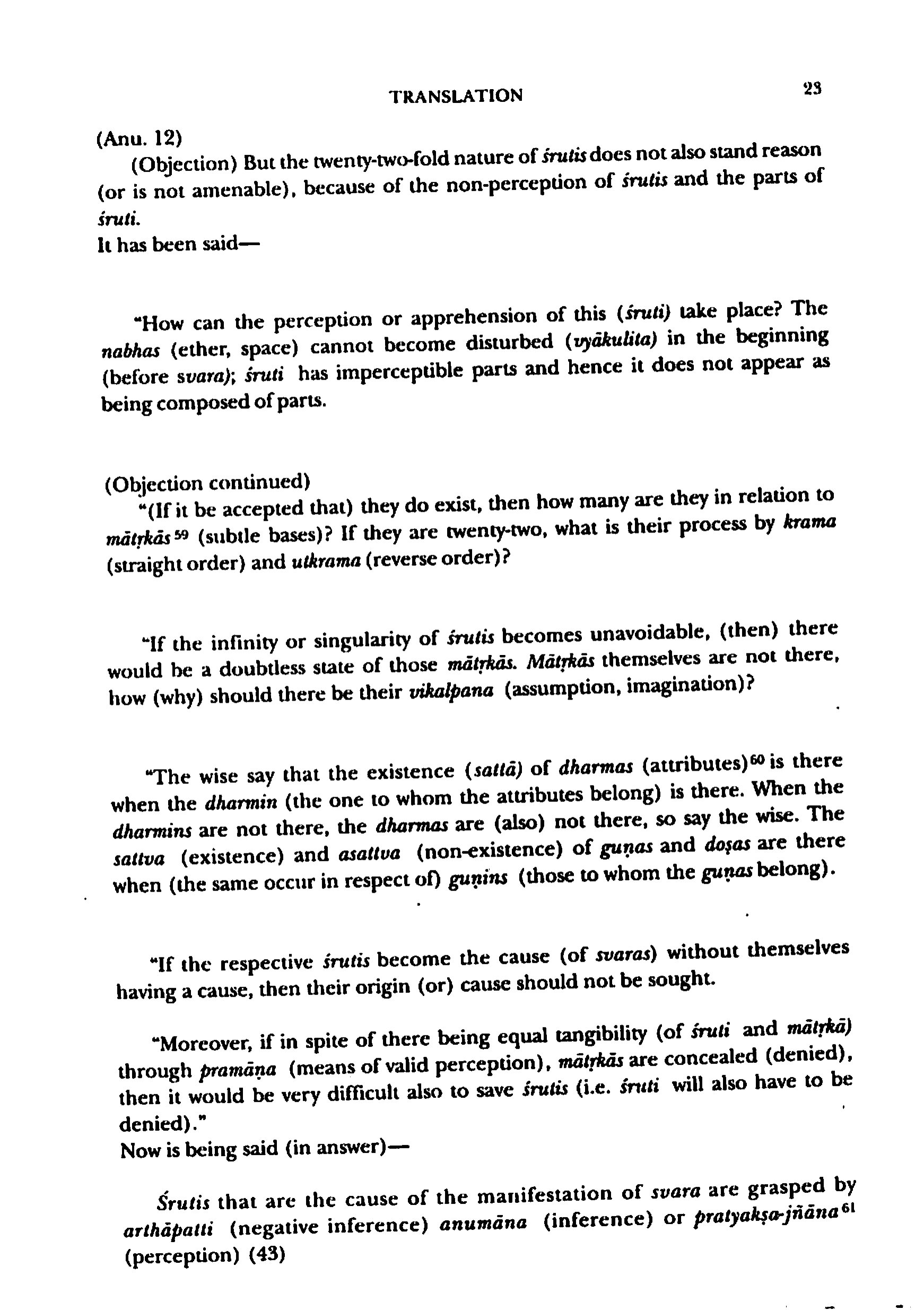
(Anu. 12) (Objection) But the twenty-two-fold nature of śrutis does not also stand reason (or is not amenable), because of the non-perception of srutis and the parts of śruli. It has been said— "How can the perception or apprehension of this (śruti) take place? The nabhas (ether, space) cannot become disturbed (vyākulita) in the beginning (before svara)53; śruti has imperceptible parts and hence it does not appear as being composed of parts.11 (Objection continued) "(If it be accepted that) they do exist, then how many are they in relation to mātṛkās4 59 (subtle bases)? If they are twenty-two, what is their process by krama (straight order) and utkrama (reverse order)?1 "If the infinity or singularity of śrutis becomes unavoidable, (then) there would be a doubtless state of those mātṛkās. Mātṛkās themselves are not there, how (why) should there be their vikalpana (assumption, imagination)?7 "The wise say that the existence (sattā) of dharmas (attributes) <math>^{60}</math> is there when the dharmin (the one to whom the attributes belong) is there. When the dharmins are not there, the dharmas are (also) not there, so say the wise. The sattva (existence) and asattva (non-existence) of gunas and dosas are there when (the same occur in respect of) gunins (those to whom the gunas belong).6 "If the respective śrutis become the cause (of svaras) without themselves having a cause, then their origin (or) cause should not be sought. "Moreover, if in spite of there being equal tangibility (of śruti and mātṛkā) through pramāņa (means of valid perception)2, mātṛkās are concealed (denied), then it would be very difficult also to save śrutis (i.e. śruti will also have to be denied)." Now is being said (in answer)— Srutis that are the cause of the manifestation of svara9 are grasped by arthāpatti (negative inference) anumāna (inference) or pratyakṣa-jñāna 61 (perception)8 (43)
1.[definition] Krama and utkrama are two orderings—straight and reverse—applicable to śrutisयदि द्वाविंशतिस्तासा व्यापारः कः क्रमोत्क्रमात्
2.[definition] Pramāņa refers to means of valid perception that provide equal tangibility to both śrutis and mātṛkāsकिञ्च प्रमाणगम्यत्वे समेऽपि यदि मातृका
3.[definition] Vyākulita means disturbed; ether cannot become disturbed before svara manifestsनादौ नभो व्याकुलितश्रुति स्यात्
4.[relation] Mātṛkās are subtle bases related to śrutis in a numeric correspondenceयदि द्वाविंशतिस्तासा व्यापारः कः क्रमोत्क्रमात्
5.[relation] Ether or space cannot become disturbed before the manifestation of svaraनादौ नभो व्याकुलितश्रुति स्यात्
6.[relation] Qualities (gunas) and defects (dosas) exist or do not exist according to the existence or non-existence of their possessor (gunin)सत्त्वासत्त्वे तदा गुणदोषाणा गुणिना यदा
7.[relation] Vikalpana (assumption or imagination) cannot apply when the bases themselves do not existमातृका एव नो सन्ति कथं तासा विकल्पनम्
9.[relation] Śrutis are the cause of the manifestation of svaraश्रुतयस्तावत् स्वराभिव्यक्तिहेतवः
1.[definition]Krama and utkrama are two orderings—straight and reverse—applicable to śrutiswhat is their process by krama (straight order) and utkrama (reverse order)?
2.[definition]Pramāņa refers to means of valid perception that provide equal tangibility to both śrutis and mātṛkāsif in spite of there being equal tangibility (of śruti and mātṛkā) through pramāņa (means of valid perception)
3.[definition]Vyākulita means disturbed; ether cannot become disturbed before svara manifestsThe nabhas (ether, space) cannot become disturbed (vyākulita) in the beginning (before svara)
4.[relation]Mātṛkās are subtle bases related to śrutis in a numeric correspondencehow many are they in relation to mātṛkās
5.[relation]Ether or space cannot become disturbed before the manifestation of svaraThe nabhas (ether, space) cannot become disturbed (vyākulita) in the beginning (before svara)
6.[relation]Qualities (gunas) and defects (dosas) exist or do not exist according to the existence or non-existence of their possessor (gunin)The sattva (existence) and asattva (non-existence) of gunas and dosas are there when (the same occur in respect of) gunins (those to whom the gunas belong).
7.[relation]Vikalpana (assumption or imagination) cannot apply when the bases themselves do not existMātṛkās themselves are not there, how (why) should there be their vikalpana (assumption, imagination)?
8.[relation]Śrutis are grasped through three means of valid perception: negative inference, logical inference, and direct perceptionSrutis that are the cause of the manifestation of svara are grasped by arthāpatti (negative inference) anumāna (inference) or pratyakṣa-jñāna (perception)
9.[relation]Śrutis are the cause of the manifestation of svaraSrutis that are the cause of the manifestation of svara
10.[relation]Attributes (dharmas) exist only when the subject to which they belong (dharmin) existsThe wise say that the existence (sattā) of dharmas (attributes) is there when the dharmin (the one to whom the attributes belong) is there.
11.[structural]Śrutis have imperceptible parts and do not appear as being composed of partsśruti has imperceptible parts and hence it does not appear as being composed of parts.