Source scans · vol_I_p021
recto · open full
scan recto
verso · open full
scan verso
Bṛhaddeśī · Volume I
pp. 24–25folio 021
Devanāgarī (Bṛhaddeśī)
[मण्डलप्रस्तारेण श्रुतीना निदर्शनम्]
[अनु. १३]
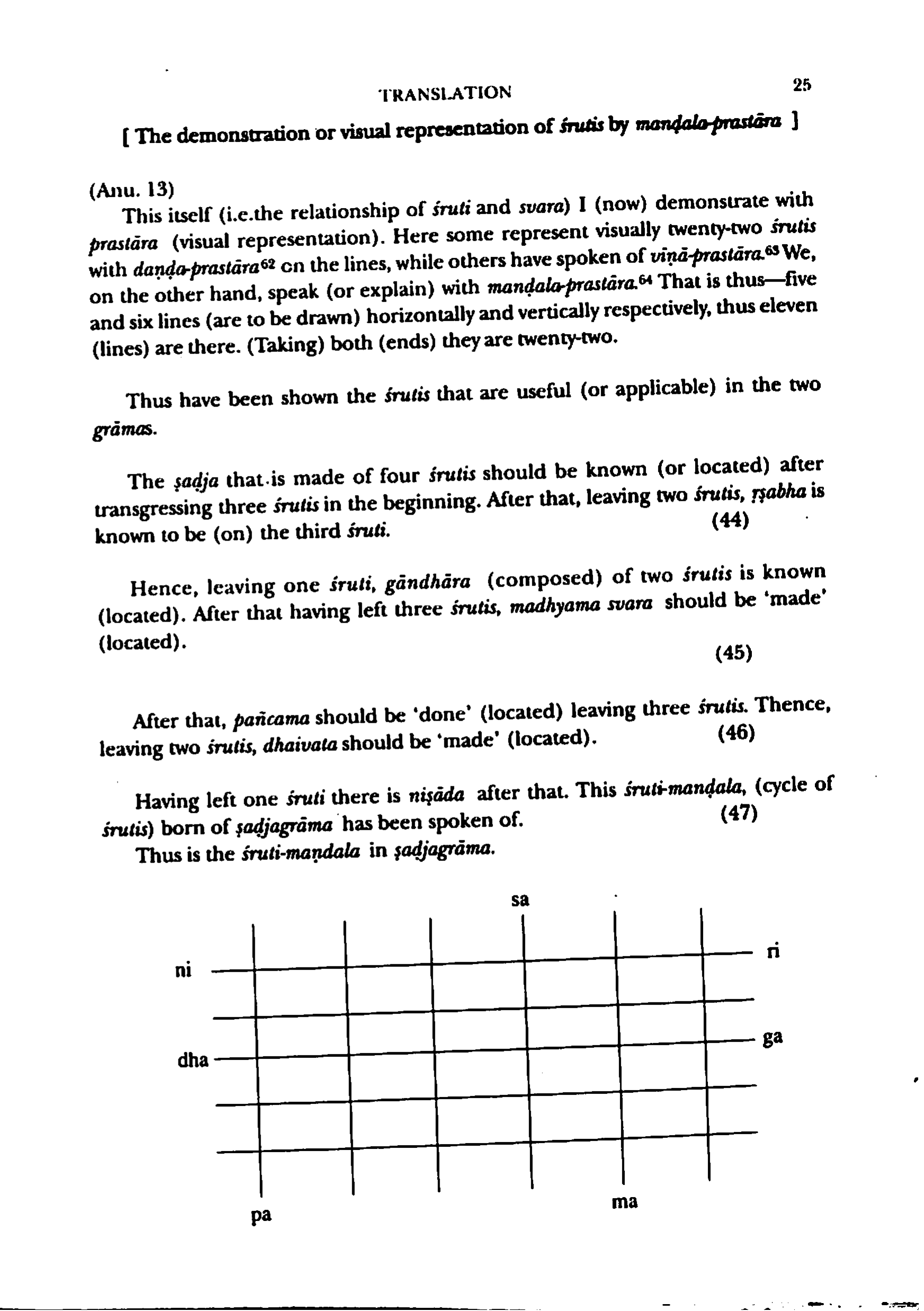
एतदेव स्पष्टीकरणार्थं प्रस्तारेण दर्शयामि2 । तत्र केचिद् दण्डप्रस्तारेण
दर्शयन्ति द्वाविंशति श्रुतयो रेखाणामिति4अन्ये तु वीणाप्रस्तारमाहु
तयः वयं पुनर्मण्डलप्रस्तारं बूमः5
। तथा हि—तिर्यगूर्ध्वं च पञ्च षड् रेखा
इत्येकादश । उभयतो द्वाविंशति8
एवं ग्रामद्वयेऽप्युपयोगिन्यः श्रुतय इति दर्शिता6
तद्यथा—
त्रिश्रुतीरतिक्रम्यादौ ज?्ञेयः षड्जश्चतुःश्रुति ।
₽रि दे तदूर्ध्वं द्वे ६६ १६ श्रुतीस्त्यक्त्वा तृतीया ऋषभो मतः॥४४॥ (तित्वा ? ती त्यक्त्वा) व्य
ततश्चैका श्रुति त्यक्त्वा गान्धारो द्विश्रुति स्मृतः11
तदनु त्रिश्रुतीस्त्यक्त्वा कर्त्तव्यो मध्यमस्वरः ॥४५॥ तदूर्ध्वं पञ्चमः कार्यः परित्यज्य श्रुतित्रयम्।13 श्रुतिद्वयं परित्यज्य कर्त्तव्यो धैवतस्ततः14॥४६॥ 89,স্ক एका श्रुति परित्यज्य निषादस्तदनन्तरम्।15 षड्जग्रामसमुद्भूत उक्तोऽसौ श्रुतिमण्डलः3॥४७॥ तद्यथा षड्जग्रामे श्रुतिमण्डलम् :— स नि रि घ ग प म
diagram
śrutimaṇḍala in ṣaḍjagrāma — Rectangular 2D grid diagram following the verse 'ṣaḍjagrāme śrutimaṇḍalam' (v.47). The seven svaras of ṣaḍjagrāma are placed at the periphery of a grid of horizontal and vertical lines representing the śruti distribution. Svaras placed: sa (स) top-center, ri (रि) right-upper, ga (ग) right-lower, ma (म) bottom-right, pa (प) bottom-left, dha (ध) left-lower, ni (नि) left-upper.
Rectangular grid (śrutimaṇḍala) with multiple parallel horizontal and vertical lines forming a 2D lattice. The seven svaras are inscribed at the outer borders of the grid in clockwise/counterclockwise positions corresponding to their śruti placement in ṣaḍjagrāma. Internal grid cells are not labelled but mark the śruti intervals.
Nodes: (top-center), (right-upper), (right-lower), (bottom-right), (bottom-left), (left-lower), (left-upper)
Total śrutis: ?
— ṣaḍjagrāme śrutimaṇḍalam
English — Sharma (translation)
[The demonstration or visual representation of śrutis by mandala-prastāra]
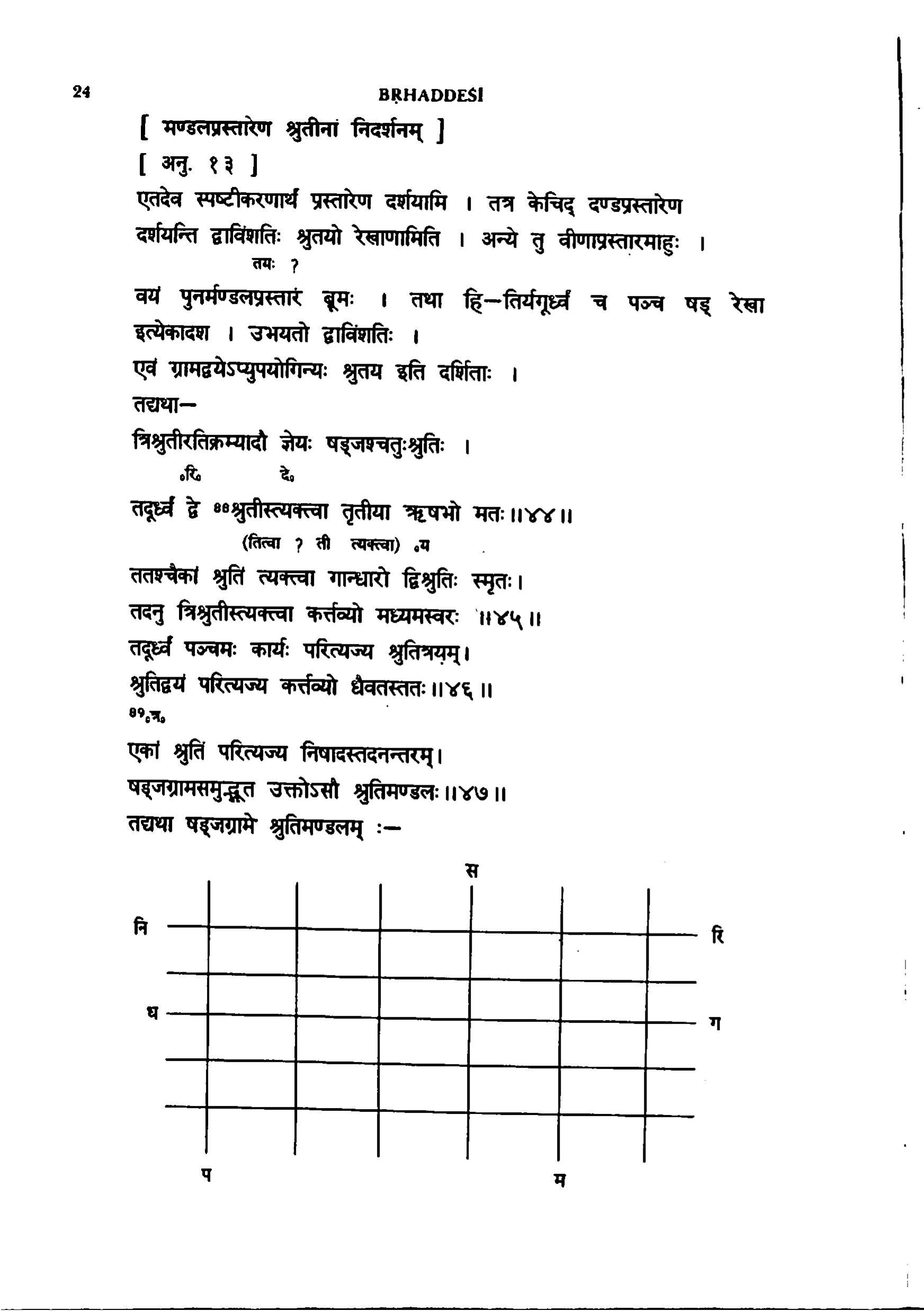
(Anu. 13) This itself (i.e.the relationship of śruti and svara) I (now) demonstrate with prastāra (visual representation).2 Here some represent visually twenty-two śrutis with danda-prastara62 on the lines4, while others have spoken of vina-prastara.63 We, on the other hand, speak (or explain) with mandala-prastara.564 That is thus—five and six lines (are to be drawn) horizontally and vertically respectively, thus eleven (lines) are there. (Taking) both (ends) they are twenty-two.8 Thus have been shown the śrutis that are useful (or applicable) in the two grāmas.6 The şadja that is made of four śrutis should be known (or located) after transgressing three śrutis in the beginning.9 After that, leaving two śrutis, ṛṣabha is
(44)
known to be (on) the third śruti.10
Hence, leaving one śruti, gāndhāra (composed) of two śrutis is known (located).11 After that having left three śrutis, madhyama svara should be 'made' (located).12
(45)
After that, pañcama should be 'done' (located) leaving three śrutis.13 Thence,
(46)
leaving two śrutis, dhaivata should be 'made' (located).14
Having left one śruti there is niṣāda after that.15 This śruti-mandala, (cycle of
(47)
śrutis) born of şadjagrāma has been spoken of. Thus is the śruti-mandala in sadjagrāma. sa n ni ga dha ma pa
diagram
śruti-maṇḍala — ṣaḍja-grāma
Rectangular grid diagram with 6 vertical / 5 horizontal lines labeled with svaras (ni, sa, ri on top; dha, ga, pa, ma at bottom) representing śruti distribution in ṣaḍja-grāma.
Nodes: pa (bottom-left), dha (bottom-center), ma (bottom-right), ni (top-left), sa (top-center), ri (top-right), ga (center)
Segments: padha; dhama; nisa; sari
— śruti-maṇḍala in ṣaḍja-grāma (inferred from context of Anu. 13)
2.[definition] Mandala-prastāra is a method of demonstrating the relationship between śrutis and svaras through visual representationएतदेव स्पष्टीकरणार्थं प्रस्तारेण दर्शयामि
3.[definition] Śruti-mandala is a cycle of śrutis that originates from or is generated by śadjagrāmaषड्जग्रामसमुद्भूत उक्तोऽसौ श्रुतिमण्डलः
4.[relation] Danda-prastara is an alternative method of representing twenty-two śrutis on linesकेचिद् दण्डप्रस्तारेण दर्शयन्ति द्वाविंशति श्रुतयो रेखाणामिति
5.[relation] Vina-prastara is another method of representing śrutis, distinct from both danda-prastara and mandala-prastaraअन्ये तु वीणाप्रस्तारमाहु । तयः वयं पुनर्मण्डलप्रस्तारं बूमः
6.[relation] The śrutis represented by mandala-prastāra are applicable or useful in both grāmas (the two grāma system)एवं ग्रामद्वयेऽप्युपयोगिन्यः श्रुतय इति दर्शिता
7.[relation]The śruti-mandala described in this section is generated from or originates in śadjagrāmaषड्जग्रामसमुद्भूत उक्तोऽसौ श्रुतिमण्डलः
8.[structural] Mandala-prastāra is constructed with five and six lines drawn horizontally and vertically respectively, totaling eleven lines, which when both ends are taken yields twenty-twoतिर्यगूर्ध्वं च पञ्च षड् रेखा इत्येकादश । उभयतो द्वाविंशति
11.[structural] In mandala-prastāra, gāndhāra is composed of two śrutis and is located after leaving one śrutiततश्चैका श्रुति त्यक्त्वा गान्धारो द्विश्रुति स्मृतः
12.[structural] In mandala-prastāra, madhyama is located after leaving three śrutis from gāndhāraततश्चैका श्रुति त्यक्त्वा गान्धारो द्विश्रुति स्मृतः। तदनु त्रिश्रुतीस्त्यक्त्वा कर्त्तव्यो मध्यमस्वरः
13.[structural] In mandala-prastāra, pañcama is located after leaving three śrutis from madhyamaतदूर्ध्वं पञ्चमः कार्यः परित्यज्य श्रुतित्रयम्।
14.[structural] In mandala-prastāra, dhaivata is located after leaving two śrutis from pañcamaश्रुतिद्वयं परित्यज्य कर्त्तव्यो धैवतस्ततः
15.[structural] In mandala-prastāra, niṣāda is located after leaving one śruti from dhaivataएका श्रुति परित्यज्य निषादस्तदनन्तरम्।
1.[attribution]The Bṛhaddeśī contains teachings on the mandala-prastāra method for demonstrating śrutis and their relationship to svarasBRHADDESI
2.[definition]Mandala-prastāra is a method of demonstrating the relationship between śrutis and svaras through visual representationThis itself (i.e.the relationship of śruti and svara) I (now) demonstrate with prastāra (visual representation).
3.[definition]Śruti-mandala is a cycle of śrutis that originates from or is generated by śadjagrāmaThis śruti-mandala, (cycle of śrutis) born of şadjagrāma has been spoken of.
4.[relation]Danda-prastara is an alternative method of representing twenty-two śrutis on linessome represent visually twenty-two śrutis with danda-prastara62 on the lines
5.[relation]Vina-prastara is another method of representing śrutis, distinct from both danda-prastara and mandala-prastarawhile others have spoken of vina-prastara.63 We, on the other hand, speak (or explain) with mandala-prastara.
6.[relation]The śrutis represented by mandala-prastāra are applicable or useful in both grāmas (the two grāma system)Thus have been shown the śrutis that are useful (or applicable) in the two grāmas.
8.[structural]Mandala-prastāra is constructed with five and six lines drawn horizontally and vertically respectively, totaling eleven lines, which when both ends are taken yields twenty-twofive and six lines (are to be drawn) horizontally and vertically respectively, thus eleven (lines) are there. (Taking) both (ends) they are twenty-two.
9.[structural]In mandala-prastāra, śadja is located after transgressing three śrutis and is composed of four śrutisThe şadja that is made of four śrutis should be known (or located) after transgressing three śrutis in the beginning.
10.[structural]In mandala-prastāra, ṛṣabha is located on the third śruti after leaving two śrutis from the previous positionAfter that, leaving two śrutis, ṛṣabha is (44) known to be (on) the third śruti.
11.[structural]In mandala-prastāra, gāndhāra is composed of two śrutis and is located after leaving one śrutiHence, leaving one śruti, gāndhāra (composed) of two śrutis is known (located).
12.[structural]In mandala-prastāra, madhyama is located after leaving three śrutis from gāndhāraAfter that having left three śrutis, madhyama svara should be 'made' (located).
13.[structural]In mandala-prastāra, pañcama is located after leaving three śrutis from madhyamaAfter that, pañcama should be 'done' (located) leaving three śrutis.
14.[structural]In mandala-prastāra, dhaivata is located after leaving two śrutis from pañcamaThence, (46) leaving two śrutis, dhaivata should be 'made' (located).
15.[structural]In mandala-prastāra, niṣāda is located after leaving one śruti from dhaivataHaving left one śruti there is niṣāda after that.