Source scans · vol_I_p074
recto · open full
scan recto
verso · open full
scan verso
Bṛhaddeśī · Volume I
pp. 1–4folio 074
Bṛhaddeśī
T. • · · • • . • • • . •
translation
Pātha-Vimarša (TEXTUAL NOTES)1
Chapter I
Section I ( Desi)
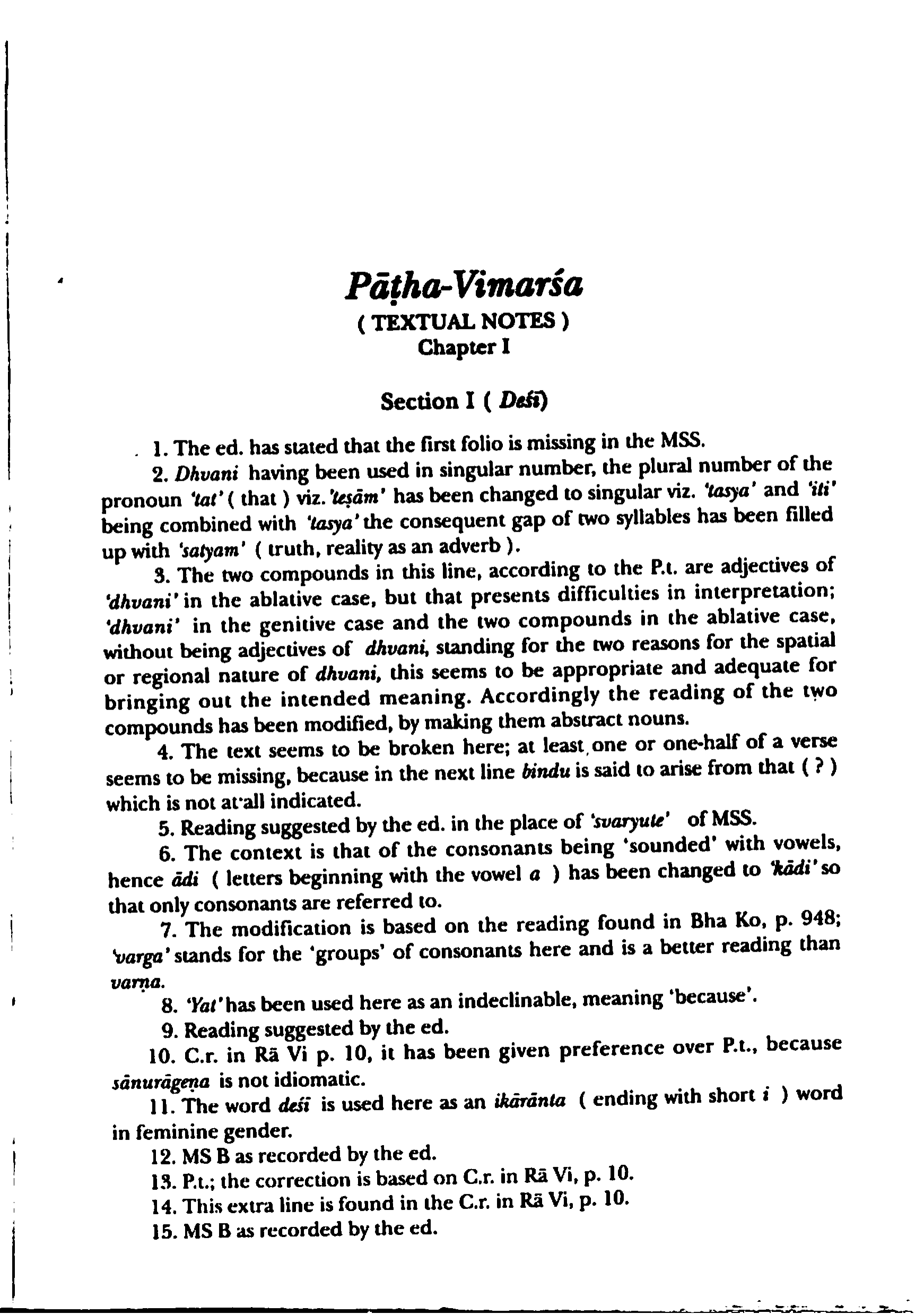
1. The ed. has stated that the first folio is missing in the MSS.10 2. Dhvani having been used in singular number, the plural number of the pronoun 'tat' (that) viz. 'teṣām' has been changed to singular viz. 'tasya'7 and 'iti' being combined with 'tasya' the consequent gap of two syllables has been filled up with 'satyam' (truth, reality as an adverb). 3. The two compounds in this line, according to the P.t. are adjectives of 'dhvani' in the ablative case, but that presents difficulties in interpretation; 'dhvani' in the genitive case and the two compounds in the ablative case, without being adjectives of dhvani, standing for the two reasons for the spatial or regional nature of dhvani8, this seems to be appropriate and adequate for bringing out the intended meaning. Accordingly the reading of the two compounds has been modified, by making them abstract nouns. 4. The text seems to be broken here; at least one or one-half of a verse seems to be missing, because in the next line bindu is said to arise from that (?) which is not at all indicated.6 5. Reading suggested by the ed. in the place of 'svaryute' of MSS. 6. The context is that of the consonants being 'sounded' with vowels, hence \bar{a}di (letters beginning with the vowel a ) has been changed to k\bar{a}di' so that only consonants are referred to. 7. The modification is based on the reading found in Bha Ko, p. 948;2 'varga' stands for the 'groups' of consonants here and is a better reading than varna.5 8. 'Yat' has been used here as an indeclinable, meaning 'because'. 9. Reading suggested by the ed. 10. C.r. in Rä Vi p. 10, it has been given preference over P.t., because sānurāgeņa is not idiomatic. 11. The word desi is used here as an ikārānta (ending with short i) word in feminine gender.9 12. MS B as recorded by the ed. 13. P.t.; the correction is based on C.r. in Rā Vi, p. 10. 14. This extra line is found in the C.r. in Rā Vi, p. 10.3 15. MS B as recorded by the ed.

1.[attribution]Pātha-Vimarša is the title of a textual commentary or critical apparatus on a musical treatisePātha-Vimarša (TEXTUAL NOTES)
2.[citation]Bha Ko is cited as a source for textual readings, specifically regarding the reading of vargaThe modification is based on the reading found in Bha Ko, p. 948;
3.[citation]An extra line is found in the commentary in Rā Vi at page 10This extra line is found in the C.r. in Rā Vi, p. 10.
4.[citation]Rā Vi is cited as a source for alternative and preferred textual readings at page 10C.r. in Rā Vi p. 10, it has been given preference over P.t.
5.[definition]varga designates groups of consonants and is preferred over the variant reading varna'varga' stands for the 'groups' of consonants here and is a better reading than varna.
6.[relation]bindu is said to arise from something in the text, but the prior source material is fragmentary or missingat least one or one-half of a verse seems to be missing, because in the next line bindu is said to arise from that (?) which is not at all indicated.
7.[structural]dhvani is used in singular number in the source text and relates to spatial or regional propertiesDhvani having been used in singular number, the plural number of the pronoun 'tat' (that) viz. 'teṣām' has been changed to singular viz. 'tasya'
8.[structural]dhvani is understood in the genitive case and has spatial or regional nature with two reasons for this distinction'dhvani' in the genitive case and the two compounds in the ablative case, without being adjectives of dhvani, standing for the two reasons for the spatial or regional nature of dhvani
9.[structural]Desi is used as an ikārānta (ending with short i) word in feminine genderThe word desi is used here as an ikārānta (ending with short i) word in feminine gender.
10.[structural]The first folio of the manuscript source is missing according to editorial notesThe ed. has stated that the first folio is missing in the MSS.