Source scans · vol_I_p075
recto · open full
scan recto
verso · open full
scan verso
Bṛhaddeśī · Volume I
pp. 1–133folio 075
Pāṭha-vimarśa — recto
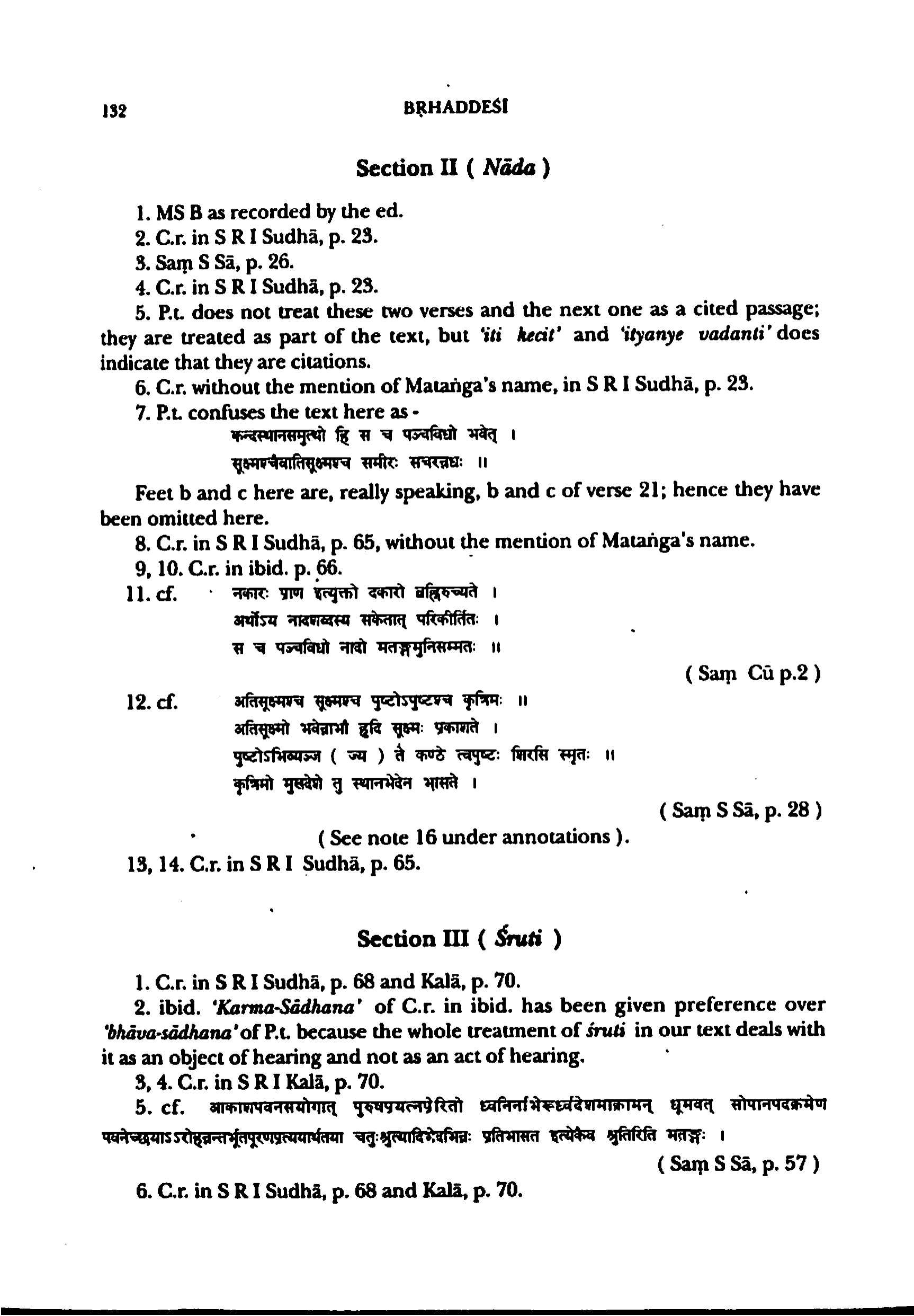
Section II ( Nada )
1. MS B as recorded by the ed. 2. C.r. in S R I Sudhā, p. 23. 3. Sam S Sā, p. 26. 4. C.r. in S R I Sudhä, p. 23. 5. P.t. does not treat these two verses and the next one as a cited passage; they are treated as part of the text, but 'iti kecit' and 'ityanye vadanti' does indicate that they are citations. 6. C.r. without the mention of Matanga's name, in S R I Sudhā, p. 23. 7. P.t. confuses the text here as -
कन्दस्थानसमुत्थो हि स च पञ्चविद्यो भवेत् ।
सुक्ष्मण्ज?ैवातिसुक्ष्मण्च समीरः सचरन्नधः ॥
Feet b and c here are, really speaking, b and c of verse 21; hence they have been omitted here. 8. C.r. in S R I Sudhā, p. 65, without the mention of Matanga's name. 9, 10. C.r. in ibid. p. 66.
11. cf. · नकारः प्राण इत्युक्तो6 दकारो ब्रह्मिरुच्यते ।
अर्थोऽय नादणव्यस्य सकेतात् परिकीर्तितः ।
स च पञ्चिवधो नादो मतङ्गमुनिसम्मतः ॥1 (Sam Cū p.2) अतिसूक्ष्मश्च सूक्ष्मश्च पुष्टोऽपुष्टश्च कृत्रिमः ॥7 12. cf.
अतिसूक्ष्मो भवेद्राभी हृदि सूक्ष्मः प्रकाशते ।
पुष्टोऽभिव्यञ्ज? ( ज?्य ) ते कण्ठे त्वपुष्टः शिरसि स्मृतः ॥
कृत्रिमो मुसदेशे तु स्थानभेदेन भासते ।
( Sam S Sā, p. 28 ) (See note 16 under annotations). 13, 14. C.r. in S R I Sudhā, p. 65.
Section III ( Śruti )
1. C.r. in S R I Sudhä, p. 68 and Kalä, p. 70. 2. ibid. 'Karma-Sādhana' of C.r. in ibid. has been given preference over 'bhāva-sādhana' of P.t. because the whole treatment of sruti in our text deals with it as an object of hearing and not as an act of hearing. 3, 4. C.r. in S R I Kalā, p. 70. 5. cf. आकाशपवनसयोगात् पुरुषप्रयत्नप्रेरितो ध्वनिर्नाभेक्ध्वदेशमाक्रामन् धूमवत् सोपानपदक्रमेण
पयनेच्छयाऽऽरोहव्रन्तर्भृतपुरणप्रत्ययार्थतया चतुःश्रुत्यादिशेदभिवः प्रतिभासत इत्येकैय श्रुतिरिति मतङ्गः ।
( Sam S Sā, p. 57 ) 6. C.r. in S R I Sudhā, p. 68 and Kalā, p. 70.
Pāṭha-vimarśa — verso
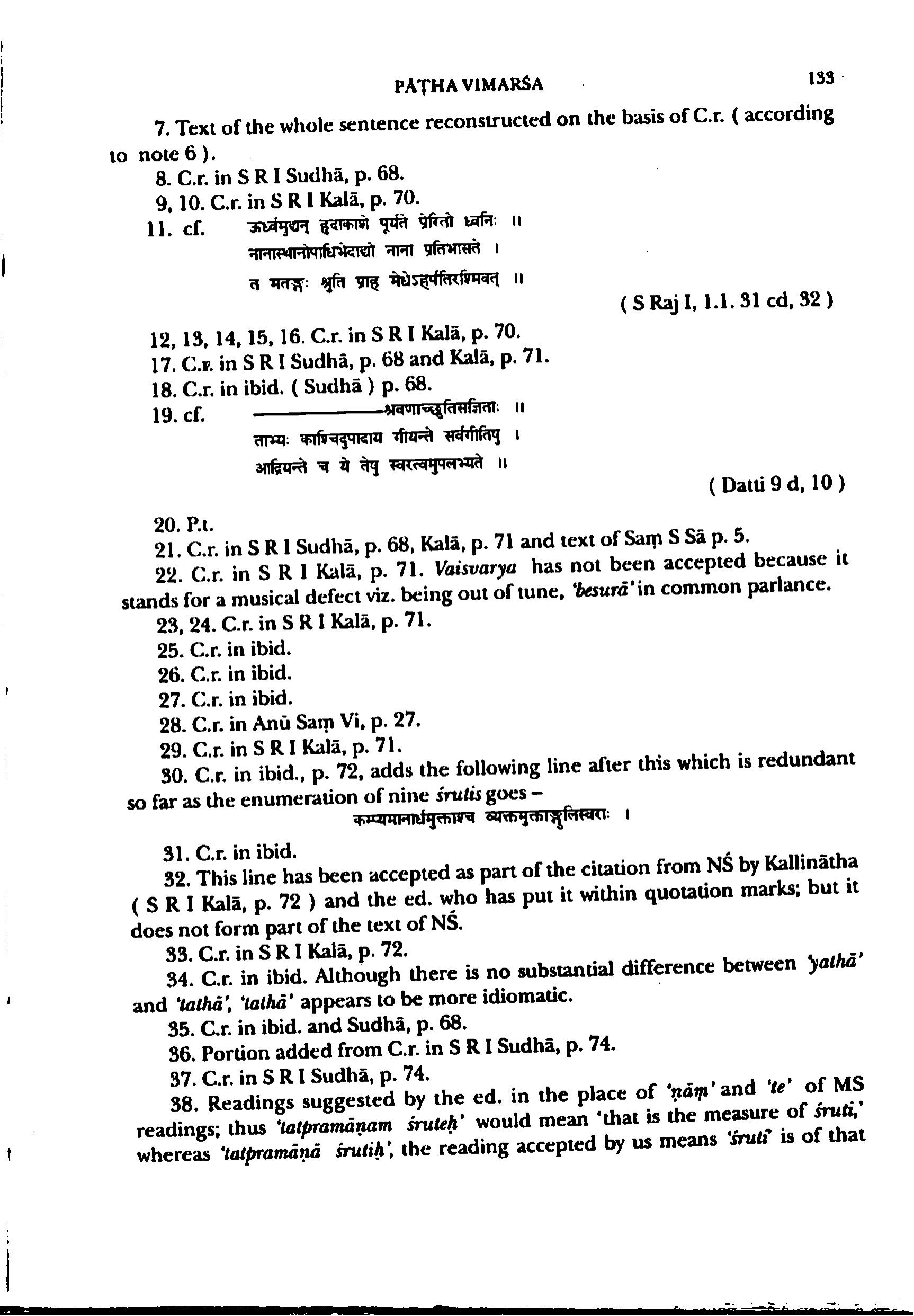
7. Text of the whole sentence reconstructed on the basis of C.r. ( according to note 6). 8. C.r. in S R I Sudhā, p. 68. 9, 10. C.r. in S R I Kalā, p. 703.
ऊर्ध्वमुखन् हुदाकाणे पूर्वते प्रेरितो ध्वनि ॥
11. cf.
नानास्थानोपाधिभेदाचो नाना प्रतिभासते ।
त मतङ्गः श्रुति प्राह मेधेऽहर्पतिरश्मिवत् ॥
(S Raj I, 1.1. 31 cd, 32) 12, 13, 14, 15, 16. C.r. in S R I Kalā, p. 70. 17. C.r. in S R I Sudhā, p. 68 and Kalā, p. 71. 18. C.r. in ibid. ( Sudhā ) p. 68.
—श्रवणाच्छ्तिसज्ञिता ॥
19. cf.
ताभ्यः काष्ट्रिचदुपादाय गीयन्ते सर्वगीतिषु ।
आद्रियन्ते च ये तेषु स्वरत्वमुपलभ्यते ॥
( Datti 9 d, 10 ) 20. P.t. 21. C.r. in S R I Sudhā, p. 68, Kalā, p. 71 and text of Sam S Sā p. 5. 22. C.r. in S R I Kalā, p. 71. Vaisvarya has not been accepted because it stands for a musical defect viz. being out of tune, 'besurā' in common parlance. 23, 24. C.r. in S R I Kalā, p. 71. 25. C.r. in ibid. 26. C.r. in ibid. , 27. C.r. in ibid. 28. C.r. in Anū Sam Vi, p. 27. 29. C.r. in S R I Kalā, p. 71. 30. C.r. in ibid., p. 72, adds the following line after this which is redundant so far as the enumeration of nine śrutis goes -
कम्प्यमानार्धमुक्ताश्च व्यक्तमुक्ताङ्ग्लिखरा ।
31. C.r. in ibid. 32. This line has been accepted as part of the citation from NS by Kallinātha2 (SRI Kalā, p. 72) and the ed. who has put it within quotation marks; but it does not form part of the text of NS. 33. C.r. in S R I Kalā, p. 72. 34. C.r. in ibid. Although there is no substantial difference between 'yathā' and 'tathā', 'tathā' appears to be more idiomatic. 35. C.r. in ibid. and Sudhā, p. 68. 36. Portion added from C.r. in S R I Sudhā, p. 74. 37. C.r. in S R I Sudhā, p. 74. 38. Readings suggested by the ed. in the place of 'nām' and 'te' of MS readings; thus 'tatpramāṇam śruteḥ' would mean 'that is the measure of śruti,' whereas 'tatpramāṇā śrutiḥ', the reading accepted by us means 'śruti' is of that
1.[attribution]Matanga is the author of the Brihaddesi and proposes a five-fold classification of nadaस च पञ्चिवधो नादो मतङ्गमुनिसम्मतः ॥
6.[definition]The letter 'na' (नकारः) is identified with praan (breath/life force)नकारः प्राण इत्युक्तो
7.[enumeration]The five varieties of nada are enumerated as: atisukhma (subtlest), sukhma (subtle), pushta (nourished), apushta (not nourished), and krtrim (artificial)अतिसूक्ष्मश्च सूक्ष्मश्च पुष्टोऽपुष्टश्च कृत्रिमः ॥
8.[relation]Panchavidy (five-fold classification) relates to the five varieties of nada recognized by Matangaस च पञ्चिवधो नादो मतङ्गमुनिसम्मतः ॥
2.[attribution]Kallinatha is an editor/commentator who accepted a line from the Natyashastra as part of the sruti discussionThis line has been accepted as part of the citation from NS by Kallinātha (SRI Kalā, p. 72)
3.[citation]SRI Kala is cited as a source text for multiple passages on nada and srutiC.r. in S R I Kalā, p. 70
4.[citation]SRI Sudha contains cross-references and citations relevant to the Brihaddesi's treatment of nada and srutiC.r. in S R I Sudhā, p. 23
5.[citation]Samgitasara (Sam S Sa) is cited as a source containing related material on the five-fold nada classification(Sam S Sā, p. 28 )
9.[relation]Karma-Sadhana is preferred over bhava-sadhana for treating sruti as an object of hearing rather than as an act of hearing'Karma-Sādhana' of C.r. in ibid. has been given preference over 'bhāva-sādhana' of P.t. because the whole treatment of sruti in our text deals with it as an object of hearing and not as an act of hearing.
10.[structural]The Brihaddesi is divided into sections including Nada (sound) and Sruti (microtonal intervals)BRHADDESI 132 Section II ( Nada ) ... Section III ( Śruti )