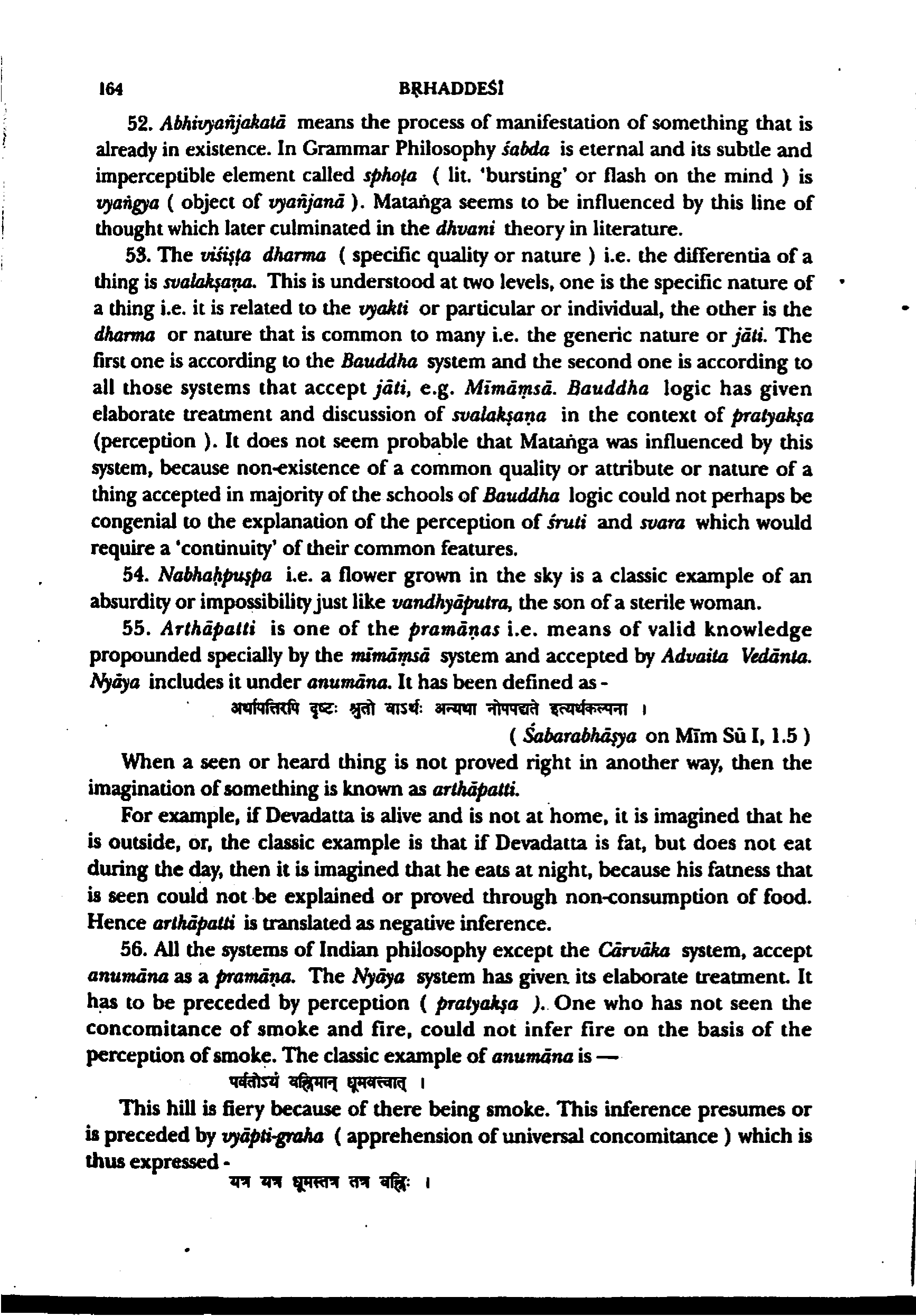
52.
Abhivyañjakatā means the process of manifestation of something that is
already in existence. In Grammar Philosophy śabda is eternal and its subtle and
imperceptible element called sphota (lit. 'bursting' or flash on the mind) is
vyangya (object of
vyanjanā).
Matanga seems to be influenced by this line of
thought which later culminated in the
dhvani theory in literature.
53. The visista dharma (specific quality or nature) i.e. the differentia of a
thing is
svalakṣaṇa. This is understood at two levels, one is the specific nature of
a thing i.e. it is related to the
vyakti or particular or individual, the other is the
dharma or nature that is common to many i.e. the generic nature or jāti. The
first one is according to the
Bauddha system and the second one is according to
all those systems that accept jāti, e.g. Mīmāṃsā. Bauddha logic has given
elaborate treatment and discussion of
svalakşana in the context of
pratyakşa
(perception ). It does not seem probable that
Matanga was influenced by this
system, because non-existence of a common quality or attribute or nature of a
thing accepted in majority of the schools of Bauddha logic could not perhaps be
congenial to the explanation of the perception of sruti and svara which would
require a 'continuity' of their common features.
54.
Nabhaḥpuṣpa i.e. a flower grown in the sky is a classic example of an
absurdity or impossibility just like
vandhyāputra, the son of a sterile woman.
55.
Arthāpatti is one of the pramāņas i.e. means of valid knowledge
propounded specially by the mimāmsā system and accepted by
Advaita Vedānta.
Nyāya includes it under anumāna. It has been defined as -
अर्थापतिरपि दृष्टः श्रुतो वाऽर्थः अन्यथा नोपपद्यते इत्यर्थकल्पना ।
(
Śabarabhāṣya on Mīm Sū I, 1.5 )
When a seen or heard thing is not proved right in another way, then the
imagination of something is known as
arthāpatti.
For example, if Devadatta is alive and is not at home, it is imagined that he
is outside, or, the classic example is that if Devadatta is fat, but does not eat
during the day, then it is imagined that he eats at night, because his fatness that
is seen could not be explained or proved through non-consumption of food.
Hence
arthāpatti is translated as negative inference.
56. All the systems of Indian philosophy except the
Carvaka system, accept
anumāna as a pramāņa. The Nyāya system has given its elaborate treatment. It
has to be preceded by perception ( pratyaksa ). One who has not seen the
concomitance of smoke and fire, could not infer fire on the basis of the
perception of smoke. The classic example of anumana is —
पर्वतोऽयं विश्वमान् धूमवत्त्वात् ।
This hill is fiery because of there being smoke. This inference presumes or
is preceded by
vyāpti-graha (apprehension of universal concomitance) which is
thus expressed -
यत्र यत्र धूमस्तत्र तत्र बह्निः ।