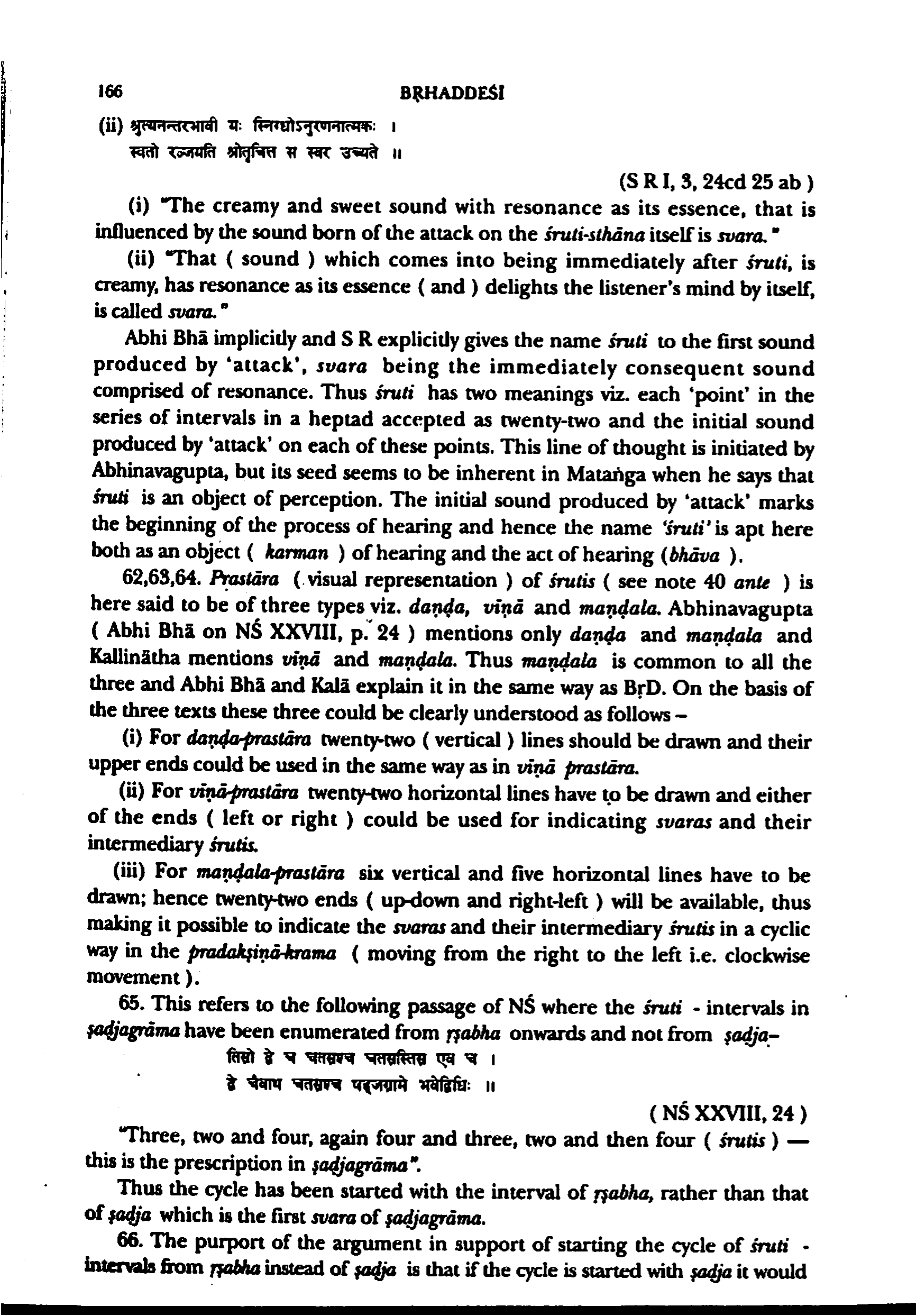
(ii) श्रुत्यनन्तरभावी यः स्निग्धोऽनुरणनात्मकः ।
स्वतो रञ्जयति श्रोतृचित्त स स्वर उच्यते
4 ॥
(SRI, 3, 24cd 25 ab)
(i) "The creamy and sweet sound with resonance as its essence, that is
influenced by the sound born of the attack on the śruti-sthāna itself is svara. "
(ii) "That (sound) which comes into being immediately after śruti, is
creamy, has resonance as its essence (and) delights the listener's mind by itself,
is called svara."
Abhi Bhā implicitly and S R explicitly gives the name śruti to the first sound
produced by 'attack', svara being the immediately consequent sound
comprised of resonance. Thus śruti has two meanings viz. each 'point' in the
series of intervals in a heptad accepted as twenty-two and the initial sound
produced by 'attack' on each of these points. This line of thought is initiated by
Abhinavagupta, but its seed seems to be inherent in
Matanga when he says that
struti is an object of perception. The initial sound produced by 'attack' marks
the beginning of the process of hearing and hence the name 'sruti' is apt here
both as an object ( karman ) of hearing and the act of hearing (bhāva ).
62,63,64.
Prastāra (visual representation) of śrutis (see note 40 ante) is
here said to be of three types viz. daņļa, viņā and maņļala.
Abhinavagupta
(
Abhi Bhā on NŚ XXVIII, p. 24) mentions only danda and mandala and
Kallinātha mentions viņā and maņļala. Thus maņļala is common to all the
three and
Abhi Bhā and Kalā explain it in the same way as BrD. On the basis of
the three texts these three could be clearly understood as follows -
(i) For
danda-prastara twenty-two (vertical) lines should be drawn and their
upper ends could be used in the same way as in
viņā prastāra.
(ii) For viņā-
prastāra twenty-two horizontal lines have to be drawn and either
of the ends (left or right) could be used for indicating svaras and their
intermediary śrutis.
(iii) For
mandala-prastara six vertical and five horizontal lines have to be
drawn; hence twenty-two ends ( up-down and right-left ) will be available, thus
making it possible to indicate the svaras and their intermediary śrutis in a cyclic
way in the
pradakṣiṇā-krama (moving from the right to the left i.e. clockwise
movement).
65. This refers to the following passage of NS where the śruti - intervals in
şadjagrāma have been enumerated from şadja-
तिसो दे च चतस्रश्च चतस्रस्तिस एव च ।
हे चैवाय चतसम्ब पद्जग्रामे भवेद्विधि
12 ॥
(
NŚ XXVIII, 24 )
"Three, two and four, again four and three, two and then four ( śrutis ) —
this is the prescription in
sadjagrāma".
Thus the cycle has been started with the interval of rsabha, rather than that
of şadja which is the first svara of
şadjagrāma.
66. The purport of the argument in support of starting the cycle of sruti -
intervals from rabha instead of sadja is that if the cycle is started with sadja it would