Source scans · vol_I_p099
recto · open full
scan recto
verso · open full
scan verso
Bṛhaddeśī · Volume I
pp. 1–181folio 099
Devanāgarī
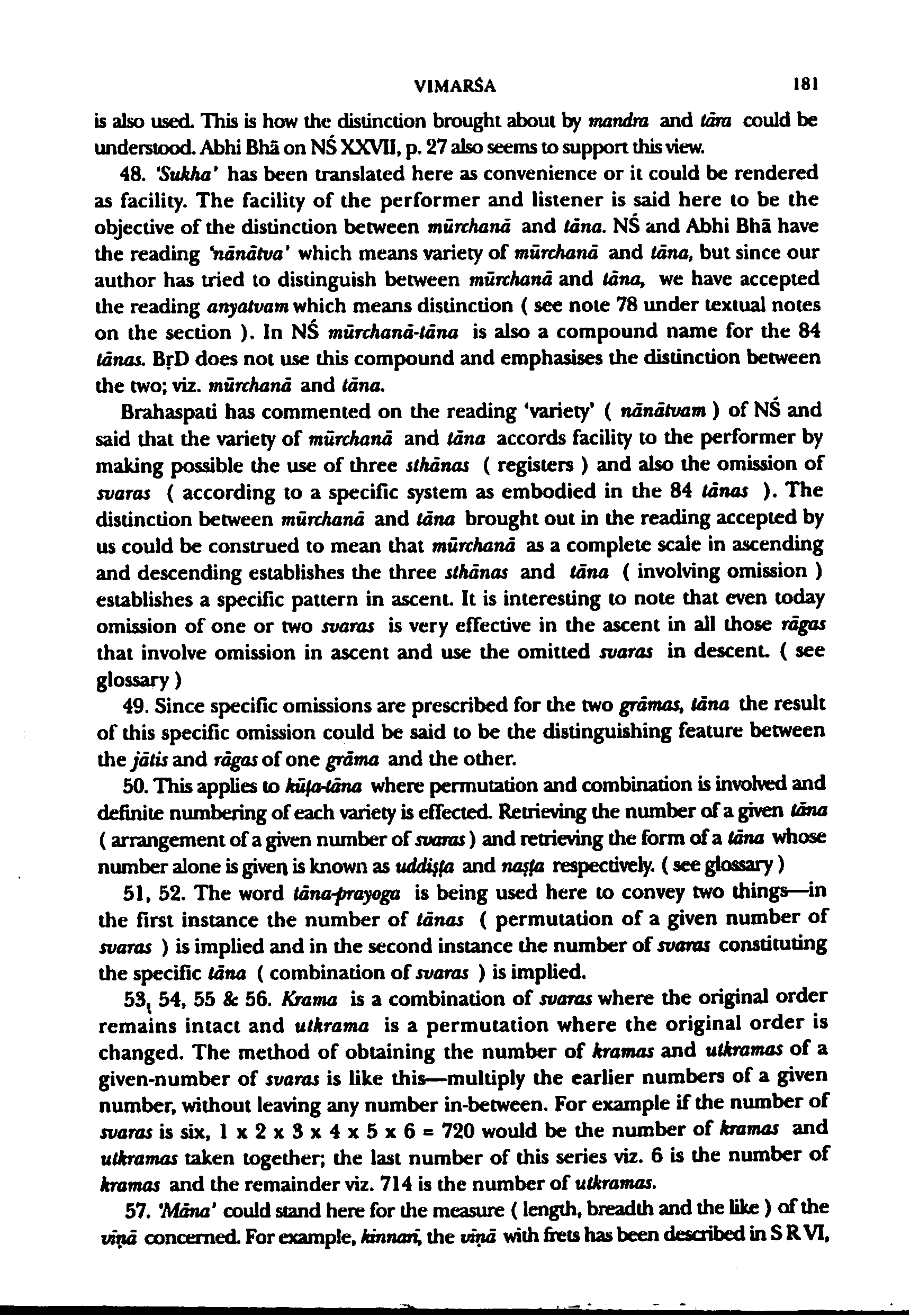
BRHADDEŚ1 mūrchanā). No later author has repeated this statement of BrD. Kumbhā has positively said that no murchana could begin with antara or kakali, without mentioning that Matanga has accepted this. A different interpretation could resolve this contradiction and that is thus—the mūrchanās meant to begin with antara and kākalī are included in the sādharaņa-mūrchanās i.e. the mūrchanā meant to begin with antara 'ga' will begin with the normal 'ga' and take only hākali 'ni' and the mūrchanā meant to begin with kākali 'ni' will begin with the normal 'ni' and take antara 'ga'. This interpretation is corroborated by Kallinātha (SRI Kalā, p. 108). 41. The performance of tana is being discussed here in the context of an open-stringed viṇā, where there is a separate string for each svara. 42. The string on which the svara to be omitted is tuned has to be 'merged' into the next higher or previous lower string by retuning for 'augmenting' or 'lowering' respectively. 43. The reference is obviously to NS XVII, 106 -
शारीर्यामध बीणाया त्रिभ्यः स्थानेभ्य एव तु ।
उरसः शिरसः कण्ठात् स्वरः काफु प्रवर्तते ॥
"In the śārīrī (bodily) viņā the svara or kāku (tonal inflexion) proceeds from three sthānas alone; viz. chest, cerebrum and throat". 44, 45. In the context of the act of omission, nigraha has been explained as a way of omitting a svara viz. 'non-touching' of the string that is tuned to the svara to be omitted. But here nigraha is paired with paryagraha as an alternative ( va ) and the pair has been explained by Abhinavagupta ( vide Abhi Bha on NS XXVIII, p. 27); nigraha as standing for use of low svaras ( mandrakriyā ) and paryagraha as standing for the use of high svaras ( tārakriyā ). The other explanation given by him is that nigraha is graha (taking up) in totality and paryagraha is absence of taking up in totality i.e. nigraha is associated with pūrņasvaratā (complete use of svaras) and paryagraha with apūrņasvaratā (incomplete use of svaras). Madhyama is indestructible or non-omissible whether there is complete or incomplete use of svaras. 46. The tonal range of the human voice is limited; in most of the cases it may not completely cover the three registers. But in viņā there is no such limitation. In open-stringed instruments, twenty-one strings would complete three sthanas. Abhinavagupta has given the name mattakokilā for the twenty-one-stringed viņā (vide Abhi Bhā on NŠ XXVIII, 112, p. 122). In the rudraviņā (of zither type) described in texts of the 16th and 17th centuries, there are four registers, the anumandra (lower than lower) being the fourth one. 47. The purport is that in the first murchana beginning with sadja if sadja is omitted, the omitted svara will be mandra (low, the first one); but when sadja is omitted in the seventh murchanā beginning with rsabha, then the omitted svara will be in tāra (high, the seventh one ). In writing, both will look alike; in hearing also the omission of the lower sadja will become clear if its previous svara viz. low nisāda is also used, similarly the omission of the higher sadja will become obvious if the next svara viz.high rsabha
English — Sharma (Vimarśa)
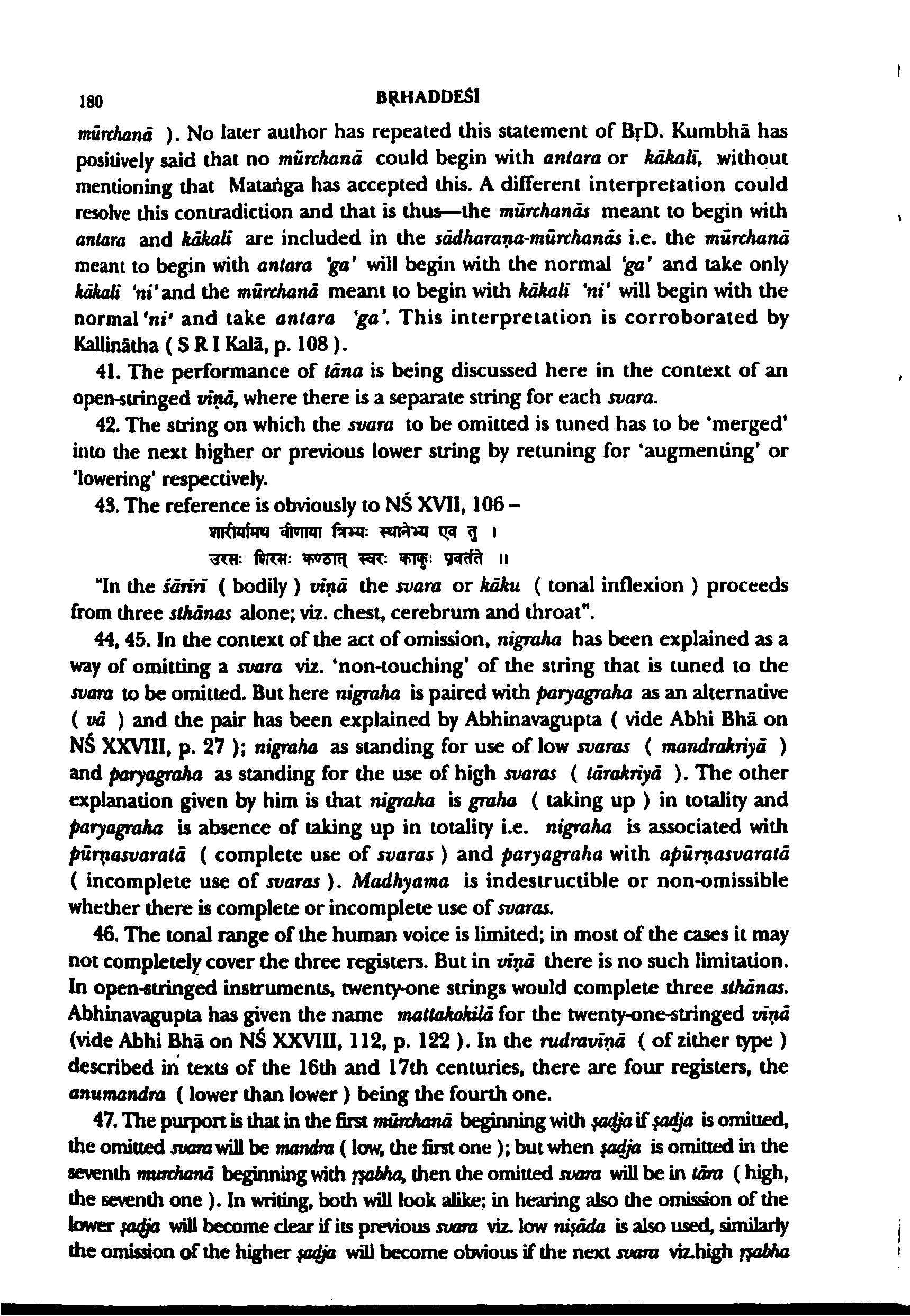
is also used. This is how the distinction brought about by mandra and tara could be understood. Abhi Bhā on NŚ XXVII, p. 27 also seems to support this view. 48. 'Sukha' has been translated here as convenience or it could be rendered as facility. The facility of the performer and listener is said here to be the objective of the distinction between mūrchanā and tāna. NŠ and Abhi Bhā have the reading 'nānātva' which means variety of mūrchanā and tāna, but since our author has tried to distinguish between murchana and tana, we have accepted the reading anyatvam which means distinction (see note 78 under textual notes on the section ). In NS mūrchanā-tāna is also a compound name for the 84 tānas. BṛD does not use this compound and emphasises the distinction between the two; viz. mūrchanā and tāna. Brahaspati has commented on the reading 'variety' ( nānātvam ) of NŠ and said that the variety of murchana and tana accords facility to the performer by making possible the use of three sthanas (registers) and also the omission of svaras (according to a specific system as embodied in the 84 tanas). The distinction between murchana and tana brought out in the reading accepted by us could be construed to mean that mūrchanā as a complete scale in ascending and descending establishes the three sthanas4 and tana (involving omission) establishes a specific pattern in ascent.5 It is interesting to note that even today omission of one or two svaras is very effective in the ascent in all those ragas that involve omission in ascent and use the omitted svaras in descent. ( see glossary) 49. Since specific omissions are prescribed for the two grāmas, tāna the result of this specific omission could be said to be the distinguishing feature between the jātis and rāgas of one grāma and the other. 50. This applies to kūļa-tāna where permutation and combination is involved and definite numbering of each variety is effected. Retrieving the number of a given tana (arrangement of a given number of svaras) and retrieving the form of a tana whose number alone is given is known as uddista and nasta respectively. (see glossary) 51, 52. The word tāna-prayoga is being used here to convey two things—in the first instance the number of tanas (permutation of a given number of svaras ) is implied and in the second instance the number of svaras constituting the specific tāna (combination of svaras) is implied. 53, 54, 55 & 56. Krama is a combination of svaras where the original order remains intact and uthrama is a permutation where the original order is changed. The method of obtaining the number of kramas and utkramas of a given-number of svaras is like this—multiply the earlier numbers of a given number, without leaving any number in-between. For example if the number of svaras is six, <math>1 \times 2 \times 3 \times 4 \times 5 \times 6 = 720</math> would be the number of kramas and uthramas taken together; the last number of this series viz. 6 is the number of kramas and the remainder viz. 714 is the number of utkramas. 57. 'Māna' could stand here for the measure (length, breadth and the like) of the viņā concerned. For example, kinnarī, the viņā with frets has been described in SRVI,
1.[attribution]Abhinavagupta gave the name mattakokilā to a twenty-one-stringed viņāAbhinavagupta has given the name mattakokilā for the twenty-one-stringed viņā (vide Abhi Bhā on NŠ XXVIII, 112, p. 122).
2.[attribution]Abhinavagupta explained nigraha and paryagraha as alternatives paired in the context of omissionthe pair has been explained by Abhinavagupta ( vide Abhi Bha on NS XXVIII, p. 27)
3.[attribution]Matanga accepted that mūrchanās could begin with antara and kākalīNo later author has repeated this statement of BrD. Kumbhā has positively said that no murchana could begin with antara or kakali, without mentioning that Matanga has accepted this.
4.[definition]Mūrchanā functions as a complete scale in ascending and descending that establishes the three sthanas (registers)mūrchanā as a complete scale in ascending and descending establishes the three sthanas
5.[definition]Tāna involves omission of svaras and establishes a specific pattern in ascenttana (involving omission) establishes a specific pattern in ascent.
6.[definition]Krama is a combination of svaras where the original order remains intactKrama is a combination of svaras where the original order remains intact
7.[definition]Uthrama is a permutation where the original order of svaras is changeduthrama is a permutation where the original order is changed.
8.[definition]Uddista refers to retrieving the number of a given tana (arrangement of svaras)Retrieving the number of a given tana (arrangement of a given number of svaras) and retrieving the form of a tana whose number alone is given is known as uddista and nasta respectively.
9.[definition]Nasta refers to retrieving the form of a tana whose number alone is givenRetrieving the number of a given tana (arrangement of a given number of svaras) and retrieving the form of a tana whose number alone is given is known as uddista and nasta respectively.
10.[definition]Nigraha stands for use of low svaras, termed mandrakriyā according to Abhinavaguptanigraha as standing for use of low svaras ( mandrakriyā )
11.[definition]Paryagraha stands for use of high svaras, termed tārakriyā according to Abhinavaguptaparyagraha as standing for the use of high svaras ( tārakriyā ).
12.[relation]Nigraha is associated with pūrņasvaratā, meaning complete use of svarasnigraha is associated with pūrņasvaratā (complete use of svaras)
13.[relation]Paryagraha is associated with apūrņasvaratā, meaning incomplete use of svarasparyagraha with apūrņasvaratā (incomplete use of svaras).
14.[structural]The rudraviņā of zither type has four registers, including the anumandra (lower than lower) as the fourth oneIn the rudraviņā (of zither type) described in texts of the 16th and 17th centuries, there are four registers, the anumandra (lower than lower) being the fourth one.
15.[structural]Kūļa-tāna involves permutation and combination with definite numbering of each varietyThis applies to kūļa-tāna where permutation and combination is involved and definite numbering of each variety is effected.