Source scans · vol_I_p105
recto · open full
scan recto
verso · open full
scan verso
Bṛhaddeśī · Volume I
pp. 192–193folio 105
Devanāgarī (Bṛhaddeśī)
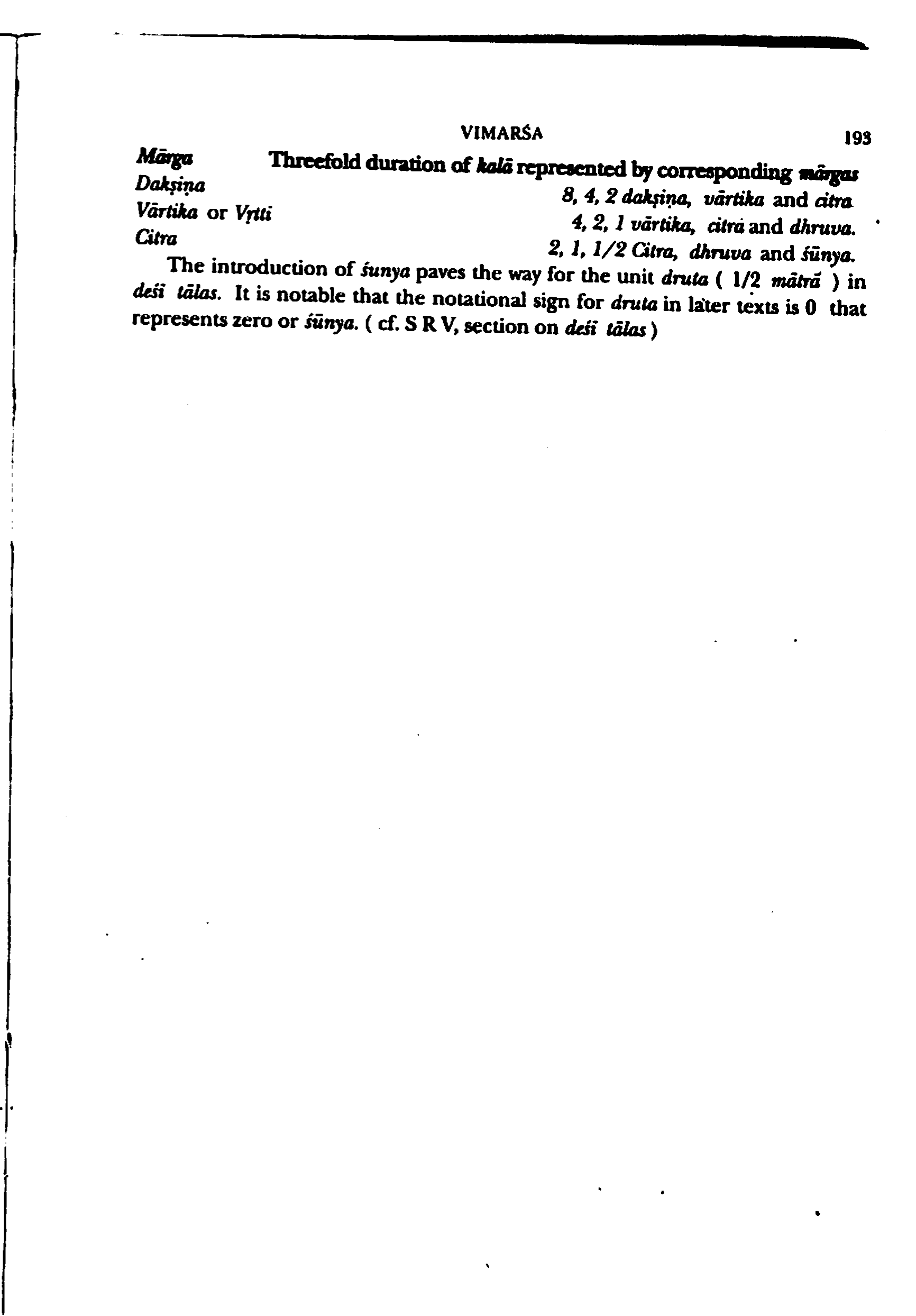
46. Avapāņi is equated with the atīta graha ( see note 20 above and 47 below ). 47. Other texts say only 'before' and 'after' in the context of graha, but BrD is , specifying four kalās as the specific duration bringing about a sense of 'before' and 'after'. Instruments in this context would mean only cymbals and drums, representing tāla. 48. Uparipāņi is equated with anāgata graha, but the explanation given is that instruments ( tāla ) start earlier and song follows later. Simhabhūpāla follows this explanation whereas S R and Kalā say that anāgata graha is that where song and others start earlier and tāla follows later. 49. Adhaḥpāṇi or avapāṇi is equated with the atīta graha and the explanation given is that 'song' starts earlier and tāla (instruments) follows later. Simhabhūpāla's Sudhā commentary is in agreement with this, whereas S R and Kallinātha's Kalā, commentary say the converse. 50,51. Māgadhī is originally assigned to citra mārga. Here it is being said that when pṛthulā giti that is originally assigned to dakṣiṇa mārga is performed in citra mārga i.e. is made faster, then it is called māgadhī gīti. The reverse order spoken of here is perhaps related to the change in the marga of a giti that leads to its being named after another giti. 52. 'Twice returned' stands for dvirnivitta of the text. In verse 172 above māgadhi has been said to involve thrice repetition of a pada. The discrepancy of saying thrice there and twice here could be resolved in this way. When the first utterance is also counted, then 'thrice' is valid, but when it is not counted, 'twice' could also be valid. 53. Yāvat' of the text has been rendered here as 'just', meaning that the expanse of performance is being limited or formalised or codified in the three mārgas. 54. \bar{A}v\bar{a}pa is the first among the four unsounded actions in t\bar{a}la, the other three being niskrāma, viksepa and praveša; all these are prefixed to the original sounded actions of tala according to the duration of each original unit in the threefold kalā viz. ekakala, dvikala and catuşkala. 55. Kalā here means a sub-section of 'song' matching a tāla-cycle. 56. See note 5 above where the repetition of half pada in ardha-māgadhī is explained. 57. Kallinātha, commenting on S R I, 8.18. has said - अत्र पदावृत्त्या पुनरुक्तिदोयः पदार्धभागेनानर्थकरच बाऽऽशाङ्क्य मतङ्गेन परिद्वृत यथा 'सामवेदे गीतप्रधान आवृत्तिष्वर्था नाद्रियन्ते' इति। तथा वेदेनैबोद्याहुत च- 'उदुत्य ज?ातवेदसम्' इत्यत्र वेदशब्दपर्यन्तमावृत्तिपरम्परया गीत्वा ज?ातवेदसमिति गीयते; परसण्डनादर्थभङ्गो न भवत्यत्रापीति। अतः सामवेदप्रकृतिके सङ्गीते गानवस्थात् क्वचित् पदाना पुनरुक्तिरधौक्तिश्च न
दोषायेति मन्तव्यम् ।।
This passage has better readings than our text and makes the point clear. 58. BrD is the only text to elucidate the ninefold operation of laya in the three mārgas, as follows -
English — Sharma (Vimarśa)
table
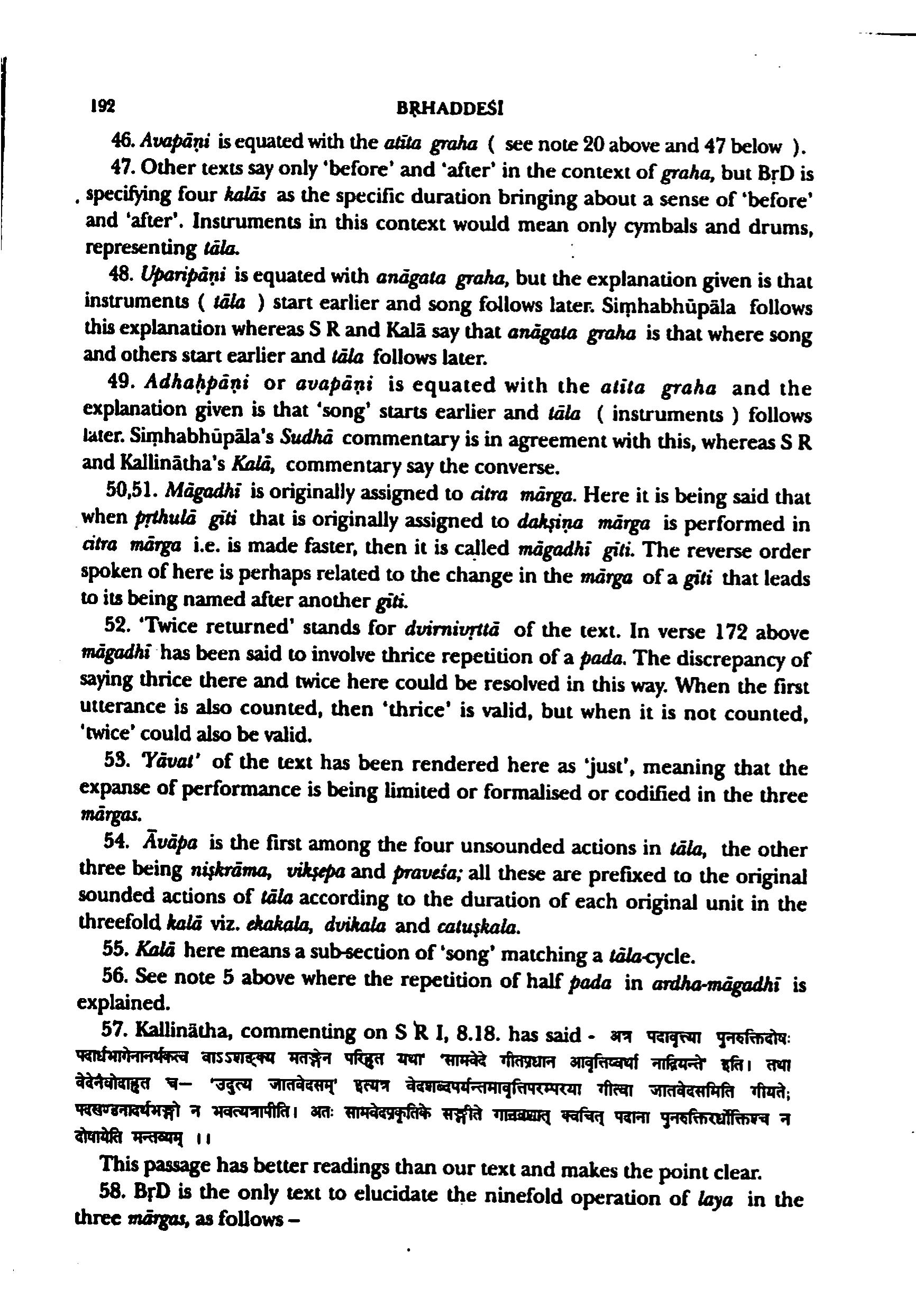
Threefold duration of kalā represented by corresponding mārgas — Vimarśa commentary on mārga/kalā durations; introduces śūnya which paves the way for druta (1/2 mātrā) in deśī tālas. cf. SRV section on deśī tālas.
mārgadurations (kalā units)corresponding mārgas
dakṣiṇa8, 4, 2dakṣiṇa, vārtika and citra
vārtika or vṛtti4, 2, 1vārtika, citra and dhruva
citra2, 1, 1/2citra, dhruva and śūnya
— Threefold duration of kalā represented by corresponding mārgas
The introduction of sunya paves the way for the unit druta (1/2 mātrā) in desi tālas.8 It is notable that the notational sign for druta in later texts is 0 that represents zero or śūnya.14 (cf. SRV, section on deśi tālas) • - . • • • •
1.[attribution]Simhabhūpāla's Sudhā commentary agrees with BrD's explanation of anāgata graha, whereas S R and Kallinātha's Kalā say the converseSimhabhūpāla follows this explanation whereas S R and Kalā say that anāgata graha is that where song and others start earlier and tāla follows later.
2.[attribution]Simhabhūpāla's Sudhā commentary agrees with BrD regarding atīta graha, whereas S R and Kallinātha's Kalā say the converseSimhabhūpāla's Sudhā commentary is in agreement with this, whereas S R and Kallinātha's Kalā, commentary say the converse.
3.[definition]Māgadhī gīti results from performing pṛthulā giti originally assigned to dakṣiṇa mārga in citra mārga (faster)when pṛthulā giti that is originally assigned to dakṣiṇa mārga is performed in citra mārga i.e. is made faster, then it is called māgadhī gīti.
4.[definition]'Twice returned' (dvirnivitta) refers to the repetition count of a pada in māgadhī'Twice returned' stands for dvirnivitta of the text.
5.[enumeration]Āvāpa is the first among four unsounded actions in tāla, followed by niskrāma, viksepa, and pravešaĀvāpa is the first among the four unsounded actions in tāla, the other three being niskrāma, viksepa and praveša
6.[relation]Avapāņi is equated with atīta grahaAvapāņi is equated with the atīta graha
7.[relation]Uparipāņi is equated with anāgata graha, with the explanation that instruments start earlier and song follows laterUparipāņi is equated with anāgata graha, but the explanation given is that instruments ( tāla ) start earlier and song follows later.
8.[relation]The introduction of śūnya paves the way for the unit druta (1/2 mātrā) in deśī tālasThe introduction of sunya paves the way for the unit druta (1/2 mātrā) in desi tālas.
9.[relation]Adhaḥpāņi or avapāņi is equated with atīta graha, with the explanation that song starts earlier and tāla follows laterAdhaḥpāņi or avapāņi is equated with the atīta graha and the explanation given is that 'song' starts earlier and tāla (instruments) follows later.
10.[structural]Four unsounded actions in tāla are prefixed to original sounded actions according to the duration of threefold kalā: ekakala, dvikala, and catuşkalaall these are prefixed to the original sounded actions of tala according to the duration of each original unit in the threefold kalā viz. ekakala, dvikala and catuşkala.
11.[structural]Dakṣiṇa mārga has threefold duration of kalā: 8, 4, 2 corresponding to dakṣiṇa, vārtika, and citraDaksiņa 8, 4, 2 dakşina, vartika and citra
12.[structural]Vārtika mārga has threefold duration of kalā: 4, 2, 1 corresponding to vārtika, citra, and dhruvaVārtika or Vṛtti 4, 2, 1 vārtika, citrā and dhruva.
13.[structural]Citra mārga has threefold duration of kalā: 2, 1, 1/2 corresponding to citra, dhruva, and śūnyaCitra 2, 1, 1/2 Citra, dhruva and śūnya.
14.[structural]The notational sign for druta in later texts is 0 (zero), representing śūnyathe notational sign for druta in later texts is 0 that represents zero or śūnya.