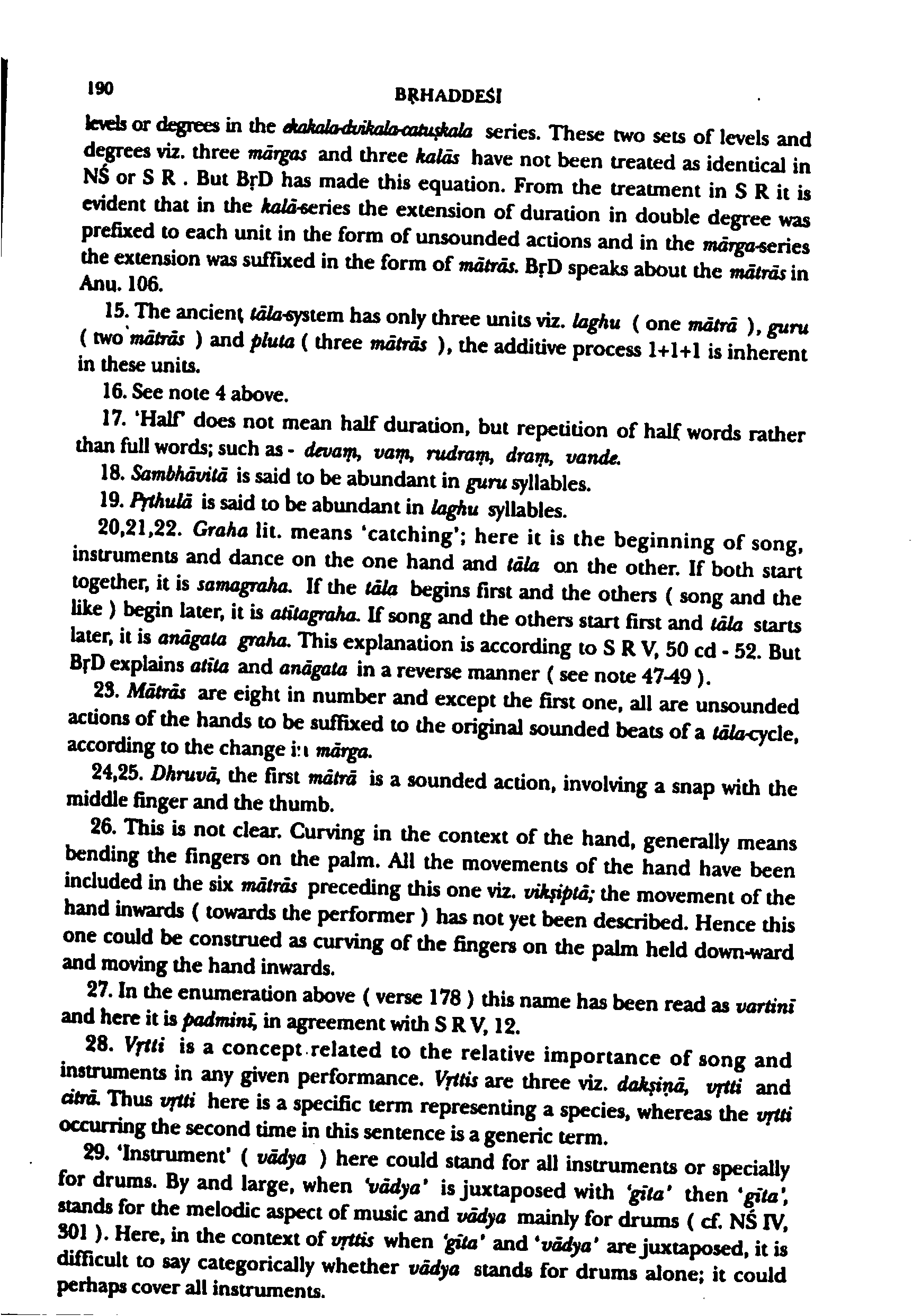
levels or degrees in the
chakala-dvikala-catuskala series. These two sets of levels and
degrees viz. three margas and three kalas have not been treated as identical in
NS or SR. But BrD has made this equation. From the treatment in SR it is
evident that in the kalā-series the extension of duration in double degree was
prefixed to each unit in the form of unsounded actions and in the marga-series
the extension was suffixed in the form of matras. BrD speaks about the matras in
Anu. 106.
15. The ancient tāla-system has only three units viz. laghu (one mātrā), guru
(two mātrās) and pluta (three mātrās), the additive process 1+1+1 is inherent
in these units.
16. See note 4 above.
17. 'Half' does not mean half duration, but repetition of half words rather
than full words; such as - devam, vam, rudram, dram, vande.
18.
Sambhāvitā is said to be abundant in guru syllables.
19. Pythulä is said to be abundant in laghu syllables.
20,21,22. Graha lit. means 'catching'; here it is the beginning of song,
instruments and dance on the one hand and tala on the other. If both start
together, it is
samagraha. If the tala begins first and the others (song and the
like) begin later, it is
atītagraha. If song and the others start first and tāla starts
later, it is
anagata graha. This explanation is according to S R V, 50 cd - 52. But
BrD explains atita and anagata in a reverse manner (see note 47-49).
23. Mātrās are eight in number and except the first one, all are unsounded
actions of the hands to be suffixed to the original sounded beats of a tāla-cycle,
according to the change in marga.
24,25. Dhruvā, the first mātrā is a sounded action, involving a snap with the
middle finger and the thumb.
26. This is not clear. Curving in the context of the hand, generally means
bending the fingers on the palm. All the movements of the hand have been
included in the six mātrās preceding this one viz.
viksiptā; the movement of the
hand inwards ( towards the performer ) has not yet been described. Hence this
one could be construed as curving of the fingers on the palm held down-ward
and moving the hand inwards.
27. In the enumeration above (verse 178) this name has been read as vartini
and here it is padmini, in agreement with SRV, 12.
28. Vṛṭṭi is a concept related to the relative importance of song and
instruments in any given performance. Vṛttis are three viz. dakṣiṇā, vṛtti and
citra. Thus vytti here is a specific term representing a species, whereas the vytti
occurring the second time in this sentence is a generic term.
29. 'Instrument' ( vādya ) here could stand for all instruments or specially
for drums. By and large, when 'vadya' is juxtaposed with 'gita' then 'gita',
stands for the melodic aspect of music and vādya mainly for drums (cf. NŚ IV,
301). Here, in the context of vittis when 'gita' and 'vādya' are juxtaposed, it is
difficult to say categorically whether vadya stands for drums alone; it could
perhaps cover all instruments.