Kosthakas are squares in the murchana-mandala filled with svaras
"Forty-nine squares filled25 with svaras, have, indeed, to be made with eight
(92)
horizontal and vertical lines."
<sup>55</sup>
TRANSLATION
The heptad of svaras (that functions) through ascent and descent<sup>21</sup> in
respective order,22 should be known by the adept ones as being spoken of by the
(91)
word mürchanā.
[ Anu. <sup>36</sup> ]
That murchanā again is twofold — one composed of seven svaras and the
other of twelve svaras.25 Out of these the murchana of seven svaras is fourfold24
__ pūrņā (lit. complete, here with all the seven svaras), ṣāḍavā (hexatonic),
auduvitā (pentatonic) and sādhāraņā (with sādhāraņa svaras). Out of them
pūrņā is that which is sung with seven svaras, that which is sung with six svaras is
ṣāḍavā, that which is sung with five svaras is auduvitā, that which is sung with
kākalī and antara svaras, is sādhāraņā.
(Anu. <sup>37</sup>)
Now the mūrchanā-maṇḍala is being spoken of. In this (maṇḍala) for
mūrchanās of seven svaras in each grāma there are forty-nine svaras and (the
same number of) squares (kosthakas), on account of the process that follows a
set path or order.
That is thus—
Forty-nine squares filled25 with svaras, have, indeed, to be made with eight
(92)
horizontal and vertical lines.
(Anu. <sup>38</sup>)
There (in the maṇḍala) are seven (mūrchanās) beginning with 26 sa - ni - dha
- pa - ma - ga - ri in sadjagrāma and seven beginning with ma - ga - ri - sa - ni -
dha - pa in madhyama-grāma. Svaras have to be 'made' (filled) (in the squares) in
the horizontal and vertical (order). That is thus - ni - dha - pa - ma - ga - ni -
į
sa is (the order) in şadja-grāma. Ga - ni - sa - ni - dha - pa - ma is (the
order) in madhyama-grāma.
Thus there are the fourteen sampūrņā (complete) mūrchanās of the two
grāmas.
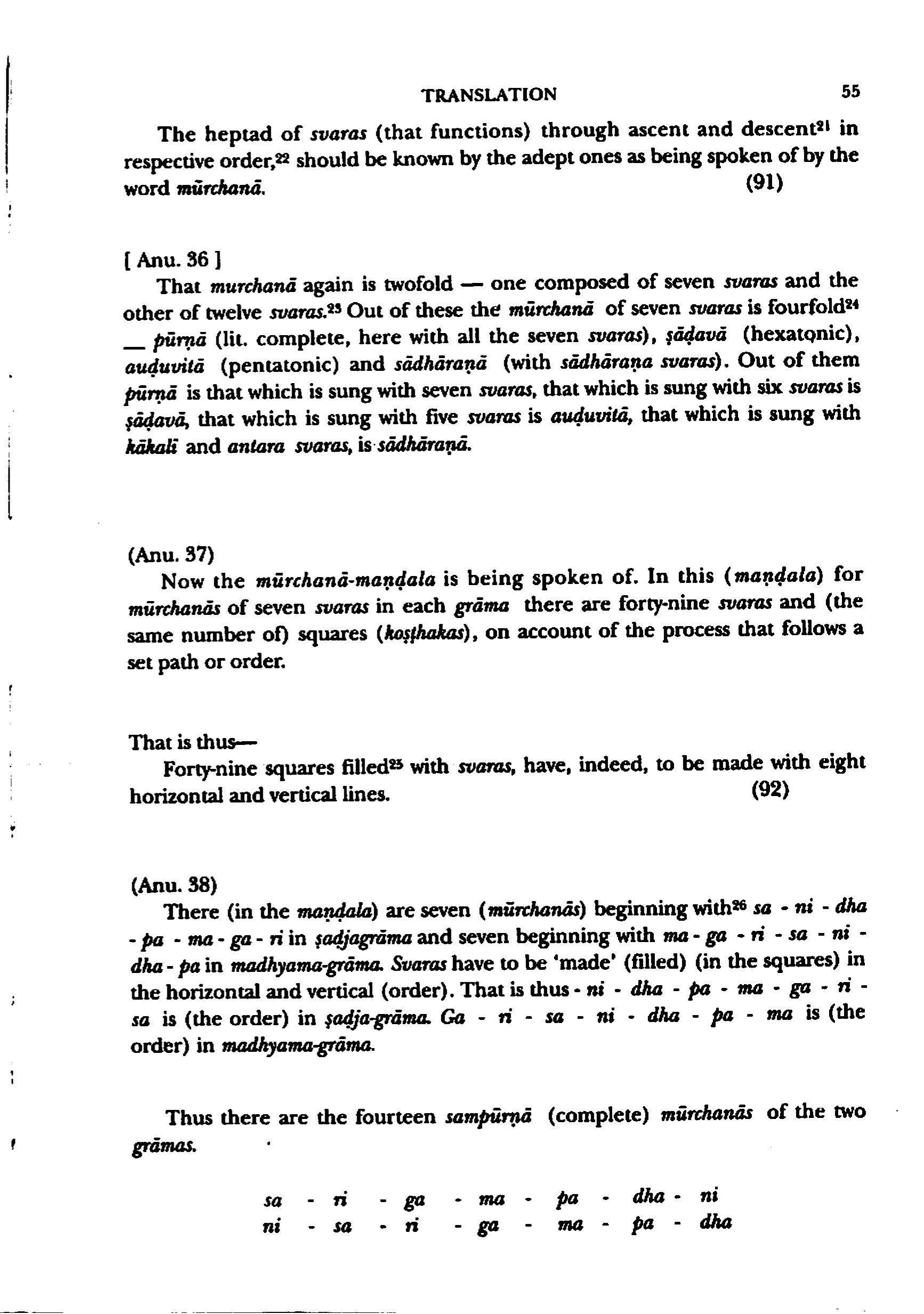
sa - ri - ga - ma - pa - dha - ni ni - sa - ri - ga - ma - pa - dha