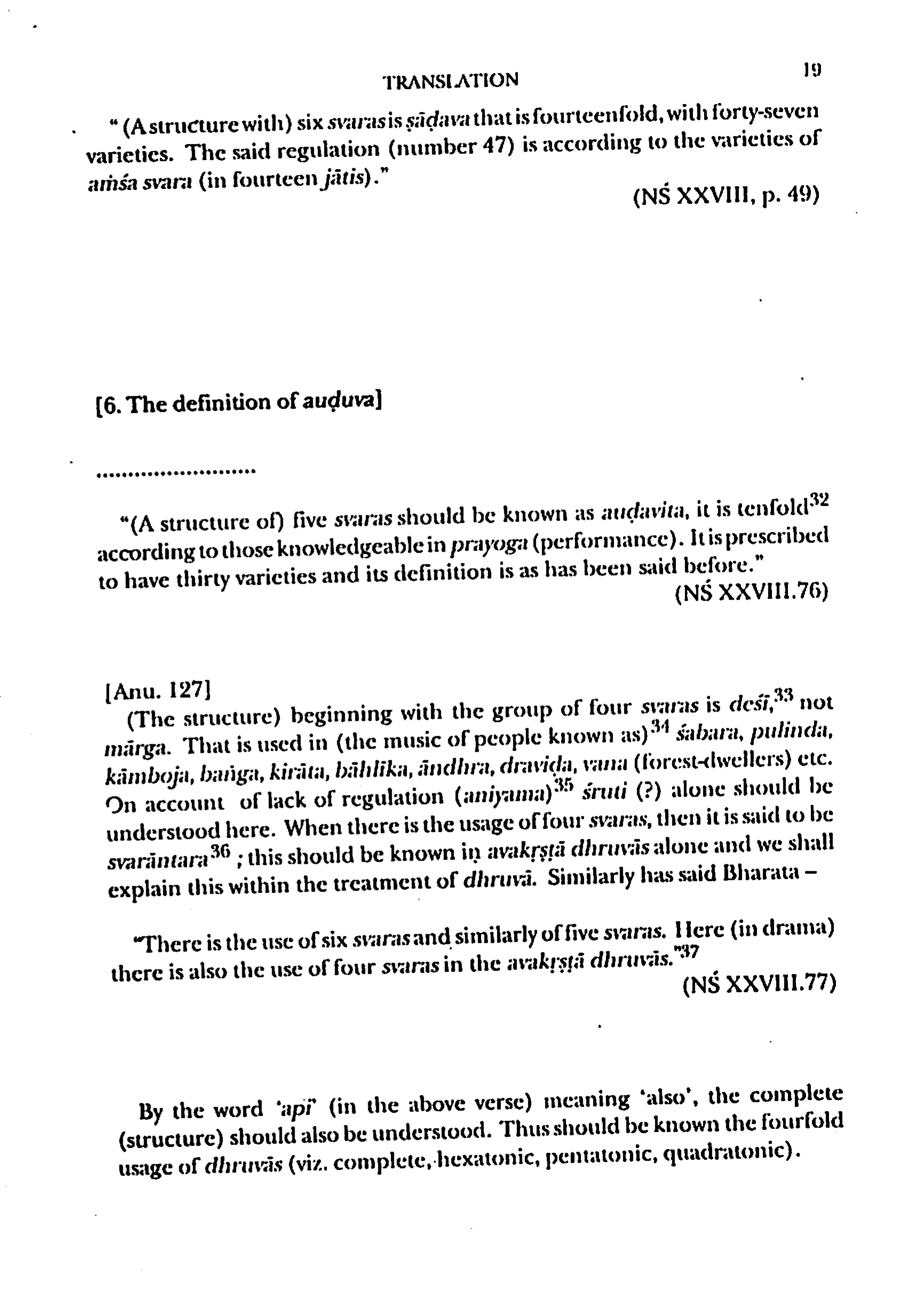
Avakṛṣṭā dhruvā is described and illustrated in Nāṭyaśāstra V, with specific metrical and rhythmic specifications for its performance.
"Avakṛṣṭā dhruvā is described and illustrated in NS V on p.157,
158 of the supplement (variant reading) to the said chapter."
VIMARŚA
<sup>297</sup>
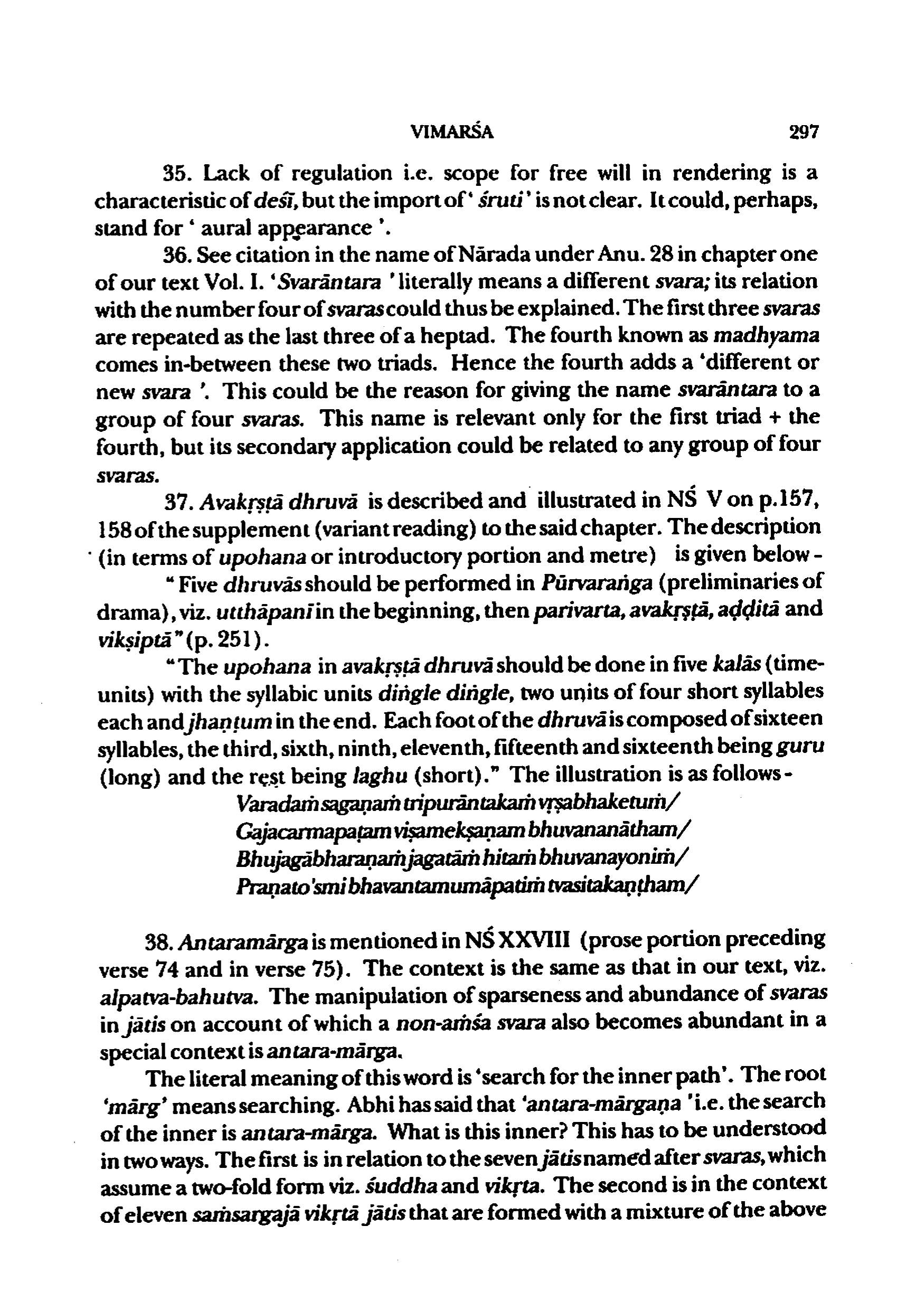
35. Lack of regulation i.e. scope for free will in rendering is a
characteristic of desi, but the import of 'sruti' is not clear. It could, perhaps,
stand for 'aural appearance'.
36. See citation in the name of Nărada under Anu. 28 in chapter one
of our text Vol. I. 'Svarāntara' literally means a different svara; its relation
with the number four of svaras could thus be explained. The first three svaras
are repeated as the last three of a heptad. The fourth known as madhyama
comes in-between these two triads. Hence the fourth adds a 'different or
new svara'. This could be the reason for giving the name svarantara to a
group of four svaras. This name is relevant only for the first triad + the
fourth, but its secondary application could be related to any group of four
svaras.
37. Avakṛṣṭā dhruvā is described and illustrated in NS V on p.157,
158 of the supplement (variant reading) to the said chapter. The description
' (in terms of upohana or introductory portion and metre) is given below -
"Five dhruvās should be performed in Pūrvaranga (preliminaries of
drama), viz. utthāpanī in the beginning, then parivarta, avakṛṣṭā, aḍḍitā and
vikşiptă” (p. 251).
"The upohana in avakṛṣṭā dhruvā should be done in five kalās (time-
units) with the syllabic units dingle dingle, two units of four short syllables
each and jhantum in the end. Each foot of the dhruva is composed of sixteen
syllables, the third, sixth, ninth, eleventh, fifteenth and sixteenth being guru
(long) and the rest being laghu (short)." The illustration is as follows-
Varadam saganam tripurāntakam vṛṣabhaketum/
Gajacarmapaṭamviṣamekṣaṇambhuvananātham/
Bhujagābharaṇaṁjagatāṁhitaṁbhuvanayoniṁ/
Praṇato'smi bhavantamumāpatim tvasitakantham/
38. Antaramārga is mentioned in NŚ XXVIII (prose portion preceding
verse 74 and in verse 75). The context is the same as that in our text, viz.
alpatva-bahutva. The manipulation of sparseness and abundance of svaras
in jātis on account of which a non-amsa svara also becomes abundant in a
special context is antara-mārga.
The literal meaning of this word is 'search for the inner path'. The root
'mārg' means searching. Abhi has said that 'antara-mārgaņa 'i.e. the search
of the inner is antara-marga. What is this inner? This has to be understood
in two ways. The first is in relation to the seven jātis named after svaras, which
assume a two-fold form viz. śuddha and vikṛta. The second is in the context
of eleven samsargajā vikṛtā jātis that are formed with a mixture of the above