1: 55
2: TRANSLATION
3: [8. Gändhārī]
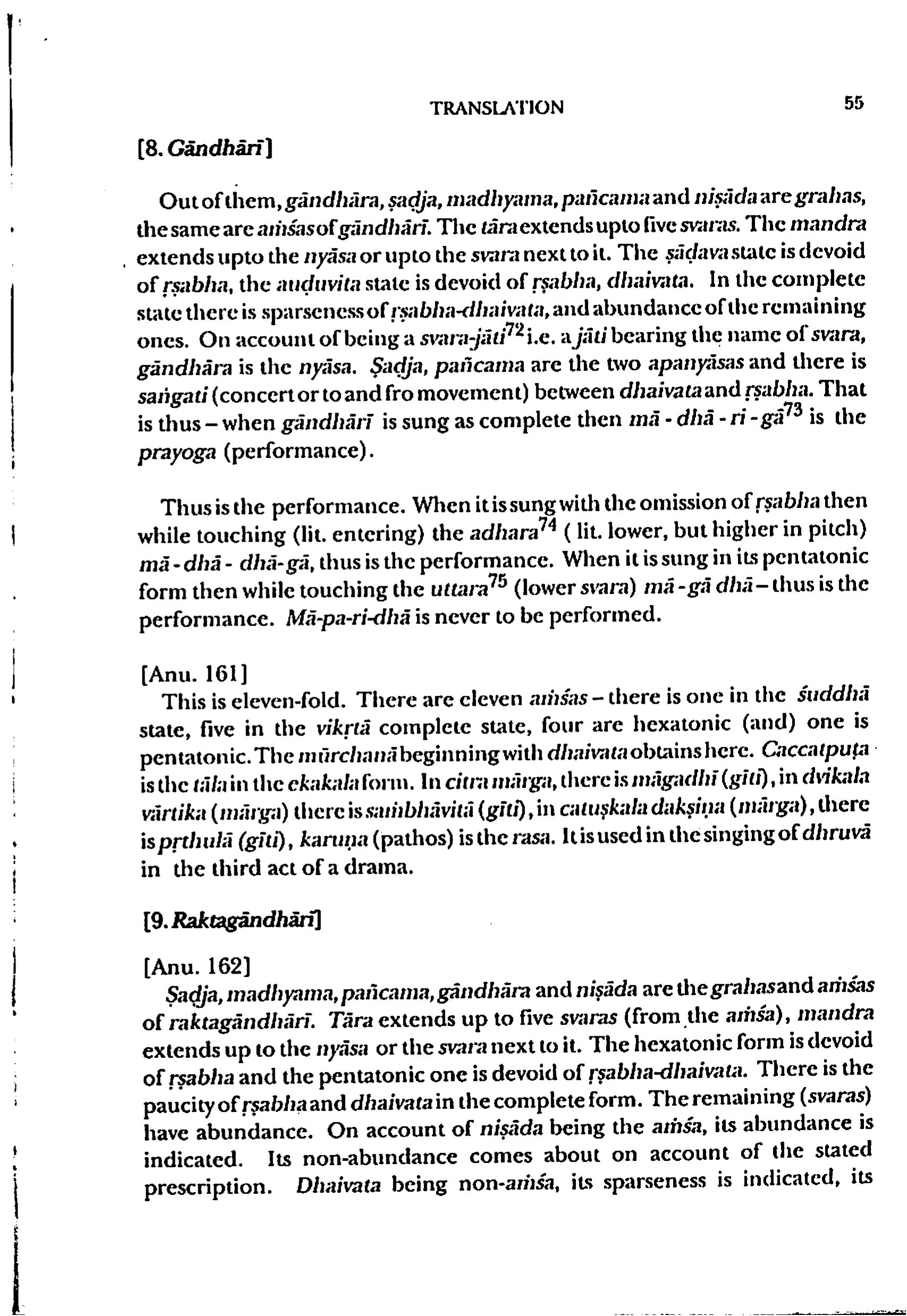
4: Out of them, gāndhāra, ṣadja, madhyama, pañcama and niṣāda are grahas,
5: the same are amsas of gandhari. The tara extends upto five svaras. The mandra
6: , extends upto the nyāsa or upto the svara next to it. The sādava state is devoid
7: of rṣabha, the auduvita state is devoid of ṛṣabha, dhaivata. In the complete
8: state there is sparseness of rṣabha-dhaivata, and abundance of the remaining
9: ones. On account of being a svara-jāti<sup>72</sup>i.e. a jāti bearing the name of svara,
10: gāndhāra is the nyāsa. Ṣadja, pañcama are the two apanyāsas and there is
11: sangati (concert or to and fro movement) between dhaivata and ṛṣabha. That
12: is thus – when <math>g\bar{a}ndh\bar{a}r\bar{i}</math> is sung as complete then <math>m\bar{a}</math> - <math>dh\bar{a}</math> - <math>ri</math> - <math>g\bar{a}^{73}</math> is the
13: prayoga (performance).
14: Thus is the performance. When it is sung with the omission of rṣabha then
15: while touching (lit. entering) the adhara 74 (lit. lower, but higher in pitch)
16: mā-dhā-dhā-gā, thus is the performance. When it is sung in its pentatonic
17: form then while touching the uttara 75 (lower svara) mā-gā dhā-thus is the
18: performance. Mā-pa-ri-dhā is never to be performed.
19: [Anu. 161]
20: This is eleven-fold. There are eleven ainsas - there is one in the suddhā
21: state, five in the vikṛtā complete state, four are hexatonic (and) one is
22: pentatonic. The mūrchanā beginning with dhaivata obtains here. Caccatpuța
23: is the tālain the ekakalaform. In citra mārga, there is māgadhī (gītī), in dvikala
24: vārtika (mārga) there is sambhāvitā (gīti), in catuşkala dakṣiṇa (mārga), there
25: is pṛthulā (gīti), karuṇa (pathos) is the rasa. It is used in the singing of dhruvā
26: in the third act of a drama.
27: [9. Raktagāndhāri]
28: [Anu. 162]
29: Ṣadja, madhyama, pañcama, gândhāra and niṣāda are the grahasand aṁśas
30: of raktagāndhārī. Tāra extends up to five svaras (from the amśa), mandra
31: extends up to the nyāsa or the svara next to it. The hexatonic form is devoid
32: of rṣabha and the pentatonic one is devoid of rṣabha-dhaivata. There is the
33: paucity of rṣabha and dhaivata in the complete form. The remaining (svaras)
34: have abundance. On account of niṣāda being the amśa, its abundance is
35: indicated. Its non-abundance comes about on account of the stated
36: prescription. Dhaivata being non-aniśa, its sparseness is indicated, its
Crop image (token + contexte)
Pas de crop disponible (Layer B n'a pas tourne sur ce token).
Page complete
Cote token (RIGHT) — line ?, token surligne en jaune
Contexte semantique (LEFT)
BRHADDEŚĪ
54
[८. गान्धारी]
तत्र गान्धार्या गान्धारषड्जमध्यमपञ्चमनिषादा <sup>१५७</sup>ग्रहा: , त एवांशा:। पञ्चस्वरपरस्तारो
न्यासपरस्तत्परो वा मन्द्र:। ऋषभहीनं षाडवम्,ऋषभधैवतहीनमौडुवितम्।
पूर्णावस्थायामृषभधैवतयोरल्पत्वम्, शेषाणां बहुत्वम्। स्वरजातित्वाद् गान्धारो न्यासः,
१५८षड्जपञ्चमावपन्यासौ, धैवतर्षभयो: सङ्गति:। तद्यथा - गान्धारी यदा सम्पूर्णा गीयते तदा
॰मध्यमा॰
माधारिगा<sup>९५९</sup> इति प्रयोग: स्यात् । यदा ऋषभहीना गीयते [तदाऽ]धरस्वरप्रवेशने माधाधागा इति
<b>ण्नं(?)</b>
(गि?गः)
(甲)
प्रयोग: स्यात् । यदा औडुविता गीयते तदा <sup>१६०</sup>उत्तर-स्वर-प्रवेशे मागागा इति प्रयोग: स्यात्,
<b>॰यन्ते</b>
मापरिध इति प्रयोगः कदाचिदपि न स्यात् ।
[अनु॰ १६१]
[ एका- ]दशविधत्वमस्या:। एकादशांशका:-शुद्ध:,विकृता: पूर्णा: पञ्च,चत्वार:षाडवा: ,
॰द्धा
औडुवित एक: । मूर्छना धैवतादि: । चच्चत्पुटस्ताल: एककलविधौ चित्रमार्गे मागधी, द्विकले
·ध:
वार्तिके सम्भाविता, चतुष्कले दक्षिणे पृथुला। रसः 'करुणः'र६१। ध्रुवागाने तृतीयप्रेक्षणके
विनियोग:।।
[९. रक्तगान्धारी]
[अनु॰ १६२]
रक्तगान्धार्याः षड्जमध्यमपञ्चमगान्धारनिषादा ग्रहा अंशाश्च । पञ्चस्वरपरस्तारः ,
<b>गान्धा(यंप्य ? यांप्य)</b>
न्यासपरस्तत्परो वा मन्द्र:। ऋषभहीनं षाडवम् ऋषभधैवतहीनमौडुवितम्।
पूर्णावस्थायामृषभधैवतयोरल्पत्वम् , शेषाणां बाहुल्यम् । निषादस्यांशत्वाद् बहुत्वे प्राप्ते
οζ
54
[८. गान्धारी]
तत्र गान्धार्या गान्धारषड्जमध्यमपञ्चमनिषादा <sup>१५७</sup>ग्रहा: , त एवांशा:। पञ्चस्वरपरस्तारो
न्यासपरस्तत्परो वा मन्द्र:। ऋषभहीनं षाडवम्,ऋषभधैवतहीनमौडुवितम्।
पूर्णावस्थायामृषभधैवतयोरल्पत्वम्, शेषाणां बहुत्वम्। स्वरजातित्वाद् गान्धारो न्यासः,
१५८षड्जपञ्चमावपन्यासौ, धैवतर्षभयो: सङ्गति:। तद्यथा - गान्धारी यदा सम्पूर्णा गीयते तदा
॰मध्यमा॰
माधारिगा<sup>९५९</sup> इति प्रयोग: स्यात् । यदा ऋषभहीना गीयते [तदाऽ]धरस्वरप्रवेशने माधाधागा इति
<b>ण्नं(?)</b>
(गि?गः)
(甲)
प्रयोग: स्यात् । यदा औडुविता गीयते तदा <sup>१६०</sup>उत्तर-स्वर-प्रवेशे मागागा इति प्रयोग: स्यात्,
<b>॰यन्ते</b>
मापरिध इति प्रयोगः कदाचिदपि न स्यात् ।
[अनु॰ १६१]
[ एका- ]दशविधत्वमस्या:। एकादशांशका:-शुद्ध:,विकृता: पूर्णा: पञ्च,चत्वार:षाडवा: ,
॰द्धा
औडुवित एक: । मूर्छना धैवतादि: । चच्चत्पुटस्ताल: एककलविधौ चित्रमार्गे मागधी, द्विकले
·ध:
वार्तिके सम्भाविता, चतुष्कले दक्षिणे पृथुला। रसः 'करुणः'र६१। ध्रुवागाने तृतीयप्रेक्षणके
विनियोग:।।
[९. रक्तगान्धारी]
[अनु॰ १६२]
रक्तगान्धार्याः षड्जमध्यमपञ्चमगान्धारनिषादा ग्रहा अंशाश्च । पञ्चस्वरपरस्तारः ,
<b>गान्धा(यंप्य ? यांप्य)</b>
न्यासपरस्तत्परो वा मन्द्र:। ऋषभहीनं षाडवम् ऋषभधैवतहीनमौडुवितम्।
पूर्णावस्थायामृषभधैवतयोरल्पत्वम् , शेषाणां बाहुल्यम् । निषादस्यांशत्वाद् बहुत्वे प्राप्ते
οζ
Voir figures de la page (diagrammes / tables)
Pas de figure detectee sur cette page (Surya layout n'a rien identifie).
Pourquoi flagué
- Tres proche d'un mot connu du dico Sanskrit (1 lettre de difference)
Vu par
OCR Surya Translitterateur Dico Sanskrit IA visuelle
Raisonnement IA visuelle
(aucun reasoning Layer B disponible)