Crop image (token + contexte)
Pas de crop disponible (Layer B n'a pas tourne sur ce token).
Page complete
Cote token (LEFT) — line ?, token surligne en jaune
2: BRHADDEŚĪ
3: 224
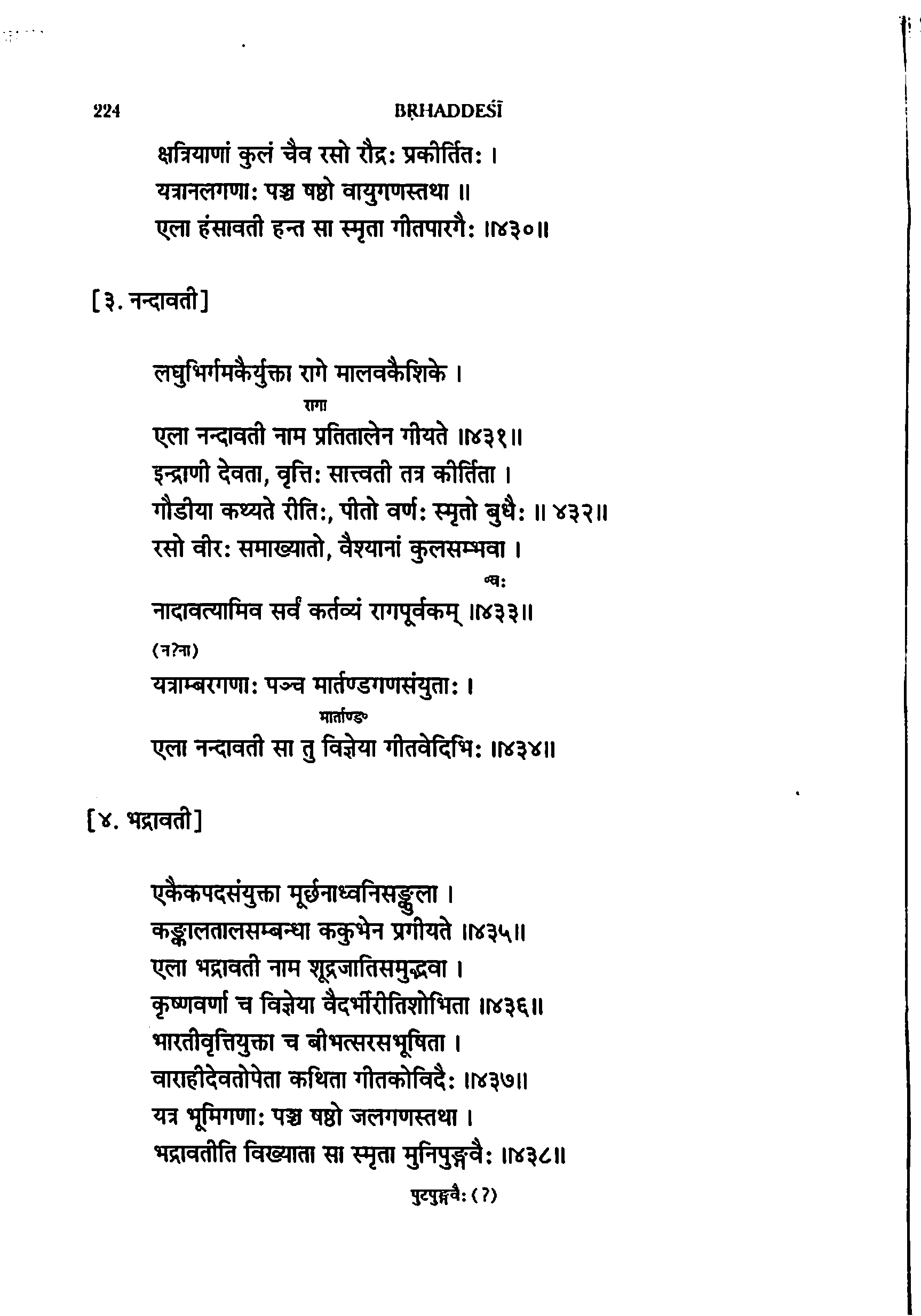
4: क्षत्रियाणां कुलं चैव रसो रौद्र: प्रकीर्तित: ।
5: यत्रानलगणाः पञ्च षष्ठो वायुगणस्तथा ॥
6: एला हंसावती हन्त सा स्मृता गीतपारगै: ॥४३०॥
7: [३. नन्दावती]
8: लघुभिर्गमकैर्युक्ता रागे मालवकैशिके ।
9: एला नन्दावती नाम प्रतितालेन गीयते ॥४३१॥
10: इन्द्राणी देवता, वृत्ति: सात्त्वती तत्र कीर्तिता ।
11: गौडीया कथ्यते रीति:, पीतो वर्ण: स्मृतो बुधै: ॥ ४३२॥
12: रसो वीर: समाख्यातो, वैश्यानां कुलसम्भवा।
13: व्य:
14: नादावत्यामिव सर्वं कर्तव्यं रागपूर्वकम् ॥४३३॥
15: (न?ना)
16: यत्राम्बरगणाः पञ्च मार्तण्डगणसंयुताः ।
17: मार्ताण्ड॰
18: एला नन्दावती सा तु विज्ञेया गीतवेदिभि: ॥४३४॥
19: [४. भद्रावती]
20: एकैकपदसंयुक्ता मूर्छनाध्वनिसङ्कुला ।
21: कङ्कालतालसम्बन्धा ककुभेन प्रगीयते ॥४३५॥
22: एला भद्रावती नाम शूद्रजातिसमुद्भवा ।
23: कृष्णवर्णा च विज्ञेया वैदर्भीरीतिशोभिता ॥४३६॥
24: भारतीवृत्तियुक्ता च बीभत्सरसभूषिता ।
25: वाराहीदेवतोपेता कथिता गीतकोविदै: ॥४३७॥
26: यत्र भूमिगणाः पञ्च षष्ठो जलगणस्तथा ।
27: भद्रावतीति विख्याता सा स्मृता मुनिपुङ्गवै: ॥४३८॥
28: पुटपुङ्गवै: (?)
Contexte semantique (RIGHT)
TRANSLATION
225
The lineage of kṣatriyas is there and the rasa has been said to be raudra.
Where there are five analoganas <math>^{40}</math> and the sixth is a vāyugana, <math>^{41}</math> lo! that elä
is known to be <i>hamsāvatī</i>, by the experts in music.
(430)
[3. Nandāvatī]
Combined with small gamakas in mālavakaišika rāga, the nandāvatī elā is
sung in <i>pratitāla</i>.
(431)
Indrāņī is the devatā (presiding deity), sāttvatī is the vṛtti<sup>42</sup> spoken of here,
gaudi is the <math>riti^{43}</math> spoken of (and) yellow is the colour accepted by the wise.
(432)
Vīra is the rasa that is said to be, (this clā) is born of the lineage of vaisyas.
Everything (else) beginning with rāga should be done as in nādāvatī.
(433)
Where there are five <math>ambara</math>-gaņas, <math>^{44}</math> combined with <math>m\bar{a}rta\eta daga\eta as^{45}</math> that
should be known as nādāvatī elā by the experts in music.
(434)
[4. Bhadrāvatī]
Structured with padas one by one, brimming with mūrchanā 46 sounds,
combined with kańkāla tāla, it is sung in kakubha (rāga).
(435)
Bhadrāvatī elā is born of the śūdra caste and should be known to be of black
colour, being bedecked with vaidarbhī rīti.47
(436)
Combined with bhāratī vṛtti 48 and embellished with bībhatsa rasa, it is said
to be endowed with vārāhī devatā,49 by those adept in music.
(437)
Where there are five <math>bh\bar{u}mi</math>-gaņas<sup>50</sup> and similarly the sixth is <math>jalagaņa_i^{51}</math>
that is known by the best among munis to be famous as bhadrāvatī.
(438)
225
The lineage of kṣatriyas is there and the rasa has been said to be raudra.
Where there are five analoganas <math>^{40}</math> and the sixth is a vāyugana, <math>^{41}</math> lo! that elä
is known to be <i>hamsāvatī</i>, by the experts in music.
(430)
[3. Nandāvatī]
Combined with small gamakas in mālavakaišika rāga, the nandāvatī elā is
sung in <i>pratitāla</i>.
(431)
Indrāņī is the devatā (presiding deity), sāttvatī is the vṛtti<sup>42</sup> spoken of here,
gaudi is the <math>riti^{43}</math> spoken of (and) yellow is the colour accepted by the wise.
(432)
Vīra is the rasa that is said to be, (this clā) is born of the lineage of vaisyas.
Everything (else) beginning with rāga should be done as in nādāvatī.
(433)
Where there are five <math>ambara</math>-gaņas, <math>^{44}</math> combined with <math>m\bar{a}rta\eta daga\eta as^{45}</math> that
should be known as nādāvatī elā by the experts in music.
(434)
[4. Bhadrāvatī]
Structured with padas one by one, brimming with mūrchanā 46 sounds,
combined with kańkāla tāla, it is sung in kakubha (rāga).
(435)
Bhadrāvatī elā is born of the śūdra caste and should be known to be of black
colour, being bedecked with vaidarbhī rīti.47
(436)
Combined with bhāratī vṛtti 48 and embellished with bībhatsa rasa, it is said
to be endowed with vārāhī devatā,49 by those adept in music.
(437)
Where there are five <math>bh\bar{u}mi</math>-gaņas<sup>50</sup> and similarly the sixth is <math>jalagaņa_i^{51}</math>
that is known by the best among munis to be famous as bhadrāvatī.
(438)
Voir figures de la page (diagrammes / tables)
Pas de figure detectee sur cette page (Surya layout n'a rien identifie).
Pourquoi flagué
- Tres proche d'un mot connu du dico Sanskrit (1 lettre de difference)
Vu par
OCR Surya Translitterateur Dico Sanskrit IA visuelle
Raisonnement IA visuelle
(aucun reasoning Layer B disponible)