1: 236
2: BRHADDEŠĪ
3: [५. द्राविडैला]
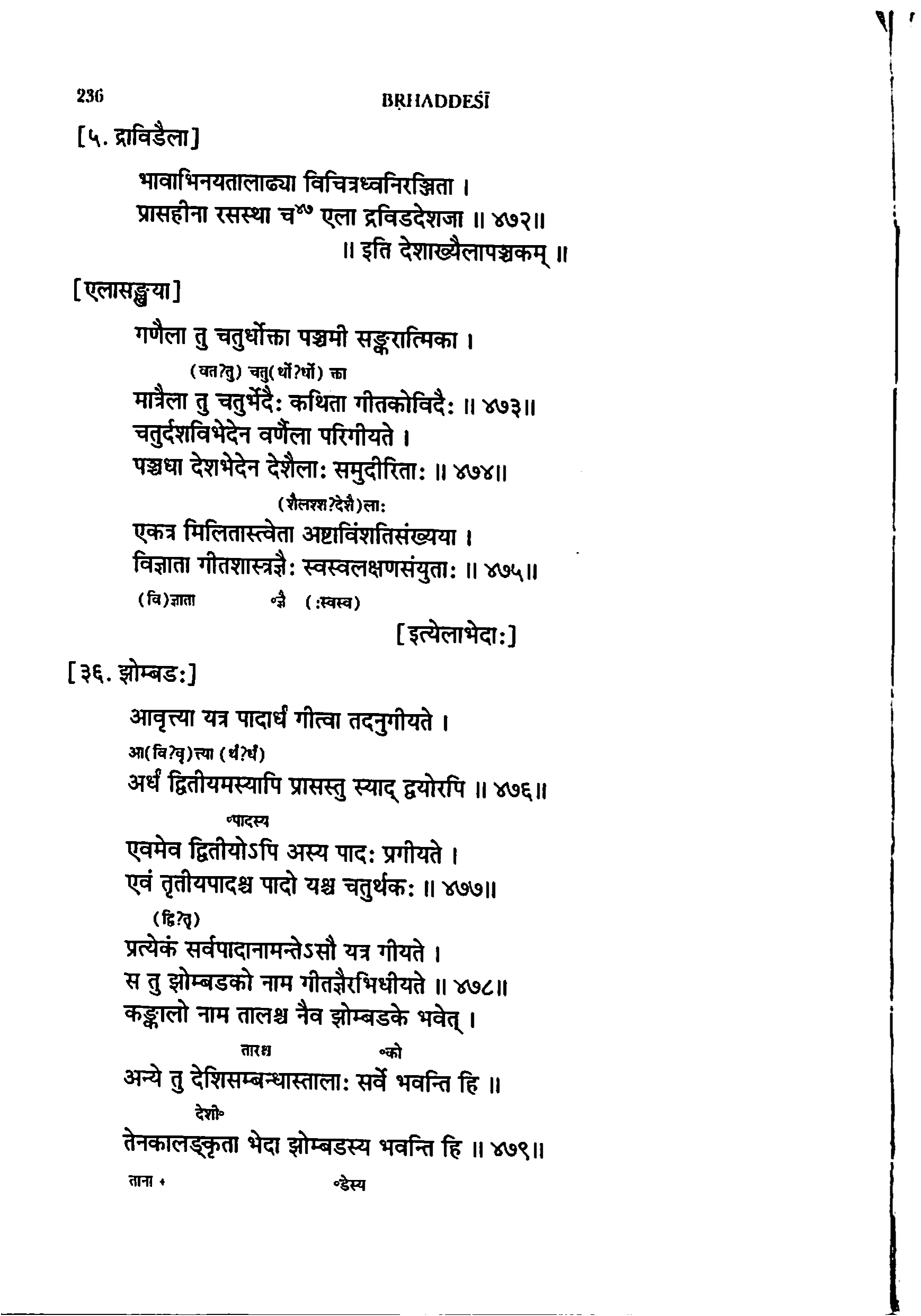
4: भावाभिनयतालाढ्या विचित्रध्वनिरञ्जिता ।
5: प्रासहीना रसस्था च<sup>४७</sup> एला द्रविडदेशजा ॥ ४७२॥
6: ॥ इति देशाख्यैलापञ्चकम् ॥
7: [एलासङ्खया]
8: गणैला तु चतुर्धोक्ता पञ्चमी सङ्करात्मका ।
9: (यत?तु) चतु(थॉं?धॉं) का
10: मात्रैला तु चतुर्भेदै: कथिता गीतकोविदै: ॥ ४७३॥
11: चतुर्दशविभेदेन वर्णेला परिगीयते ।
12: पञ्चधा देशभेदेन देशैला: समुदीरिता: ॥ ४७४॥
13: (शैलरश?देशै)ला:
14: एकत्र मिलितास्त्वेता अष्टाविंशतिसंख्यया ।
15: विज्ञाता गीतशास्त्रज्ञै: स्वस्वलक्षणसंयुता: ॥ ४७५॥
16: (वि)ज्ञाता
17: <b>भी (:स्वस्व)</b>
18: [इत्येलाभेदा:]
19: [३६. झोम्बड:]
20: आवृत्त्या यत्र पादार्धं गीत्वा तदनुगीयते ।
21: आ(वि?वृ)त्या (धं?धं)
22: अर्धं द्वितीयमस्यापि प्रासस्तु स्याद् द्वयोरिप ॥ ४७६॥
23: <b>पादस्य</b>
24: एवमेव द्वितीयोऽपि अस्य पाद: प्रगीयते ।
25: एवं तृतीयपादश्च पादो यश्च चतुर्थक: ॥ ४७७॥
26: (द्वि?तृ)
27: प्रत्येकं सर्वपादानामन्तेऽसौ यत्र गीयते ।
28: स तु झोम्बडको नाम गीतज्ञैरिभधीयते ॥ ४७८॥
29: कङ्कालो नाम तालश नैव झोम्बडके भवेत्।
30: तारश
31: ॰को
32: अन्ये तु देशिसम्बन्धास्तालाः सर्वे भवन्ति हि ॥
33: देशी॰
34: तेनकालङ्कृता भेदा झोम्बडस्य भवन्ति हि ॥ ४७९॥
35: ताना +
36: •डेस्य
Crop image (token + contexte)
Pas de crop disponible (Layer B n'a pas tourne sur ce token).
Page complete
Cote token (LEFT) — line ?, token surligne en jaune
Contexte semantique (RIGHT)
TRANSLATION
237
[5. Drāvidailā]
The <i>elā</i> born in the <i>draviḍa</i> region is adorned with <i>bhāva</i>, <i>abhinaya</i> and <i>tāla</i>,
coloured with variegated sounds, devoid <math>^{85}</math> of prāsa and established in rasa.
(472)
Thus end the five <i>clās</i> bearing regional names.
[The number of <i>Elās</i>]
Ganailā has been said to be fourfold, the fifth is of the nature of sankara
(mixture); mātrailā has been spoken of with four varieties, by the experts in
music.
(473)
Varņailā has been described as having fourteen varieties, deśailās have
been said to be five-fold according to the distinction of region.
(474)
Altogether these are known to be twenty-eight in number by the experts
in the science of music, they are combined with their respective characteristics.
(475)
[Thus end the varieties of <i>elā</i>]
[36. Jhombada]
Where half of the (first) foot is sung in repetition and then the second half
of the same is sung and there is alliteration between the two, similarly is sung
its second foot, in the same way the third foot and where the foot that is the
fourth one is sung at the end of each of all the feet, that is called <i>jhombada</i>
by the experts in music.
<math>(476-478)</math>
The tāla named kankāla never obtains in jhombadaka. All other tālas
related to desi obtain here. There are varieties of jhombada, adorned with
tenaka.
(479)
237
[5. Drāvidailā]
The <i>elā</i> born in the <i>draviḍa</i> region is adorned with <i>bhāva</i>, <i>abhinaya</i> and <i>tāla</i>,
coloured with variegated sounds, devoid <math>^{85}</math> of prāsa and established in rasa.
(472)
Thus end the five <i>clās</i> bearing regional names.
[The number of <i>Elās</i>]
Ganailā has been said to be fourfold, the fifth is of the nature of sankara
(mixture); mātrailā has been spoken of with four varieties, by the experts in
music.
(473)
Varņailā has been described as having fourteen varieties, deśailās have
been said to be five-fold according to the distinction of region.
(474)
Altogether these are known to be twenty-eight in number by the experts
in the science of music, they are combined with their respective characteristics.
(475)
[Thus end the varieties of <i>elā</i>]
[36. Jhombada]
Where half of the (first) foot is sung in repetition and then the second half
of the same is sung and there is alliteration between the two, similarly is sung
its second foot, in the same way the third foot and where the foot that is the
fourth one is sung at the end of each of all the feet, that is called <i>jhombada</i>
by the experts in music.
<math>(476-478)</math>
The tāla named kankāla never obtains in jhombadaka. All other tālas
related to desi obtain here. There are varieties of jhombada, adorned with
tenaka.
(479)
Voir figures de la page (diagrammes / tables)
Pas de figure detectee sur cette page (Surya layout n'a rien identifie).
Pourquoi flagué
- Tres proche d'un mot connu du dico Sanskrit (1 lettre de difference)
Vu par
OCR Surya Translitterateur Dico Sanskrit IA visuelle
Raisonnement IA visuelle
(aucun reasoning Layer B disponible)