1: BRHADDESI
2: 74
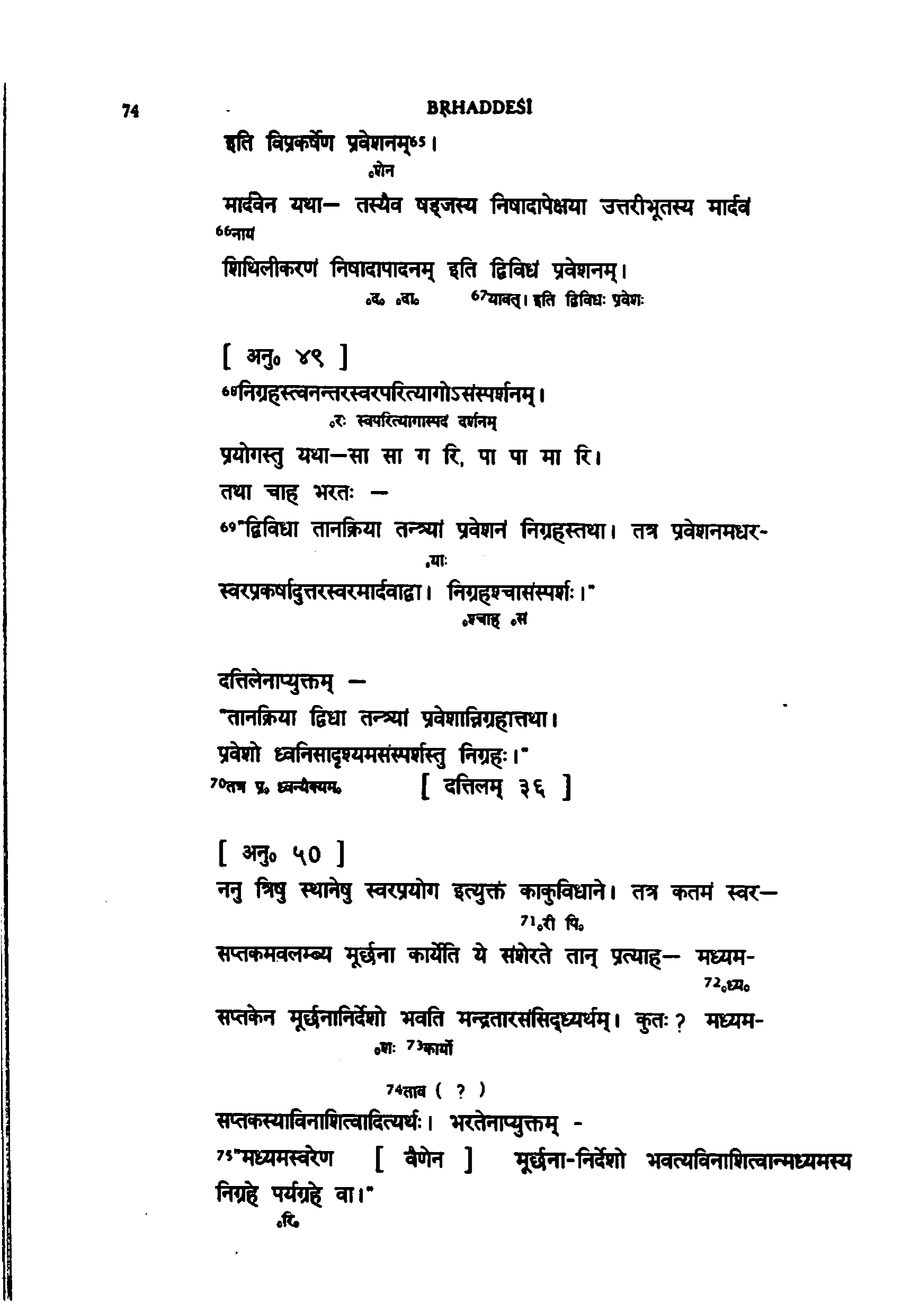
3: इति विप्रकर्षेण प्रवेशनम् ७५।
4: -धेन
5: मार्ववेन यथा- तस्यैव षड्जस्य निषादापेक्षया उत्तरीभूतस्य मार्दवं
6: 66नाय
7: शिथिलीकरणं निषादापादनम् इति द्विविधं प्रवेशनम्।
8: ्द ब्दाः <sup>67</sup>यावत्। इति द्विविधः प्रवेशः
9: [ अनु॰ ४९ ]
10: <b>७</b> निग्रहस्त्वनन्तरस्वरपरित्यागोऽसंस्पर्शनम्।
11: ०रः स्वपरित्यागास्पदं दर्शनम्
12: प्रयोगस्तु यथा—सा सा ग रि, पा पा मा रि।
13: तथा चाह भरतः -
14: 69 द्विविधा तानक्रिया तन्त्र्यां प्रवेशनं निग्रहस्तथा। तत्र प्रवेशनमधर-
15: .याः
16: स्वरप्रकर्षादुत्तरस्वरमार्दवाद्वा। निग्रहश्चासंस्पर्शः।"
17: •श्चाह ∙स
18: दत्तिलेनाप्युक्तम् -
19: "तानक्रिया द्विधा तन्त्र्या प्रवेशान्निग्रहात्तथा।
20: प्रवेशो ध्वनिसादृश्यमसंस्पर्शस्तु निग्रहः।"
21: 70तत्र प्रध्यन्येक्यमः [दत्तिलम् ३६]
22: [ अनु₀ ५0 ]
23: ननु त्रिषु स्थानेषु स्वरप्रयोग इत्युक्तं काकुविधाने। तत्र कतमं स्वर—
24: 71。代 保。
25: सप्तकमवलम्ब्य मूर्छना कार्येति ये संशेरते तान् प्रत्याह - मध्यम-
26: 72。红石。
27: सप्तकेन मूर्जनानिर्देशो भवति मन्द्रतारसंसिद्ध्यर्थम्। कुतः ? मध्यम-
28: ∘शः <sup>73</sup>कार्यो
29: 74साव ( ? )
30: सप्तकस्याविनाशित्वादित्यर्थः। भरतेनाप्युक्तम् -
31: CANADA STREET, STREET, STREET, STREET, STREET, STREET, STREET, STREET, STREET, STREET, STREET, STREET, STREET, STREET, STREET, STREET, STREET, STREET, STREET, STREET, STREET, STREET, STREET, STREET, STREET, STREET, STREET,
32: 75"मध्यमस्वरेण [ वैणेन ] मूर्छना-निर्देशो भवत्यविनाशित्वान्मध्यमस्य
33: निग्रहे पर्यग्रहे वा।"
34: ंदि
Crop image (token + contexte)
Pas de crop disponible (Layer B n'a pas tourne sur ce token).
Page complete
Cote token (LEFT) — line ?, token surligne en jaune
Contexte semantique (RIGHT)
75
TRANSLATION -
șadja which is higher than nișāda (is subjected to) mārdava or loosening i.e. it
is made to attain (the position of) niṣāda; thus is the twofold pravesa i.e. the act
of the lower or higher svara being made to 'enter' or merge into the higher or
lower svara respectively.42
[ Anu. 49 ]
Nigraha is, on the other hand, the omission or 'non-touching' of the
immediate svara. The performance or usage is thus - sā sā gari, pā pā mari
Similarly has said Bharata -
"There is twofold kriyā (lit. performance) of tana on the string (in the
viņā); viz. praveša (lit. entering) and 'nigraha' (lit. restraint). Out of these
(two), pravesa (takes place) on account of the prakarşa (augmentation) of the
lower svara or by the mārdava (lowering) of the higher svara. And nigraha is
'non-touching'."
Dattila has also said -
There is twofold kniyā (action or performance) of tāna on the string; viz.
on account of pravesa and nigraha. Pravesa is the similarity (rather identity) of
sound; nigraha on the other hand, is 'non-touching'."
[ Dattilam 36]
(Anu. 50)
But it is said in the prescription of kāku45 that svaras are (to be) performed
in the three sthanas (registers). Out of them which heptad of svaras should be
resorted to for making murchana? Those who harbour a doubt like this, he (the
author) has said unto them - for the sake of the demonstration of mandra (low)
and tara (high) the murchanas are indicated in (lit. with) the middle heptad.
How? On account of the indestructibility of the middle heptad, this is the
purport. Bharata has also said, "on account of the indestructibility of madhyama
in nigraha 44 (acceptance in totality) or paryagraha 45 (non-acceptance in totality
i.e. partial acceptance), the murchanas are indicated in the madhyama svara of
the vina.
TRANSLATION -
șadja which is higher than nișāda (is subjected to) mārdava or loosening i.e. it
is made to attain (the position of) niṣāda; thus is the twofold pravesa i.e. the act
of the lower or higher svara being made to 'enter' or merge into the higher or
lower svara respectively.42
[ Anu. 49 ]
Nigraha is, on the other hand, the omission or 'non-touching' of the
immediate svara. The performance or usage is thus - sā sā gari, pā pā mari
Similarly has said Bharata -
"There is twofold kriyā (lit. performance) of tana on the string (in the
viņā); viz. praveša (lit. entering) and 'nigraha' (lit. restraint). Out of these
(two), pravesa (takes place) on account of the prakarşa (augmentation) of the
lower svara or by the mārdava (lowering) of the higher svara. And nigraha is
'non-touching'."
Dattila has also said -
There is twofold kniyā (action or performance) of tāna on the string; viz.
on account of pravesa and nigraha. Pravesa is the similarity (rather identity) of
sound; nigraha on the other hand, is 'non-touching'."
[ Dattilam 36]
(Anu. 50)
But it is said in the prescription of kāku45 that svaras are (to be) performed
in the three sthanas (registers). Out of them which heptad of svaras should be
resorted to for making murchana? Those who harbour a doubt like this, he (the
author) has said unto them - for the sake of the demonstration of mandra (low)
and tara (high) the murchanas are indicated in (lit. with) the middle heptad.
How? On account of the indestructibility of the middle heptad, this is the
purport. Bharata has also said, "on account of the indestructibility of madhyama
in nigraha 44 (acceptance in totality) or paryagraha 45 (non-acceptance in totality
i.e. partial acceptance), the murchanas are indicated in the madhyama svara of
the vina.
Voir figures de la page (diagrammes / tables)
Pas de figure detectee sur cette page (Surya layout n'a rien identifie).
Pourquoi flagué
- Tres proche d'un mot connu du dico Sanskrit (1 lettre de difference)
Vu par
OCR Surya Translitterateur Dico Sanskrit IA visuelle
Raisonnement IA visuelle
(aucun reasoning Layer B disponible)