1: BRHADDEŚI
2: 84
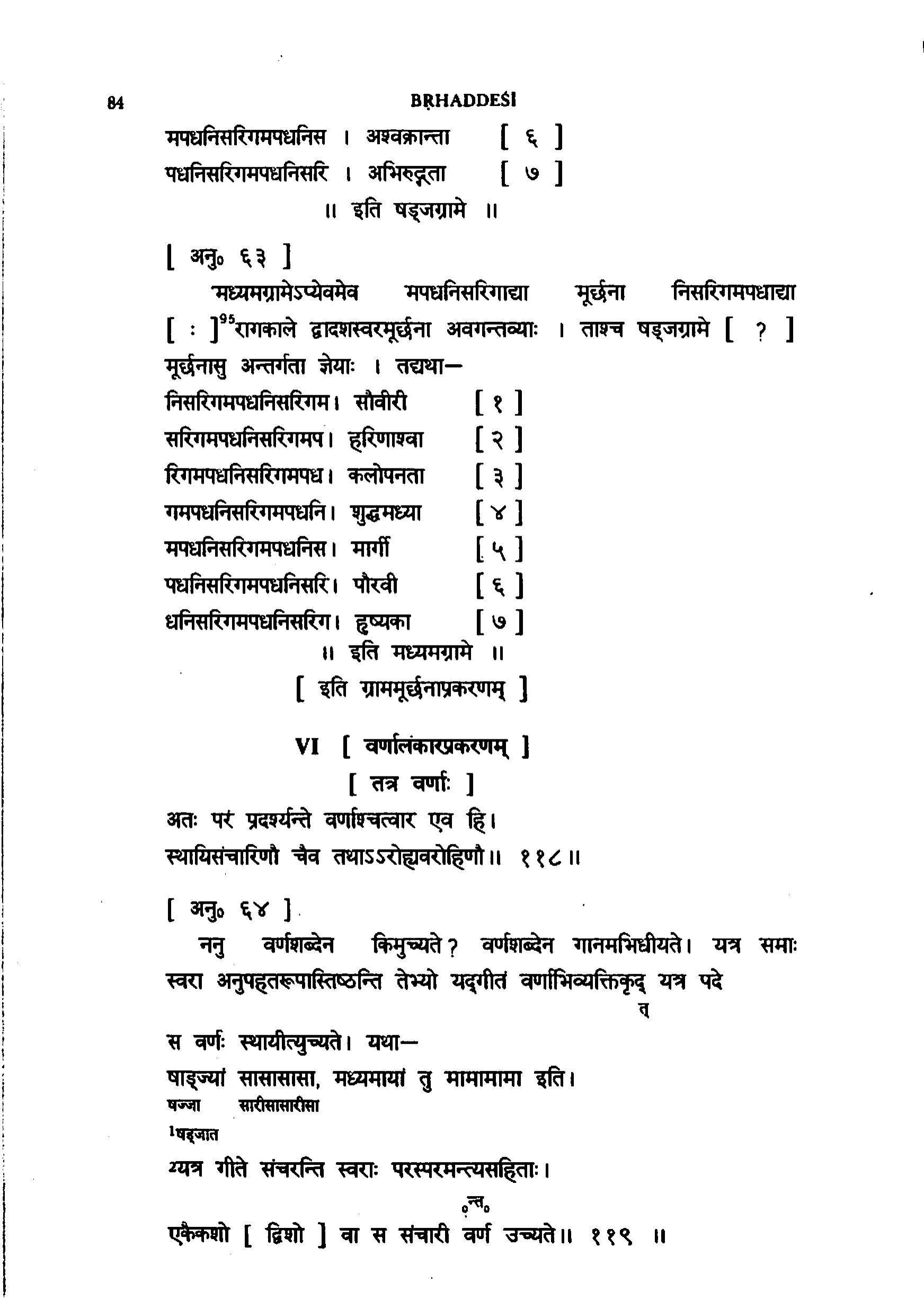
3: मपधनिसरिगमपधनिस । अश्वक्रान्ता ६
4: पधनिसरिगमपधनिसरि । अभिरुद्गता [ ७ ]
5: ॥ इति षड्जग्रामे ॥
6: [ अनु₀ ६३ ]
7: 'मध्यमग्रामेऽप्येवमेव मपधनिसरिगाद्या मूर्छना निसरिगमपधाद्या
8: <math>[:]^{95}</math>रागकाले द्वादशस्वरमूर्छना अवगन्तव्याः । ताश्च षड्जग्रामे <math>[:]^{95}</math>
9: मूर्छनासु अन्तर्गता ज्ञेयाः । तद्यथा—
10: निसरिगमपधनिसरिगम। सौवीरी [१]
11: सरिगमपधनिसरिगमप। हरिणाश्वा [२]
12: रिगमपधनिसरिगमपध। कलोपनता [३]
13: [8]
14: गमपधनिसरिगमपधनि। शुद्धमध्या
15: मपधनिसरिगमपधनिस। मार्गी
16: [4]
17: पधनिसरिगमपधनिसरि। पौरवी
18: [६]
19: धनिसरिगमपधनिसरिग। हृष्यका
20: [ ૭ ]
21: ॥ इति मध्यमग्रामे ॥
22: [ इति ग्राममूर्छनाप्रकरणम् ]
23: VI [ वर्णालंकारप्रकरणम् ]
24: [ तत्र वर्णाः ]
25: अतः परं प्रदर्श्यन्ते वर्णाश्चत्वार एव हि।
26: स्थायिसंचारिणौ चैव तथाऽऽरोह्यवरोहिणौ।। ११८।।
27: [ अनु₀ ६४ ].
28: वर्णशब्देन किमुच्यते ? वर्णशब्देन गानमभिधीयते। यत्र समाः
29: नन्
30: स्वरा अनुपहतरूपास्तिष्ठन्ति तेभ्यो यद्गीतं वर्णाभिव्यक्तिकृद् यत्र पदे
31: त्
32: स वर्णः स्थायीत्युच्यते। यथा—
33: षाङ्ज्यां सासासासा, मध्यमायां तु मामामामा इति।
34: सारीसासारीसा
35: षज्जा
36: <sup>1</sup>षड्जात
37: <b>य्यत्र गीते संचरिन्त स्वराः परस्परमन्त्यसहिताः।</b>
38: एकैकशो [ द्विशो ] वा स संचारी वर्ण उच्यते।। ११९ ॥
Crop image (token + contexte)
Pas de crop disponible (Layer B n'a pas tourne sur ce token).
Page complete
Cote token (LEFT) — line ?, token surligne en jaune
Contexte semantique (RIGHT)
85
<b>TRANSLATION</b>
Aśvākrāntā (6)
ma-pa-dha-ni-sa-ri-ga-ma-pa-dha-ni-sa
Abhirudgatā (7)
pa-dha-ni-sa-ri-ga-ma-pa-dha-ni-sa-ri
Thus end (the mūrchanās with twelve svaras) in şadjagrāma.
(Anu. 63)
In madhyamagrāma also, it is the same; the mūrchanās beginning with ma-pa-
dha-ni-sa-ri-ga begin with ni-sa-ri-ga-ma-pa-dha (when they are formed with 12
svaras). During the performance of raga, murchanas should be known to be
composed of twelve svaras. They should be known to be included in the
mūrchanās of şadjagrāma (?).64
That is thus -
Sauvīrī (1)
ni-sa-ri-ga-ma-pa-dha-ni-sa-ri-ga-ma.
Hariņāśvā (2)
sa-ri-ga-ma-pa-dha-ni-sa-ri-ga-ma-pa.
Kalopanatā (3)
ri-ga-ma-pa-dha-ni-sa-ri-ga-ma-pa-dha.
Suddhamadhyā (4)
ga-ma-pa-dha-ni-sa-ri-ga-ma-pa-dha-ni.
Mārgī (5)
ma-pa-dha-ni-sa-ri-ga-ma-pa-dha-ni-sa.
Pauravi (6)
pa-dha-ni-sa-ri-ga-ma-pa-dha-ni-sa-ri.
Hṛṣyakā (7)
dha-ni-sa-ri-ga-ma-pa-dha-ni-sa-ri-ga.
Thus end (the mūrchanās with twelve svaras) in madhyamagrāma.
[Thus ends the section on grāma-mūrchanā]
VI [Section on Varņas and Alankāras]
[The Varnas]
After this (now) are demonstrated the varnas 1 (patterns of melodic
movement) that are verily four only; viz. sthāyin (steady), sancārin (circulatory),
(118)
ārohin (ascending) and avarohin (descending).
(Anu. 64)
(Contention) what is spoken of by the word varna? (Answer) The act of
singing<sup>2</sup> is spoken of by the word varņa. Where svaras are equal<sup>3</sup> and stay
unimpeded4, the gita5 (melodic rendering) born out of them, that is the
manifestor of varņa (unit of melodic movement) in a given pada6 (textual
unit), that varņa is called sthāyin (steady). Just as sāsāsāsā in the ṣāḍjī (jātī) and
māmāmāmā in the madhyamā (jāti).
<b>TRANSLATION</b>
Aśvākrāntā (6)
ma-pa-dha-ni-sa-ri-ga-ma-pa-dha-ni-sa
Abhirudgatā (7)
pa-dha-ni-sa-ri-ga-ma-pa-dha-ni-sa-ri
Thus end (the mūrchanās with twelve svaras) in şadjagrāma.
(Anu. 63)
In madhyamagrāma also, it is the same; the mūrchanās beginning with ma-pa-
dha-ni-sa-ri-ga begin with ni-sa-ri-ga-ma-pa-dha (when they are formed with 12
svaras). During the performance of raga, murchanas should be known to be
composed of twelve svaras. They should be known to be included in the
mūrchanās of şadjagrāma (?).64
That is thus -
Sauvīrī (1)
ni-sa-ri-ga-ma-pa-dha-ni-sa-ri-ga-ma.
Hariņāśvā (2)
sa-ri-ga-ma-pa-dha-ni-sa-ri-ga-ma-pa.
Kalopanatā (3)
ri-ga-ma-pa-dha-ni-sa-ri-ga-ma-pa-dha.
Suddhamadhyā (4)
ga-ma-pa-dha-ni-sa-ri-ga-ma-pa-dha-ni.
Mārgī (5)
ma-pa-dha-ni-sa-ri-ga-ma-pa-dha-ni-sa.
Pauravi (6)
pa-dha-ni-sa-ri-ga-ma-pa-dha-ni-sa-ri.
Hṛṣyakā (7)
dha-ni-sa-ri-ga-ma-pa-dha-ni-sa-ri-ga.
Thus end (the mūrchanās with twelve svaras) in madhyamagrāma.
[Thus ends the section on grāma-mūrchanā]
VI [Section on Varņas and Alankāras]
[The Varnas]
After this (now) are demonstrated the varnas 1 (patterns of melodic
movement) that are verily four only; viz. sthāyin (steady), sancārin (circulatory),
(118)
ārohin (ascending) and avarohin (descending).
(Anu. 64)
(Contention) what is spoken of by the word varna? (Answer) The act of
singing<sup>2</sup> is spoken of by the word varņa. Where svaras are equal<sup>3</sup> and stay
unimpeded4, the gita5 (melodic rendering) born out of them, that is the
manifestor of varņa (unit of melodic movement) in a given pada6 (textual
unit), that varņa is called sthāyin (steady). Just as sāsāsāsā in the ṣāḍjī (jātī) and
māmāmāmā in the madhyamā (jāti).
Voir figures de la page (diagrammes / tables)
Pas de figure detectee sur cette page (Surya layout n'a rien identifie).
Pourquoi flagué
- Tres proche d'un mot connu du dico Sanskrit (1 lettre de difference)
Vu par
OCR Surya Translitterateur Dico Sanskrit IA visuelle
Raisonnement IA visuelle
(aucun reasoning Layer B disponible)