[3. Gadya]
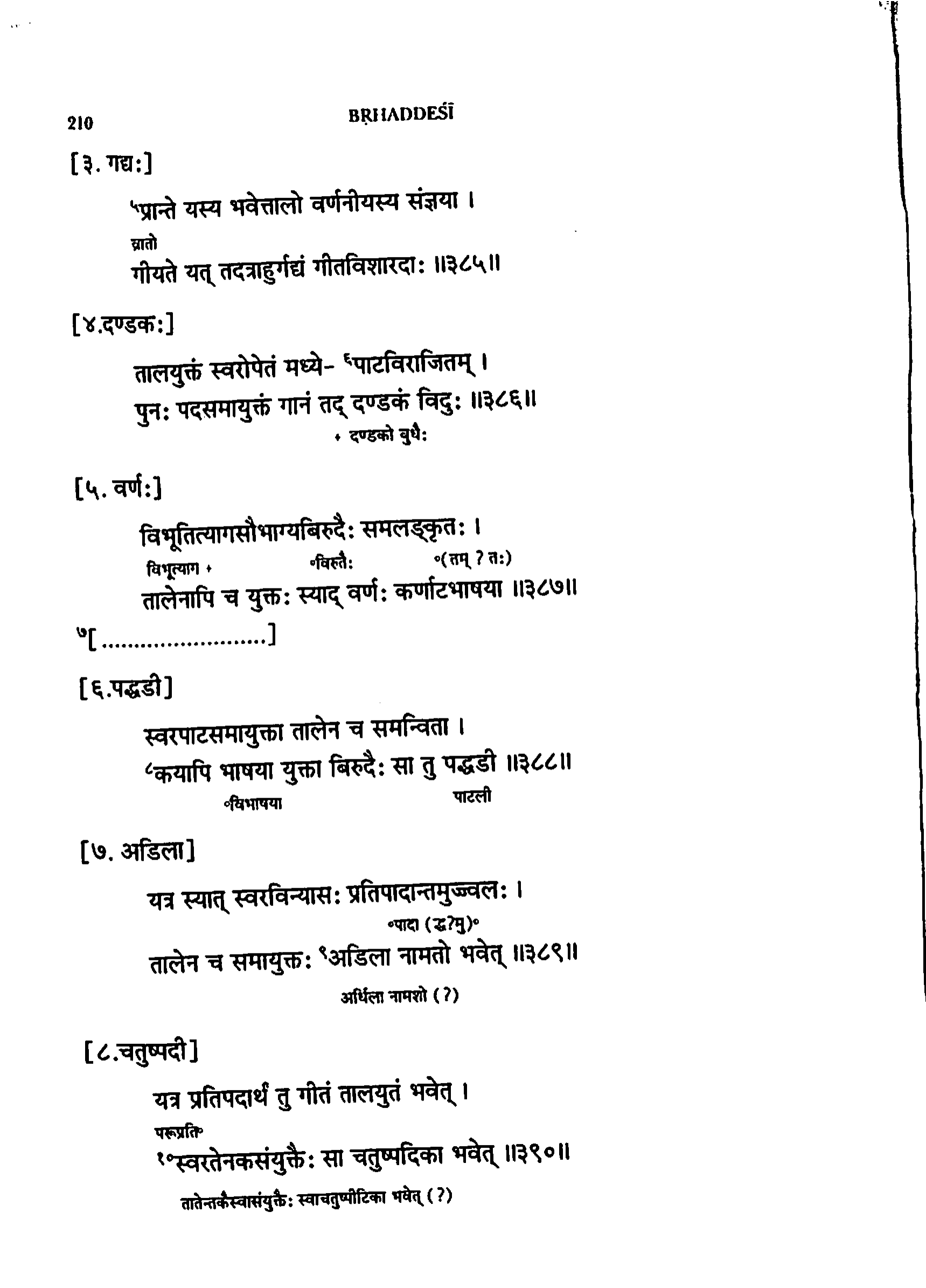
That in which <math>t\bar{a}la</math> comes at the end along with the name of the object of
description 10 (divine or human) and is sung as such,
is said here to be gadya,
by the proficient ones in music.1
(385)
[4. Daṇḍaka]
Combined with <math>t\bar{a}la</math>, endowed with svara, bedecked with <math>p\bar{a}ta^{11}</math> in the
middle (and) again combined with pada,
that song is known as daṇḍaka.2
(386)
[5. Varņa]
Bedecked with
birudas12 (eulogistic phrases) related to plenty,
renunciation, well-being or prosperity3 and combined also with <math>t\bar{a}la</math>, is varya (composed) in the <math>
Karn\bar{a}ta^{13}</math> language.
(387)
*******
Combined with svara (and) pāṭa and endowed with tāla, composed in any
language and combined with
birudas is that paddhaḍī.
(388)
[7. Adilā]
Where there is the brilliant arrangement of svaras at the end of every foot,
combined with <math>t\bar{a}la</math>, that is <math>a\dot{q}il\bar{a}^{14}</math> by name.
(389)
Where the song is endowed with meaning in every unit of text (pada)
(and) is combined with <math>t\bar{a}la</math>, having svara and <math>tenaka</math>, that is <math>catuspadik\bar{a}</math>.