Source scans · vol_II_p113
recto · open full
scan recto
verso · open full
scan verso
Bṛhaddeśī · Volume II
pp. 208–209folio 113
Devanāgarī (Bṛhaddeśī)
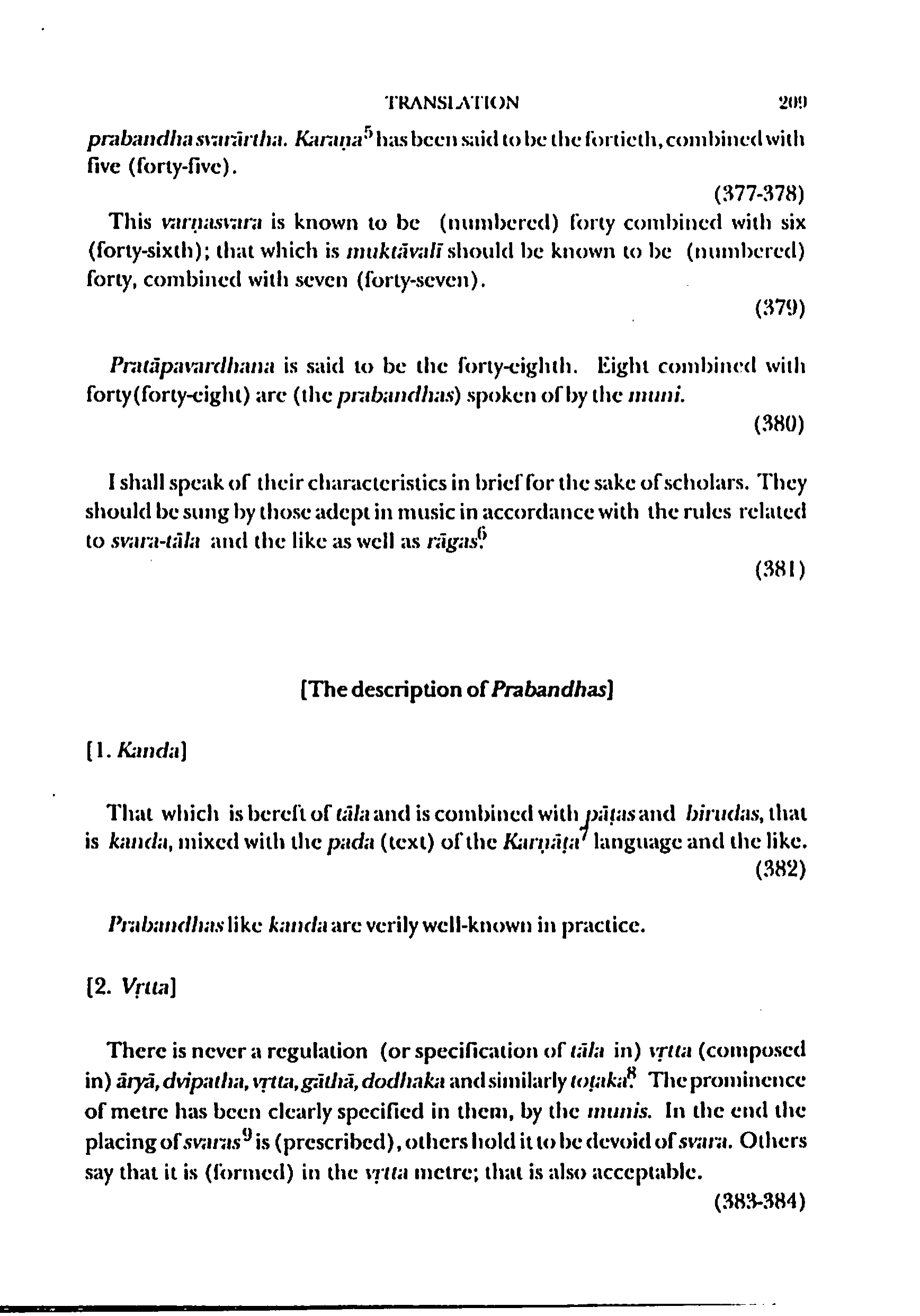
प्रबन्धोऽयं स्वरार्थ: स्याद् ज्ञेयोऽसौ गीतवेदिभि: ।
चत्वारिंशत्तमं प्रोक्तं करणं पञ्चभिर्युतम्6 ॥३७८॥
चत्वारिंशद्युत:°ता: षड्भिश्चासौ वर्णस्वर: स्मृत:7
चत्वारिंशत्सप्तयुता ज्ञेया मुक्तावलीति या ॥३७९॥
प्रतापवर्धनश्चाष्ट्रचत्वारिशः(त?न)॰शत् प्रकीर्तितः9
अष्टौ च मुनिना ख्याताश्चत्वारिंशत् सुसंयुता[:] ॥३८०॥ पञ्चधा मुनिनान्ता चत्वाः
एतेषां लक्षणं विच्यचच्छि समासाद् विदुषां कृते ।
विदुषात्तमम्
यथोक्तं चात्र नियमै[:] [पदतालादिसंयुतै:] ॥
रागैर्यथावदुक्तैस्तु गातव्या गीतकोविदै: ॥३८१॥
[प्रबन्धानां लक्षणानि]
[१.कन्द:]
तालशून्यस्तु य: पाटैर्बिरुदेश्च समन्वित:॰ता:
स कन्द इति कर्णाटभाषादिपदिमश्रित:10 ॥३८२॥
कन्दादिप्रबन्धा लक्ष्यत: प्रसिद्धा एव ।
क(दा?न्दा)
[२. वृत्त:]
आर्यायां द्विपथे वृत्तो गाथायां दोघके तथा।
वृते्याः गाधाया जेधके तथा(?)
तोटके[ ऽथ] च तालस्य नियमो नास्ति कदाचन ॥
•केन मुख्यता तेषु निर्दिष्टा मुनिभिश्छन्दस: स्फुटम्1॰सा॥३८३॥
अन्ते च स्वरविन्यास:12 [स्वरहीनं स्मृतं परै:] ।
अन्त: स्वर + विन्यास: + + + + +न्तः [वृत्ते छन्दिस यच्चान्ये] वङ्क्ति तदिप सम्मतम् ॥३८४॥ . . . . . . . . . NAME OF TAXABLE PARTY. محفظ ماملا دي ماسي الراكات المار 4 . . . . . . . . .
English — Sharma (translation)
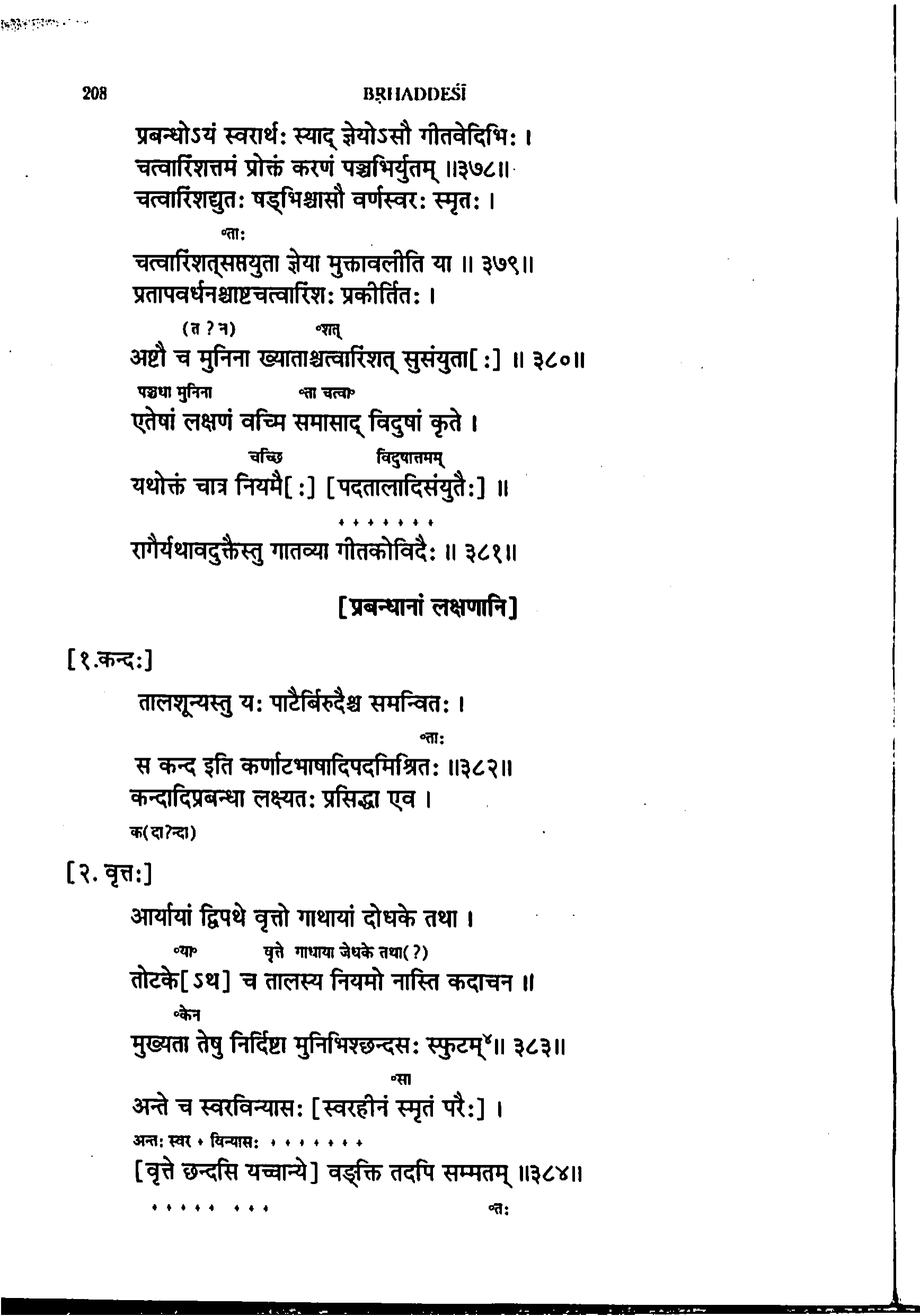
prabandha svarārtha. Karaņa5 has been said to be the fortieth, combined with five (forty-five).6 <math>(377-378)</math> This varņasvara is known to be (numbered) forty combined with six (forty-sixth)7; that which is muktāvalī should be known to be (numbered) forty, combined with seven (forty-seven).8
(379)
Pratāpavardhana is said to be the forty-eighth.9 Eight combined with forty(forty-eight) are (the prabandhas) spoken of by the muni.
(380)
I shall speak of their characteristics in brief for the sake of scholars. They should be sung by those adept in music in accordance with the rules related to svara-tāla and the like as well as <math>r\bar{a}gas^6</math>.
(381)
[The description of Prabandhas]
[1. Kanda]
That which is bereft of tāla and is combined with pāṭas and birudas, that is kanda, mixed with the pada (text) of the Karpāṭa7 language and the like.10
(382)
Prabandhas like kanda are verily well-known in practice.
[2. Vṛtta]
There is never a regulation (or specification of tāla in) vṛtta (composed in) āryā, dvipatha, vṛtta, gāthā, dodhaka and similarly toṭaka.113 The prominence of metre has been clearly specified in them, by the munis.1 In the end the placing of svaras9 is (prescribed), others hold it to be devoid of svara.12 Others say that it is (formed) in the vitta metre; that is also acceptable. (383-384) - ---
1.[attribution] The prominence of metre in vṛtta has been clearly specified by the munis.मुख्यता तेषु निर्दिष्टा मुनिभिश्छन्दसः स्फुटम्
6.[structural] Karana is the fortieth type, combined with five elements (totaling forty-five).चत्वारिंशत्तमं प्रोक्तं करणं पञ्चभिर्युतम्
7.[structural] Varnasvara is numbered as the forty-sixth (forty combined with six).चत्वारिंशद्युतः षड्भिश्चासौ वर्णस्वरः स्मृतः
9.[structural] Pratapvardhana is said to be the forty-eighth prabandha form.प्रतापवर्धनश्चाष्ट्रचत्वारिशः प्रकीर्तितः
10.[structural] Kanda is mixed with the pada (text) of the Karpāṭa language and the like.स कन्द इति कर्णाटभाषादिपदिमश्रितः
12.[structural] In vṛtta, the placing of svaras is prescribed at the end, though some hold it to be devoid of svara.अन्ते च स्वरविन्यासः
1.[attribution]The prominence of metre in vṛtta has been clearly specified by the munis.The prominence of metre has been clearly specified in them, by the munis.
2.[definition]Kanda is defined as that which is bereft of tāla and is combined with pāṭas and birudas.That which is bereft of tāla and is combined with pāṭas and birudas, that is kanda
3.[enumeration]These are metres used in the composition of vṛtta prabandhas.There is never a regulation (or specification of tāla in) vṛtta (composed in) āryā, dvipatha, vṛtta, gāthā, dodhaka and similarly toṭaka.
4.[relation]Pāṭas are combined with kanda as a structural component.That which is bereft of tāla and is combined with pāṭas and birudas, that is kanda
5.[relation]Birudas are combined with kanda as a structural component.That which is bereft of tāla and is combined with pāṭas and birudas, that is kanda
6.[structural]Karana is the fortieth type, combined with five elements (totaling forty-five).Karaņa has been said to be the fortieth, combined with five (forty-five).
7.[structural]Varnasvara is numbered as the forty-sixth (forty combined with six).This varņasvara is known to be (numbered) forty combined with six (forty-sixth)
8.[structural]Muktavali is numbered as the forty-seventh (forty combined with seven).that which is muktāvalī should be known to be (numbered) forty, combined with seven (forty-seven).
9.[structural]Pratapvardhana is said to be the forty-eighth prabandha form.Pratāpavardhana is said to be the forty-eighth.
10.[structural]Kanda is mixed with the pada (text) of the Karpāṭa language and the like.that is kanda, mixed with the pada (text) of the Karpāṭa language and the like.
11.[structural]Vṛtta has no regulation or specification of tāla when composed in āryā, dvipatha, vṛtta, gāthā, dodhaka, and toṭaka metres.There is never a regulation (or specification of tāla in) vṛtta (composed in) āryā, dvipatha, vṛtta, gāthā, dodhaka and similarly toṭaka.
12.[structural]In vṛtta, the placing of svaras is prescribed at the end, though some hold it to be devoid of svara.In the end the placing of svaras is (prescribed), others hold it to be devoid of svara.