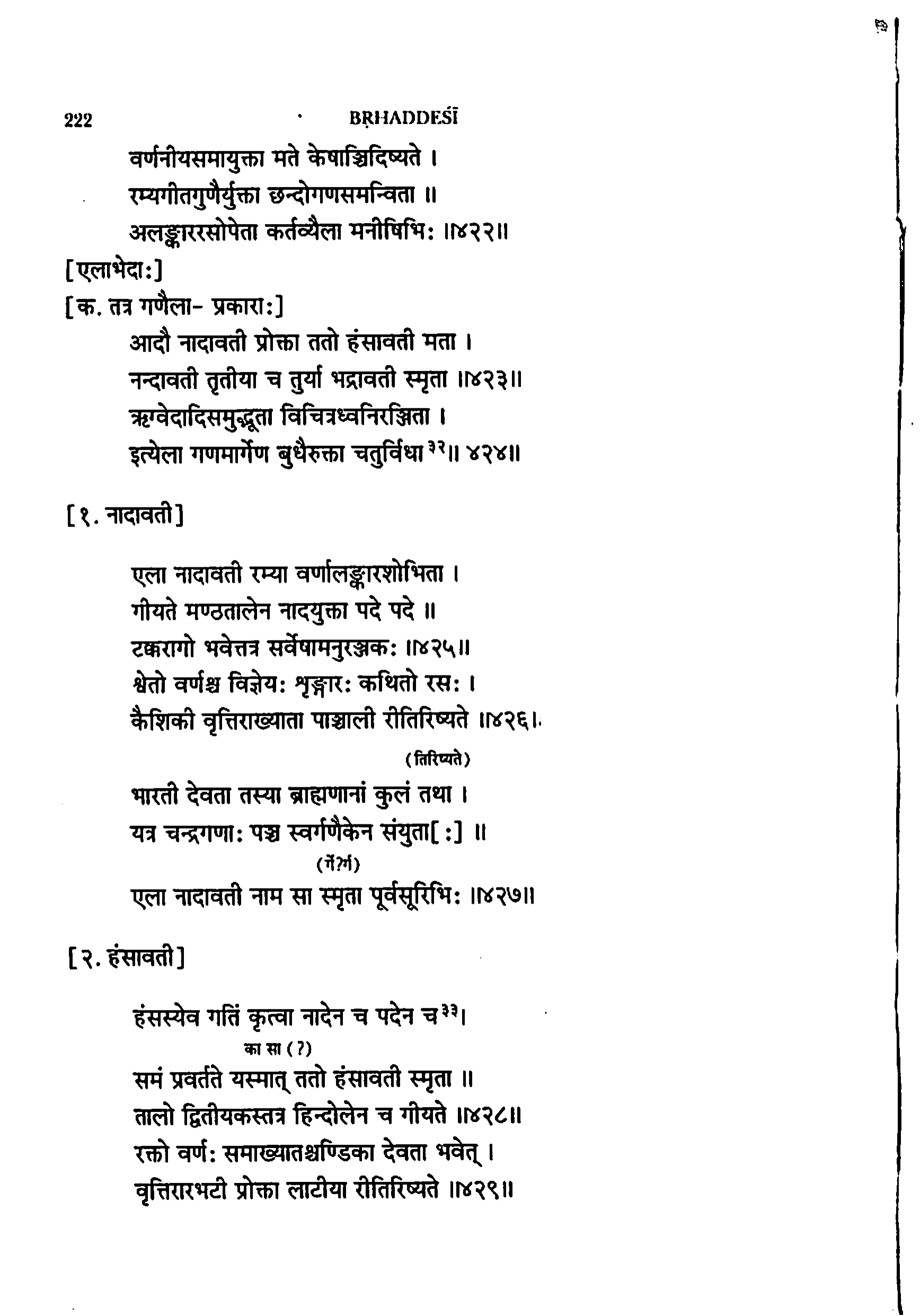
In the opinion of some, it (elā) is combined with the (name of the) object
of description (alone). Elā should be made full of charming qualities of
song, embodying the gaņas (textual units)
31 of metre (and) endowed with
alankāra and rasa, by the wise.
(422)
[The types of Elā]
[A. Out of them the varieties of
Gaṇailā]
First, nādāvatī has been said, then is known hamsāvatī, nandāvatī is the
third and bhadrāvatī is known as the fourth.3
(423)
Derived out of Rgveda and the like, 'coloured' with variegated sounds,
thus has elā been said to be fourfold by the wise1, in accordance with the
'path'<math>^{32}</math> (order) of ganas.
(424)
The elā (named)
nādāvatī is charming, bedecked with varņa (and)
alankāra,
is sung with manthatāla (and) is full of nāda 33 in every foot.10 There
takkarāga becomes delightful to all.4
(425)
(Its) colour should be known to be white and śṛṅgāra has been said to be
the rasa11;
kaišikī vṛtti34 has been spoken of5 (and)
pañcālī rīti35 is accepted.6
(426)
Bhāratī is its devatā (presiding deity) and the lineage of brāhmaņas prevails.
Where five candraganas 36 combined with one svargana 37 are there, that cla
is known to be nādāvatī12, by the foregoing learned ones.
(427)
Making movement like a swan, with nāda and pada, it is known as
hamsāvatī2, because it proceeds smoothly.
Dvitīyaka is the tāla there and (it)
is sung in
hindola (rāga).
(428)
Red colour has been said to prevail. Caṇḍikā is the devatā (presiding
deity)14,
ārabhaţī is the vṛtti387 (and)
lāṭīyā rīti39 is accepted.8
(429)