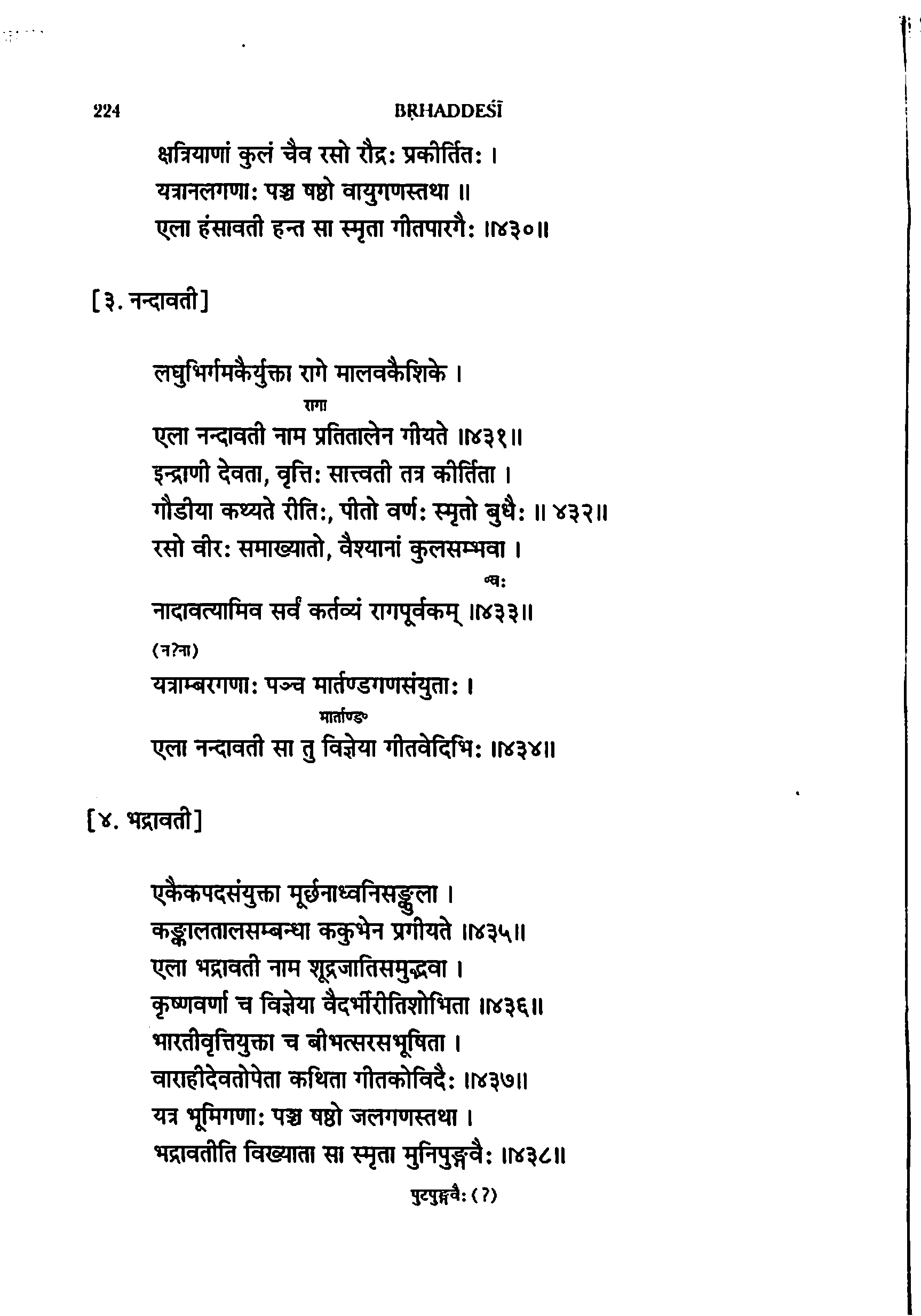
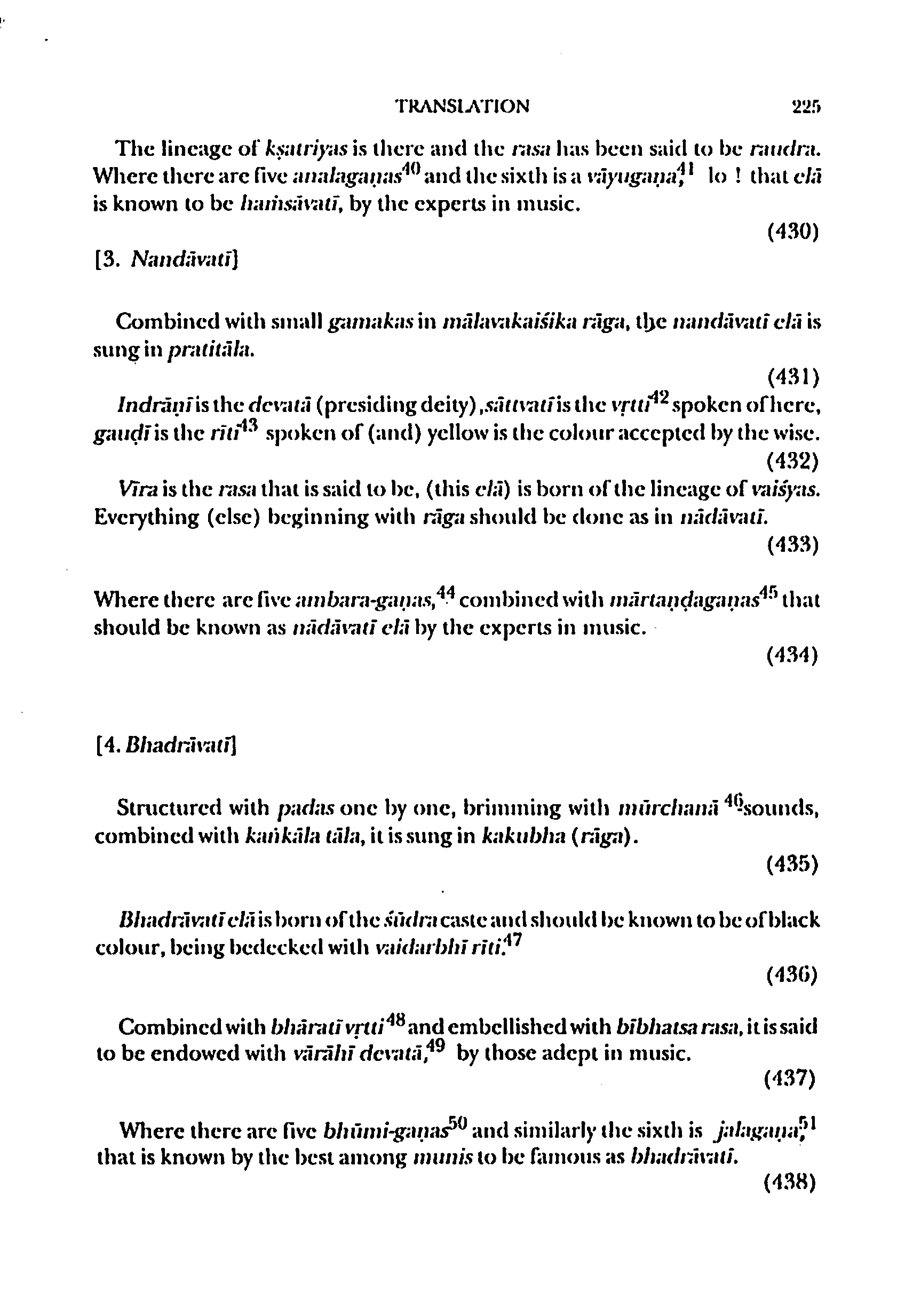
The lineage of kṣatriyas is there and the rasa has been said to be raudra.
Where there are five analoganas <math>^{40}</math> and the sixth is a vāyugana, <math>^{41}</math> lo! that elä
is known to be
hamsāvatī, by the experts in music.
(430)
Combined with small
gamakas in
mālavakaišika rāga, the
nandāvatī elā is
sung in
pratitāla.
(431)
Indrāņī is the devatā (presiding deity)2,
sāttvatī is the vṛtti
42 spoken of here,
gaudi is the <math>riti^{43}</math> spoken of (and) yellow is the colour accepted by the wise.
(432)
Vīra is the rasa that is said to be, (this clā) is born of the lineage of vaisyas.1
Everything (else) beginning with rāga should be done as in
nādāvatī.
(433)
Where there are five <math>ambara</math>-gaņas, <math>^{44}</math> combined with <math>m\bar{a}rta\eta daga\eta as^{45}</math> that
should be known as
nādāvatī elā by the experts in music.
(434)
Structured with padas one by one, brimming with
mūrchanā 46 sounds,
combined with kańkāla tāla, it is sung in kakubha (rāga).12
(435)
Bhadrāvatī elā is born of the śūdra caste and should be known to be of black
colour,15 being bedecked with vaidarbhī rīti.547
(436)
Combined with bhāratī vṛtti6 48 and embellished with
bībhatsa rasa, it is said
to be endowed with vārāhī devatā,49 by those adept in music.
(437)
Where there are five <math>bh\bar{u}mi</math>-gaņas
50 and similarly the sixth is <math>jalagaņa_i^{51}</math>
that is known by the best among munis to be famous as
bhadrāvatī.
(438)