Source scans · vol_I_p011
recto · open full
scan recto
verso · open full
scan verso
Bṛhaddeśī · Volume I
pp. 4–1270folio 011
Devanāgarī
BŖHADDEŚĪ
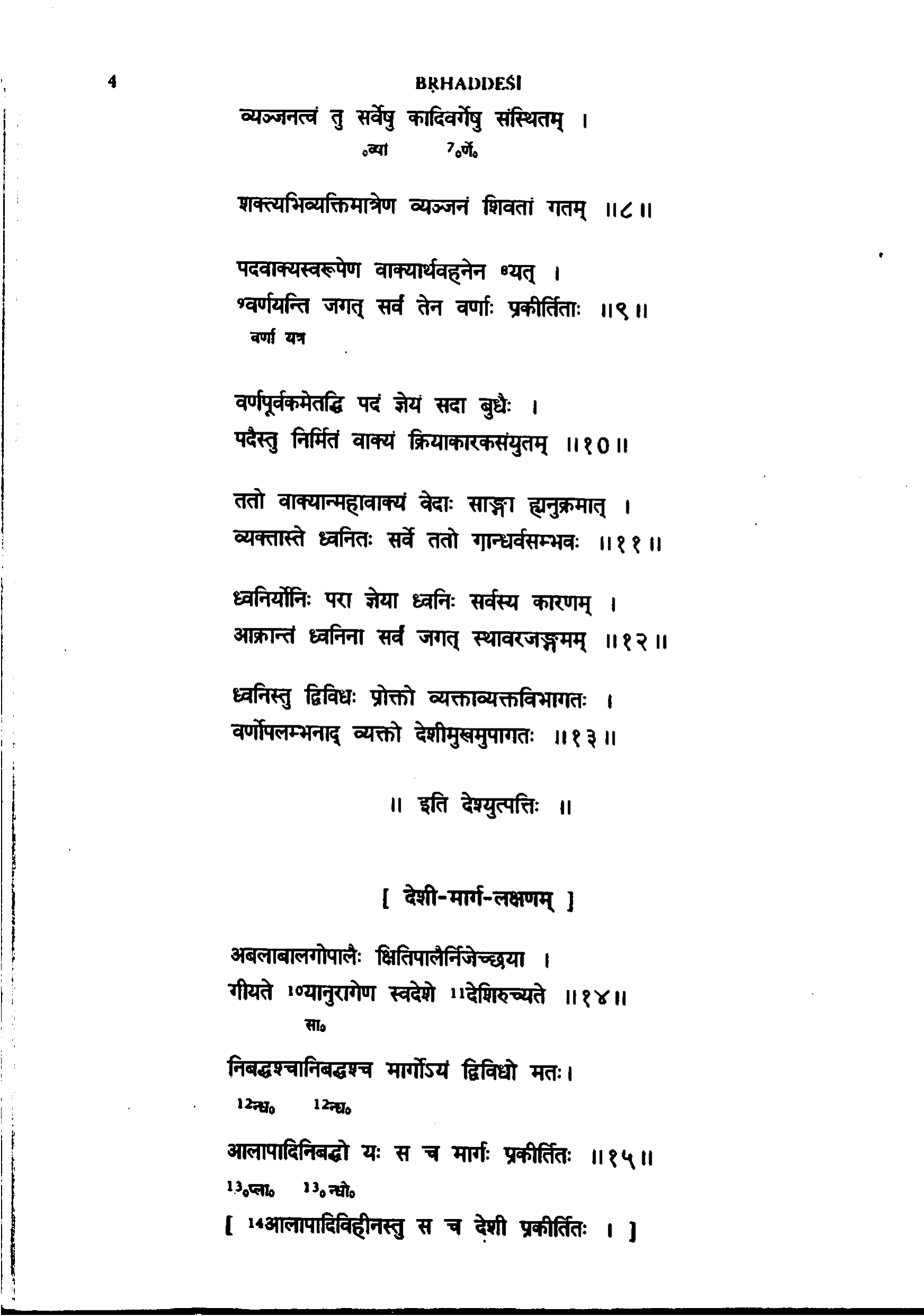
व्यञ्जनत्वं तु सर्वेषु<b>ु</b>व्या कादिवर्गेषु7ुर्णे संस्थितम्12
शक्त्यभिव्यक्तिमात्रेण व्यञ्जनं शिवतां गतम्9 ॥८॥
पदवाक्यस्वरूपेण वाक्यार्थवहनेन ध्यत् ।
9वर्णयन्तिवर्णा यत्र जगत् सर्वं तेन वर्णाः प्रकीर्तिताः ॥९॥
वर्णपूर्वकमेतिद्ध पदं ज्ञेयं सदा बुधैः ।
पदैस्तु निर्मितं वाक्यं क्रियाकारकसंयुतम् ॥१०॥
ततो वाक्यान्महावाक्यं11 वेदाः साङ्गा ह्यनुक्रमात् ।
व्यक्तास्ते ध्वनितः सर्वे ततो गान्धर्वसम्भवः10 ॥११॥
ध्वनियोंनिः परा ज्ञेया ध्वनिः सर्वस्य कारणम् ।
आक्रान्तं ध्वनिना सर्वं जगत् स्थावरजङ्गमम्8 ॥१२॥
ध्वनिस्तु द्विविधः प्रोक्तो व्यक्ताव्यक्तविभागतः6
वर्णीपलम्भनाद् व्यक्तो देशीमुखमुपागतः ॥१३॥
॥ इति देश्युत्पत्तिः ॥
[देशी-मार्ग-लक्षणम्]
अबलाबालगोपालैः क्षितिपालैर्निजेच्छया ।
गीयते 10यानुरागेणसा स्वदेशे 11देशिरुच्यते ॥१४॥
निबद्धश्चानिबद्धश्च मार्गोऽयं द्विविधो मतः7
12710 आलापादिनिबद्धो13, प्ला, 13, न्धो, यः स च मार्गः प्रकीर्तितः5 ॥१५॥
[14आलापादिविहीनस्तु स च देशी प्रकीर्तितः2]
English — Sharma
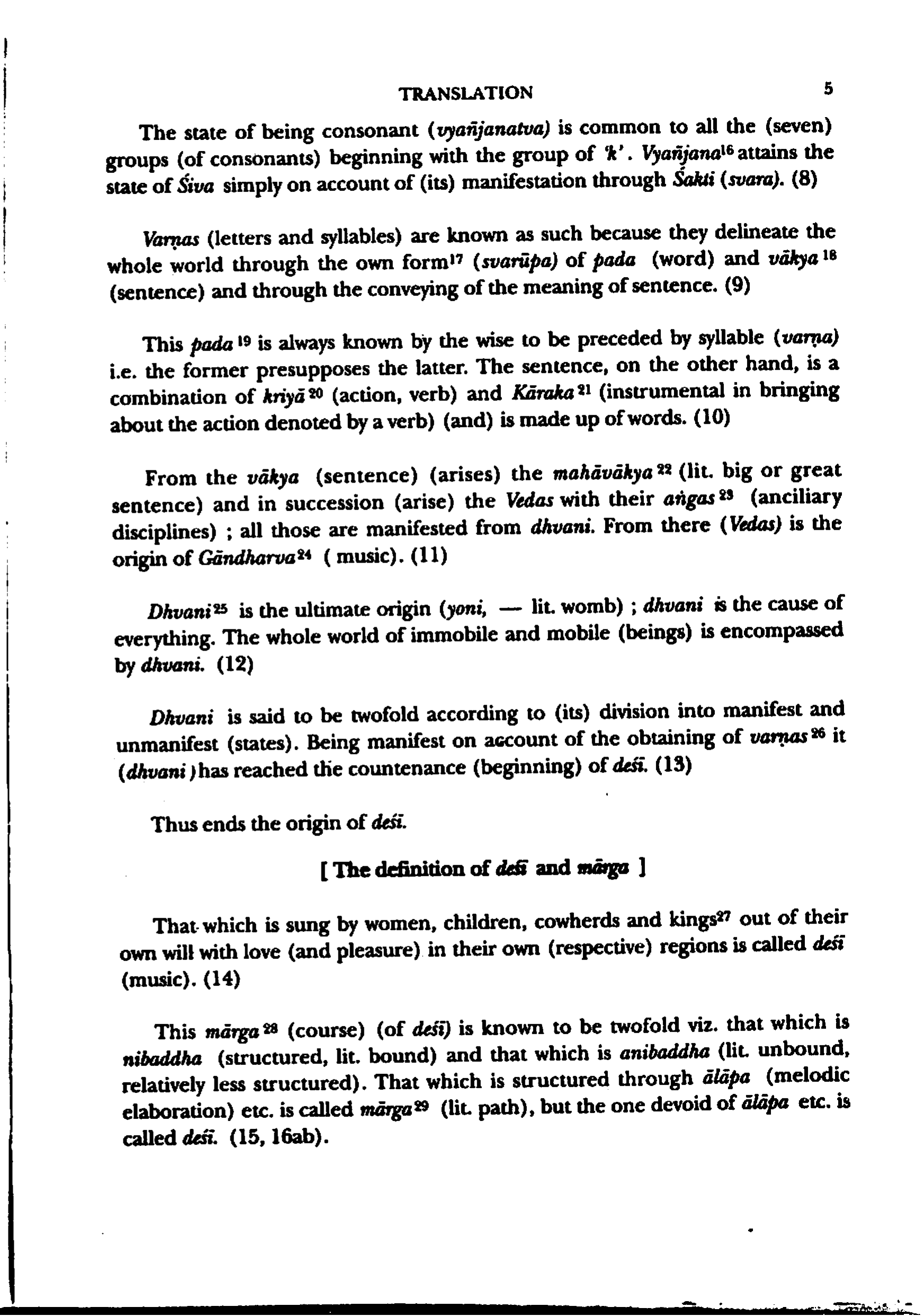
The state of being consonant (vyanjanatva) is common to all the (seven) groups (of consonants) beginning with the group of 'k'.12 Vyanjana16 attains the state of Siva simply on account of (its) manifestation through Sakti (svara).9 (8) Varņas (letters and syllables) are known as such because they delineate the whole world through the own form17 (svarūpa) of pada (word) and vākya 18 (sentence) and through the conveying of the meaning of sentence. (9) This pada 19 is always known by the wise to be preceded by syllable (varna) i.e. the former presupposes the latter. The sentence, on the other hand, is a combination of kriyā 20 (action, verb) and Kāraka 21 (instrumental in bringing about the action denoted by a verb) (and) is made up of words. (10) From the vākya (sentence) (arises) the mahāvākya 22 (lit. big or great sentence) and in succession (arise) the Vedas with their angas 23 (anciliary disciplines); all those are manifested from dhvani. From there (Vedas) is the origin of Gandharva24 (music). (11) Dhvani25 is the ultimate origin (yoni, — lit. womb); dhvani is the cause of everything. The whole world of immobile and mobile (beings) is encompassed by dhvani.8 (12) Dhvani is said to be twofold according to (its) division into manifest and unmanifest (states).6 Being manifest on account of the obtaining of varnas 26 it (dhvani) has reached the countenance (beginning) of desi. (13) Thus ends the origin of desi.
[The definition of dest and marga]
That which is sung by women, children, cowherds and kings27 out of their own will with love (and pleasure) in their own (respective) regions is called desi (music). (14) This mārga 28 (course) (of deśi) is known to be twofold viz. that which is nibaddha (structured, lit. bound) and that which is anibaddha (lit. unbound, relatively less structured). That which is structured through ālāpa (melodic elaboration) etc. is called mārga 29 (lit. path), but the one devoid of ālāpa etc. is called desi.2 (15, 16ab).
1.[citation] The Brihaddesi treats the origin of desi music and the definition of desi and marga.॥ इति देश्युत्पत्ति ॥
2.[definition] Anibaddha desi is devoid of ālāpa and related elaborative techniques.आलापादिविहीनस्तु स च देशी प्रकीर्तितः
5.[definition] Nibaddha mārga is structured through ālāpa and related techniques.आलापादिनिबद्धो यः स च मार्गः प्रकीर्तितः
6.[enumeration] Dhvani is twofold: manifest and unmanifest.ध्वनिस्तु द्विविधः प्रोक्तो व्यक्ताव्यक्तविभागतः
7.[enumeration] Mārga has two varieties: nibaddha (structured) and anibaddha (unstructured).निबद्धश्चानिबद्धश्च मार्गोऽयं द्विविधो मतः
8.[relation] The entire world of immobile and mobile beings is encompassed by dhvani.आक्रान्तं ध्वनिना सर्वं जगत् स्थावरजङ्गमम्
9.[relation] Vyanjana attains the state of Siva through manifestation via Sakti (svara).शक्त्यभिव्यक्तिमात्रेण व्यञ्जनं शिवता गतम्
10.[relation] Gandharva (music) originates from the Vedas with their ancillary disciplines.ततो गान्धर्वसम्भवः
11.[relation] Mahāvākya (great sentence) arises from vākya (sentence).ततो वाक्यान्महावाक्यं
12.[structural] The state of being consonant (vyanjanatva) is common to all groups of consonants beginning with the group of 'k'.व्यञ्जनत्वं तु सर्वेषु कादिवर्गेषु संस्थितम्
1.[citation]The Brihaddesi treats the origin of desi music and the definition of desi and marga.Thus ends the origin of desi. [The definition of dest and marga ]
2.[definition]Anibaddha desi is devoid of ālāpa and related elaborative techniques.but the one devoid of ālāpa etc. is called desi.
3.[definition]Dhvani is the ultimate origin (yoni) and the cause of everything.Dhvani25 is the ultimate origin (yoni, — lit. womb); dhvani is the cause of everything.
4.[definition]Desi is music sung by women, children, cowherds and kings out of their own will with love in their own regions.That which is sung by women, children, cowherds and kings27 out of their own will with love (and pleasure) in their own (respective) regions is called desi (music).
5.[definition]Nibaddha mārga is structured through ālāpa and related techniques.That which is structured through ālāpa (melodic elaboration) etc. is called mārga29 (lit. path)
6.[enumeration]Dhvani is twofold: manifest and unmanifest.Dhvani is said to be twofold according to (its) division into manifest and unmanifest (states).
7.[enumeration]Mārga has two varieties: nibaddha (structured) and anibaddha (unstructured).This mārga28 (course) (of deśī) is known to be twofold viz. that which is nibaddha (structured, lit. bound) and that which is anibaddha (lit. unbound, relatively less structured).
8.[relation]The entire world of immobile and mobile beings is encompassed by dhvani.The whole world of immobile and mobile (beings) is encompassed by dhvani.
9.[relation]Vyanjana attains the state of Siva through manifestation via Sakti (svara).Vyanjana16 attains the state of Siva simply on account of (its) manifestation through Sakti (svara).
10.[relation]Gandharva (music) originates from the Vedas with their ancillary disciplines.From there (Vedas) is the origin of Gandharva24 (music).
11.[relation]Mahāvākya (great sentence) arises from vākya (sentence).From the vākya (sentence) (arises) the mahāvākya22 (lit. big or great sentence)
12.[structural]The state of being consonant (vyanjanatva) is common to all groups of consonants beginning with the group of 'k'.The state of being consonant (vyanjanatva) is common to all the (seven) groups (of consonants) beginning with the group of 'k'.