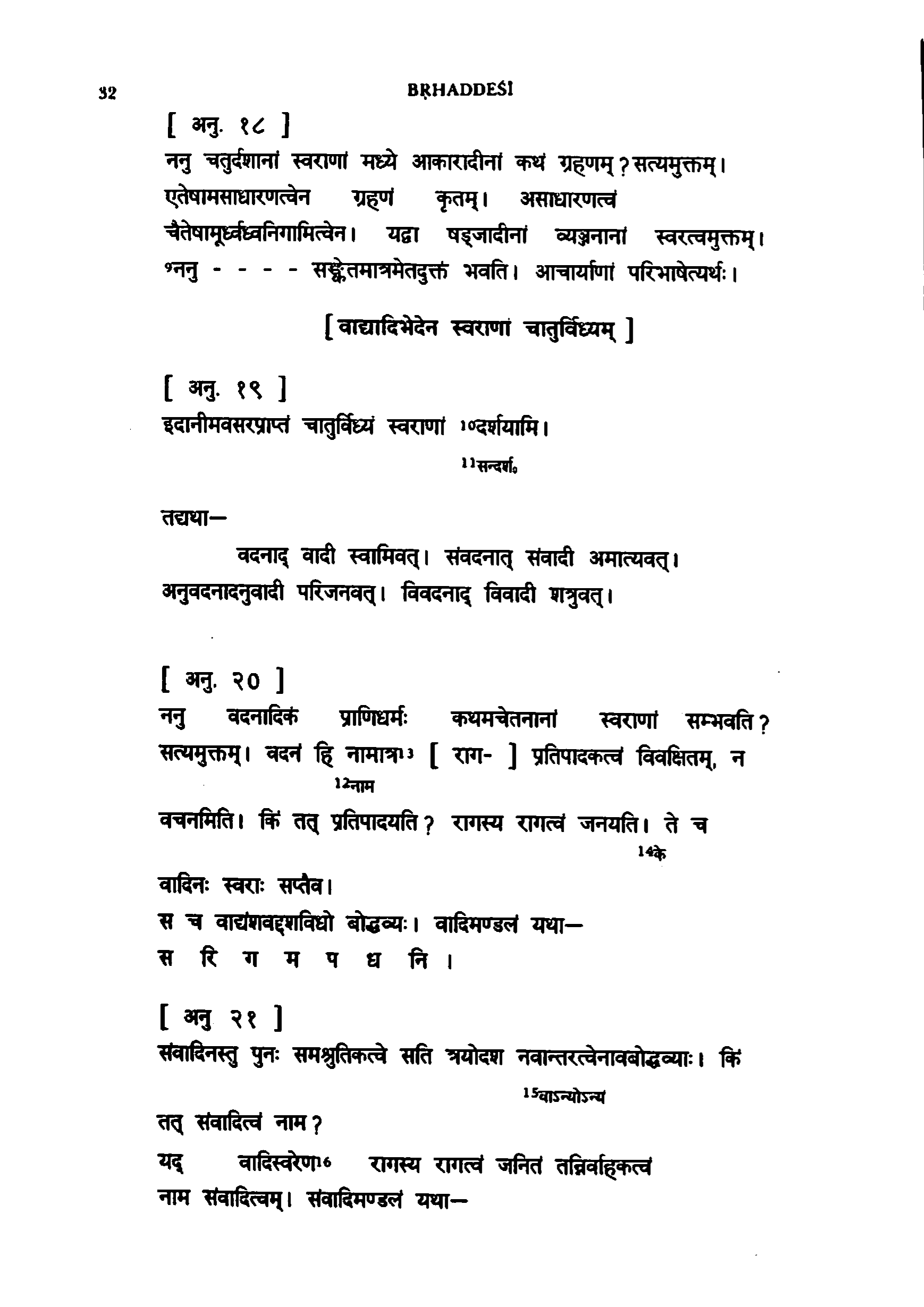
(Anu. 18)
But why are (vowels) beginning with ākāra 21 accepted out of fourteen 22
svaras? Truly has this been said. These have been accepted because of their
uncommonness. Their uncommonness is because of their movement in upward
sound.23 Or,
the svaratva of vyanjanas beginning with şadja has been spoken of.11
But ....
this is said to be only a sign 24 (by convention), that is to say, (the names
of svaras) are the paribhāṣā 25 (list of abbreviations or signs) used by ācāryas
(teachers).4
[The fourfold-ness of svaras according to kinds beginning with vadin]
(Anu. 19)
Now I show the fourfold-ness of svaras, that befits the occasion or context.
That is thus -
Vādin 26 is so because of vadana 27 (speaking), like the master.1 The
saṃvādin28 is so because of saṃvadana
29 (supportive speaking), like the minister.
The
anuvādin50 is so because of anuvadana
51 (following or obedient speaking)
like the attendants.
Vivādin 52 is so because of vivadana 53 (opposite speaking),
like the enemy.
(Anu. 20)
But vadana and the like are the nature (dharma) of living beings, how are they
possible in insentient svaras? Truly has this been said.
Vadana is here intended to
mean the exposition of raga 34 (melody-matrix), not talking.3 What does it (vadana
and the like) expound? It produces the ragatva 35 of raga.3610 Those vadin svaras
are only seven. That vādin should be understood as tenfold like the amśa.57
The
vādi-maņdala (cycle of vādins) is thus - sa, ri, ga, ma, pa, dha, ni.9
(Anu. 21)
The
samvadins should again be understood according to the interval of
thirteen and nine śrutis, when there is
sama-śrutikatva 38 (equal interval of the
two svaras concerned, in terms of number of śrutis).2 What indeed is that
samuāditua? The carrying forward or accomplishment
59 of the rāgatua of rāga
produced by the vādi-svara is indeed samvāditva (the nature of
samvādin). The
samvādi-mandala is thus —