Source scans · vol_I_p024
recto · open full
scan recto
verso · open full
scan verso
Bṛhaddeśī · Volume I
pp. 30–31folio 024
Devanāgarī
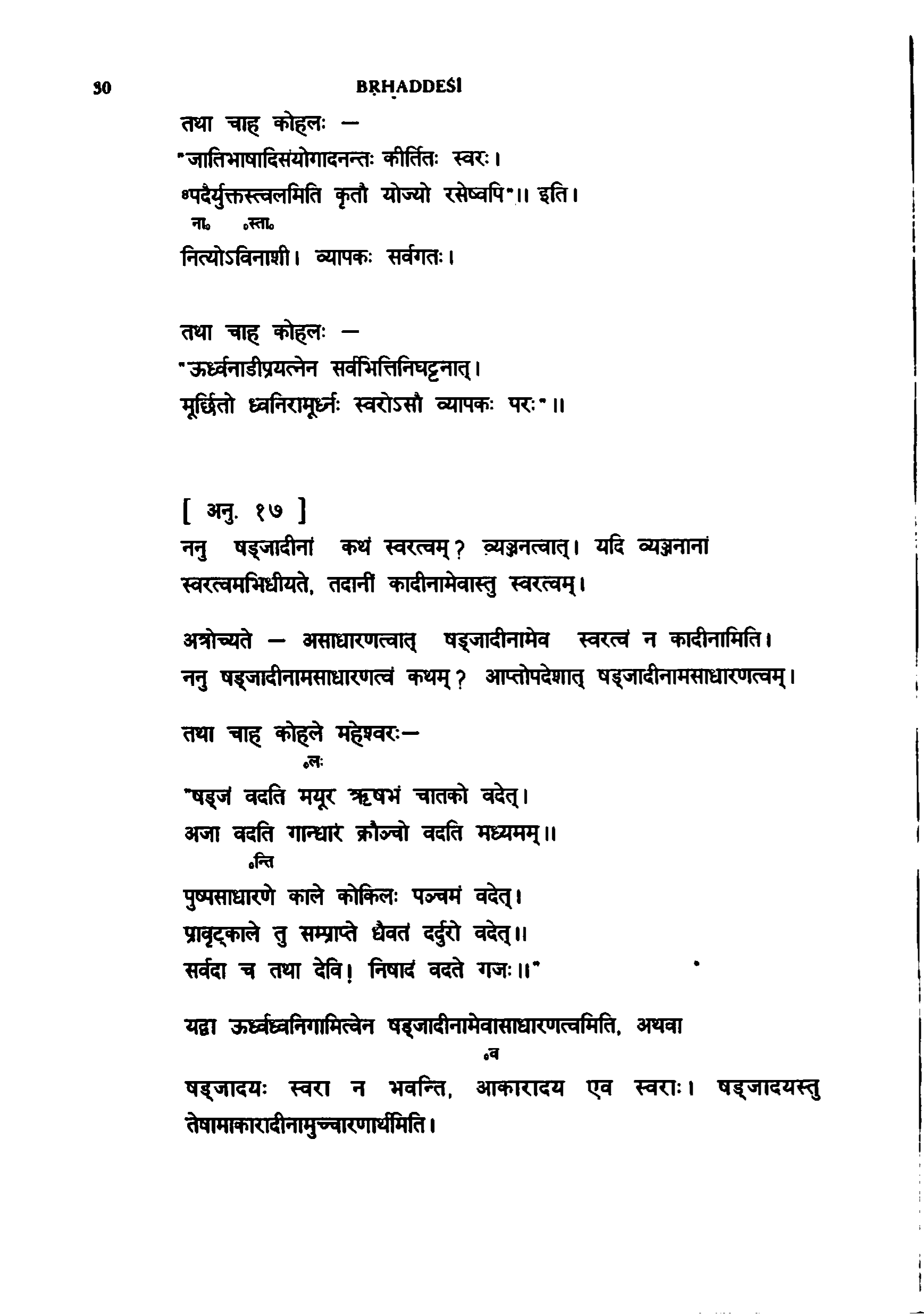
तथा चाह कोहलः — "जातिभाषादिसंयोगादनन्तः。स्ता。ना कीर्तितः<b>॰पदैर्युक्तस्त्वलमिति कृतौ योज्यो रसेष्वपि</b>"।। इति। स्वरः।1 नित्योऽविनाशी11तथा चाह कोहलः —व्यापकः सर्वगतः।5 "ऊर्ध्वनाडीप्रयत्नेन सर्वीभत्तिनिघट्टनात्। मुर्छितो ध्वनिरामुर्ध्नः स्वरोऽसौ व्यापकः परः"।।7
[अनु. १७]
ननु षड्जादीनां कथं स्वरत्वम् ? व्यञ्जनत्वात्। यदि व्यञ्जनानां
स्वरत्वमभिधीयते, तदानीं कादीनामेवास्तु स्वरत्वम्।
अत्रोच्यते — असाधारणत्वात् षड्जादीनामेव स्वरत्वं न कादीनामिति।8 ननु षड्जादीनामसाधारणत्वं कथम् ? आप्तोपदेशात् षड्जादीनामसाधारणत्वम्।2 तथा चाह कोहले。लः महेश्वरः-4 "षड्जं वदति मयूर ऋषभं चातको वदेत्। अजा वदित्नित गान्धारं क्रौञ्चो वदित मध्यमम्।।6 पुष्पसाधारणे काले कोकिलः पञ्चमं वदेत्।9
प्रावृद्काले तु सम्प्राप्ते धैवतं दर्दुरो वदेत्।।
सर्वदा च तथा देवि। निषादं वदते गजः॥" यद्वा ऊर्ध्वध्वनिगामित्वेन षड्जादीनामेवासाधारणत्वमिति,₄व अथवा षड्जादयः स्वरा न भवन्ति, आकारादय एव स्वराः। षड्जादयस्तु तेषामाकारादीनामुच्चारणार्थमिति।10
English — Sharma (translation)
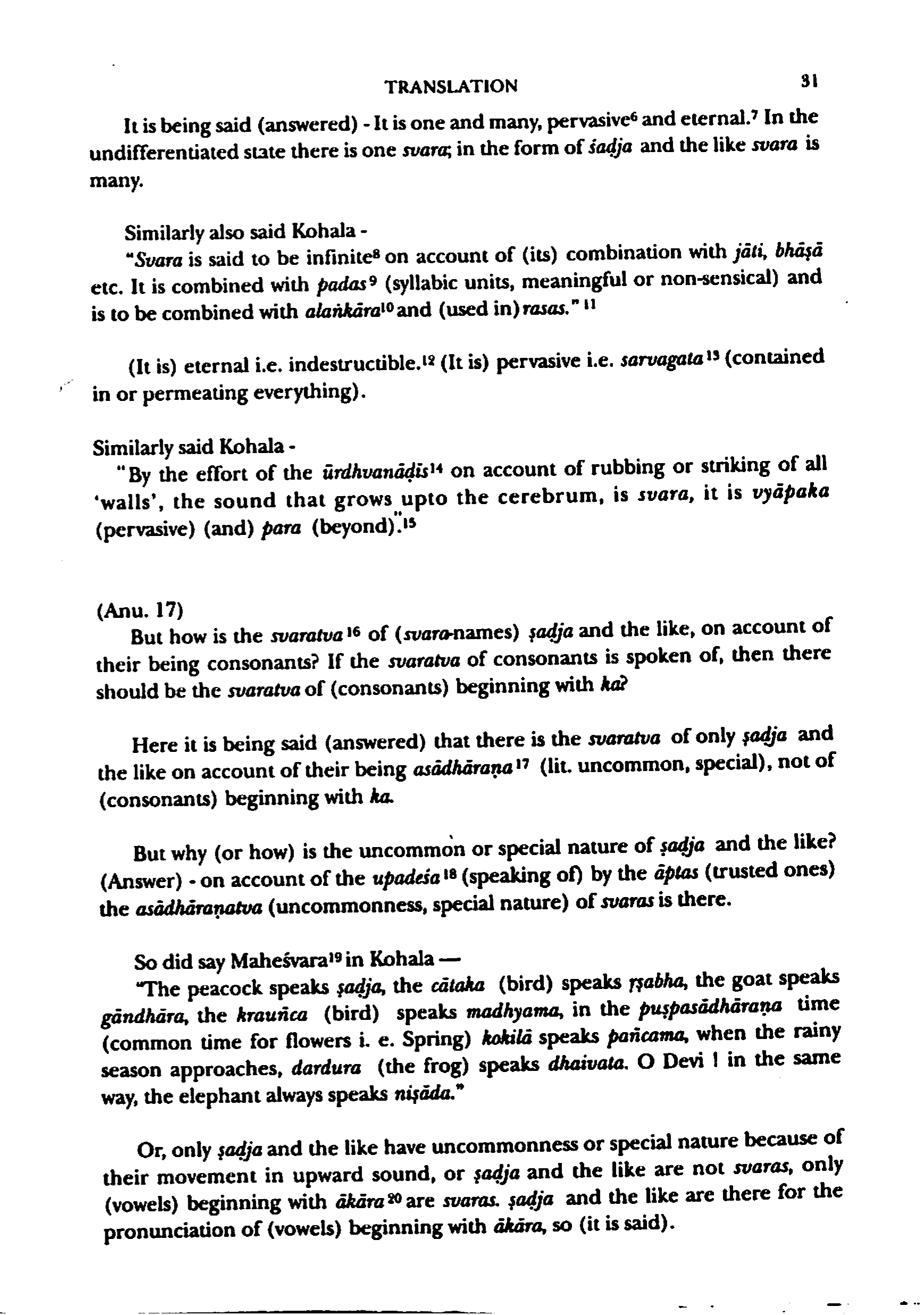
It is being said (answered) - It is one and many, pervasive6 and eternal.7 In the undifferentiated state there is one svara; in the form of sadja and the like svara is many. Similarly also said Kohala - "Svara is said to be infinite" on account of (its) combination with jāti, bhāṣā etc.31 It is combined with padas 9 (syllabic units, meaningful or non-sensical) and is to be combined with alankāra10 and (used in) rasas." 11 (It is) eternal i.e. indestructible. 12 (It is) pervasive i.e. sarvagata 13 (contained in or permeating everything).5 Similarly said Kohala - "By the effort of the ūrdhvanāḍīs14 on account of rubbing or striking of all 'walls', the sound that grows upto the cerebrum, is svara, it is vyāpaka (pervasive) (and) para (beyond).15 (Anu. 17) But how is the svaratva 16 of (svara-names) şadja and the like, on account of their being consonants? If the svaratva of consonants is spoken of, then there should be the svaratva of (consonants) beginning with ka? Here it is being said (answered) that there is the svaratva of only şadja and the like on account of their being asādhāraņa 17 (lit. uncommon, special), not of (consonants) beginning with ka.8 But why (or how) is the uncommon or special nature of sadja and the like? (Answer) - on account of the upadesa 18 (speaking of) by the aptas (trusted ones) the asadharanatva (uncommonness, special nature) of svaras is there.2 So did say Maheśvara19 in Kohala —4 "The peacock speaks şadja, the cātaka (bird) speaks ṛṣabha, the goat speaks gāndhāra, the kraunca (bird) speaks madhyama,6 in the puspasādhāraņa time (common time for flowers i. e. Spring) kokilā speaks pañcama,9 when the rainy season approaches, dardura (the frog) speaks dhaivata. O Devi ! in the same way, the elephant always speaks niṣāda." Or, only sadja and the like have uncommonness or special nature because of their movement in upward sound, or şadja and the like are not svaras, only (vowels) beginning with ākāra 20 are svaras. şadja and the like are there for the pronunciation of (vowels) beginning with ākāra10, so (it is said).
1.[attribution]Svara is infinite on account of its combination with jāti, bhāṣā and other elements"ज?ातिभाषादिसंयोगादनन्तः कीर्तितः स्वरः।
2.[attribution] The uncommon or special nature of śadja and the like is established by the teaching (upadesa) of the trusted authorities (aptas)आप्तोपदेशात् षड्ज?ादीनामसाधारणत्वम्।
3.[attribution] Kohala is credited with teachings on svara as infinite, combined with padas, alankāra and rasasतथा चाह कोहलः — "ज?ातिभाषादिसंयोगादनन्तः कीर्तितः स्वरः।
4.[citation] Maheśvara is cited in the Kohala text for a verse describing which animals speak which svarasतथा चाह कोहले महेश्वरः-
5.[definition] Svara is pervasive, meaning it is contained in or permeating everythingव्यापकः सर्वगतः।
6.[enumeration]The seven svaras are śadja, ṛṣabha, gāndhāra, madhyama, pañcama, dhaivata, and niṣāda, each associated with specific animals"षड्ज? वदति मयूर ऋषभं चातको वदेत्। अजा वदित गान्धारं क्रौञ्चो वदित मध्यमम्।।
7.[relation]By the effort of ūrdhvanāḍīs and through striking of all walls, sound that grows upto the cerebrum becomes svara"ऊर्ध्वनाडीप्रयत्नेन सर्वीभत्तिनिघट्टनात्। मुर्छितो ध्वनिरामुर्ध्नः स्वरोऽसौ व्यापकः परः"।।
8.[relation] Śadja and the like have svaratva (the quality of being a svara) due to their asādhāraņa nature, not consonants beginning with kaअसाधारणत्वात् षड्ज?ादीनामेव स्वरत्वं न कादीनामिति।
9.[relation]During the puspasādhāraņa time (spring, the common season for flowers), the kokilā (cuckoo) speaks pañcamaपुष्पसाधारणे काले कोकिलः पञ्चमं वदेत्।
10.[relation] Vowels beginning with ākāra are considered true svaras, while śadja and the like exist for their pronunciationषड्ज?ादयस्तु तेषामाकारादीनामुच्चारणार्थमिति।
11.[structural] Svara is eternal and indestructibleनित्योऽविनाशी
1.[attribution] Svara is infinite on account of its combination with jāti, bhāṣā and other elements"Svara is said to be infinite" on account of (its) combination with jāti, bhāṣā etc.
2.[attribution]The uncommon or special nature of śadja and the like is established by the teaching (upadesa) of the trusted authorities (aptas)on account of the upadesa (speaking of) by the aptas (trusted ones) the asadharanatva (uncommonness, special nature) of svaras is there.
3.[attribution]Kohala is credited with teachings on svara as infinite, combined with padas, alankāra and rasasSimilarly also said Kohala - "Svara is said to be infinite" on account of (its) combination with jāti, bhāṣā etc.
4.[citation]Maheśvara is cited in the Kohala text for a verse describing which animals speak which svarasSo did say Maheśvara in Kohala —
5.[definition]Svara is pervasive, meaning it is contained in or permeating everything(It is) pervasive i.e. sarvagata (contained in or permeating everything).
6.[enumeration] The seven svaras are śadja, ṛṣabha, gāndhāra, madhyama, pañcama, dhaivata, and niṣāda, each associated with specific animals"The peacock speaks şadja, the cātaka (bird) speaks ṛṣabha, the goat speaks gāndhāra, the kraunca (bird) speaks madhyama,
8.[relation]Śadja and the like have svaratva (the quality of being a svara) due to their asādhāraņa nature, not consonants beginning with kathere is the svaratva of only şadja and the like on account of their being asādhāraņa (lit. uncommon, special), not of (consonants) beginning with ka.
9.[relation] During the puspasādhāraņa time (spring, the common season for flowers), the kokilā (cuckoo) speaks pañcamain the puspasādhāraņa time (common time for flowers i. e. Spring) kokilā speaks pañcama,
10.[relation]Vowels beginning with ākāra are considered true svaras, while śadja and the like exist for their pronunciationonly (vowels) beginning with ākāra are svaras. şadja and the like are there for the pronunciation of (vowels) beginning with ākāra
11.[structural]Svara is eternal and indestructibleIt is eternal i.e. indestructible.