Source scans · vol_I_p048
recto · open full
scan recto
verso · open full
scan verso
Bṛhaddeśī · Volume I
pp. 78–79folio 048
Devanāgarī
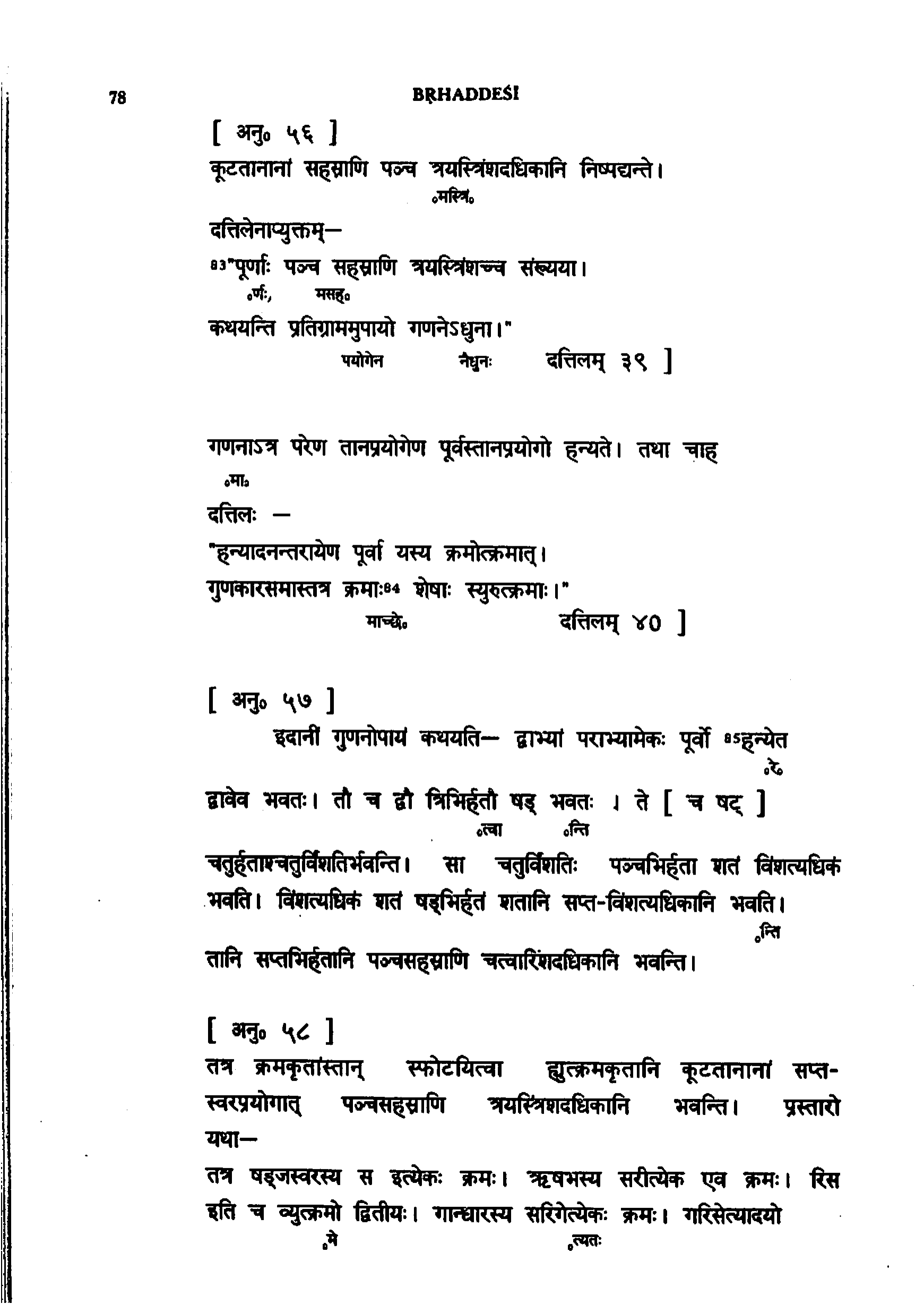
[अनु₀ ५६]
कूटतानानां सहस्राणि पञ्च त्रयस्त्रिंशदधिकानि निष्पद्यन्ते।11 मस्त्रिःदत्तिलेनाप्युक्तम्—
83"पूर्णाःुर्णः, पञ्च सहस्राणि त्रयस्त्रिशच्च संख्यया।
मसत्, कथयन्ति प्रतिग्राममुपायो गणनेऽधुना।" नेधुनः दत्तिलम् ३९ ] पयोगेन गणनाऽत्र₀मा₃ परेण तानप्रयोगेण पूर्वस्तानप्रयोगो हन्यते।2 तथा चाह दत्तिलः —
"हन्यादनन्तरायेण पूर्वा यस्य क्रमोत्क्रमात्।
गुणकारसमास्तत्र5 क्रमाः ध्येमाच्छे. शेषाः स्युरुत्क्रमाः।" दित्तलम् ४० |
[अनु ५७]
इदानी गुणनोपायं कथयति— द्वाभ्यां्रत्वा पराभ्यामेकः्रित पूर्वो बऽहन्येत J. द्वावेव भवतः। तौ च द्वौ त्रिभिर्हतौ षड् भवतः । ते [ च षट् ] चतुर्हताश्चतुर्विंशतिर्भवन्ति। सा चतुर्विंशतिः पञ्चभिर्हता शतं विंशत्यधिकं
भवति। विंशत्यधिकं शतं षड्भिर्हतं शतानि सप्त-विंशत्यधिकानि भवति।
्रन्ति
तानि सप्तभिर्हतानि पञ्चसहस्राणि चत्चारिंशदधिकानि भवन्ति।
अनु₀ ५८ तत्र क्रमकृतास्तान् स्फोटयित्वा ह्युत्क्रमकृतानि कूटतानानां सप्त-
स्वरप्रयोगात् पञ्चसहस्राणि त्रयस्त्रिशदधिकानि भवन्तिप्रस्तारो
यथा— तत्र षड्जस्वरस्य स इत्येकः क्रमः। ऋषभस्य सरीत्येक एव क्रमः। रिस इति च व्युक्तमोुम द्वितीयः।7 गान्धारस्य सरिगेत्येकःुत्यतः क्रमः। गरिसेत्यादयो
English — Sharma (translation)
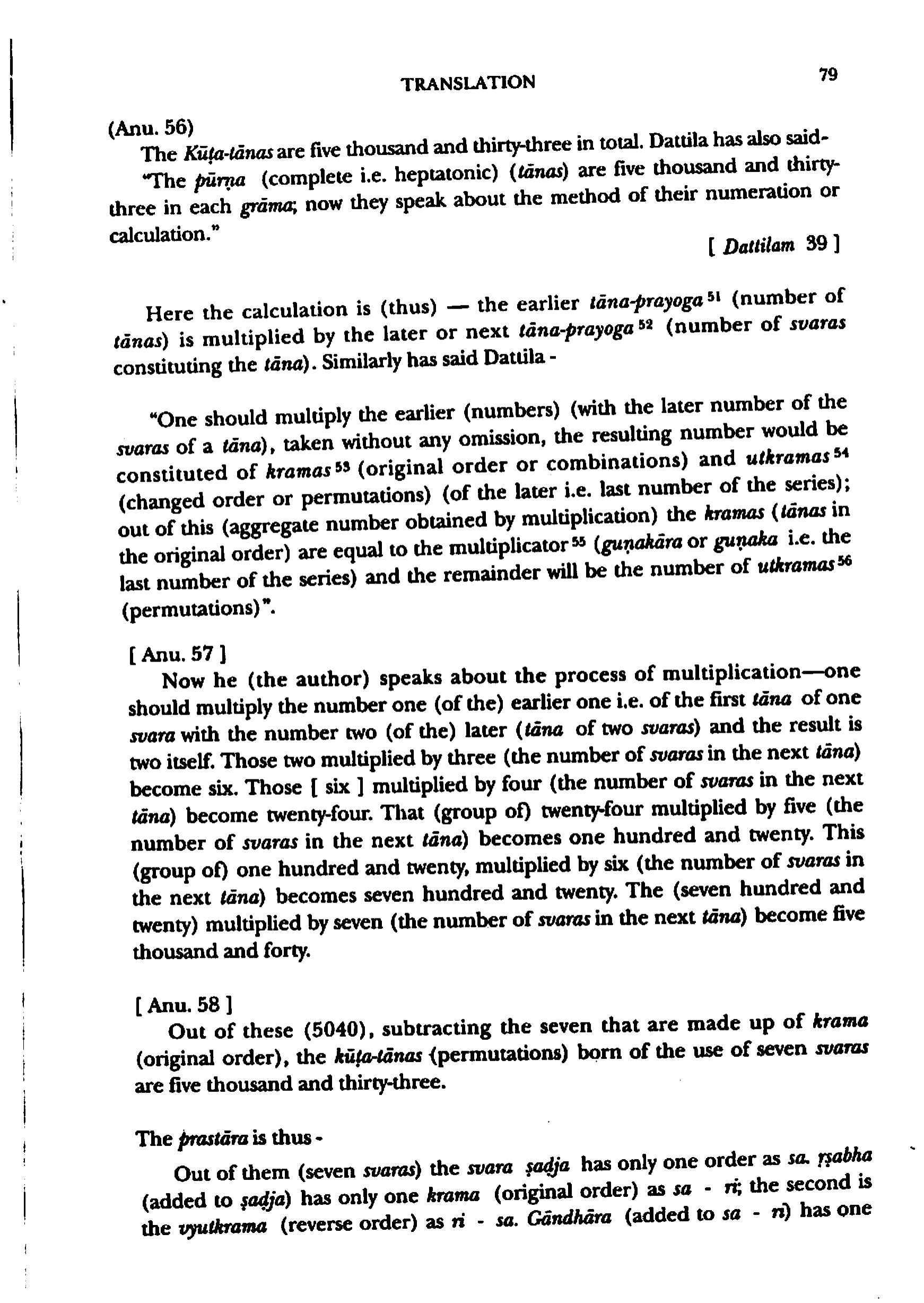
(Anu. 56) The Kūṭa-tānas are five thousand and thirty-three in total. Dattila has also said-1 "The pūrņa (complete i.e. heptatonic) (tānas) are five thousand and thirty- three in each grāma; now they speak about the method of their numeration or calculation." Here the calculation is (thus) — the earlier tāna-prayoga 51 (number of tānas) is multiplied by the later or next tāna-prayoga 52 (number of svaras constituting the tāna)2. Similarly has said Dattila - "One should multiply the earlier (numbers) (with the later number of the svaras of a tana), taken without any omission, the resulting number would be constituted of kramas 53 (original order or combinations)3 and utkramas 54 (changed order or permutations)4 (of the later i.e. last number of the series); out of this (aggregate number obtained by multiplication) the kramas (tānas in the original order) are equal to the multiplicator 55 (guṇakāra or guṇaka i.e. the last number of the series)5 and the remainder will be the number of utkramas 56 (permutations)".
[Anu. 57]
Now he (the author) speaks about the process of multiplication—one should multiply the number one (of the) earlier one i.e. of the first tana of one svara with the number two (of the) later (tana of two svaras) and the result is two itself. Those two multiplied by three (the number of svaras in the next tana) become six. Those [ six ] multiplied by four (the number of svaras in the next tāna) become twenty-four. That (group of) twenty-four multiplied by five (the number of svaras in the next tana) becomes one hundred and twenty. This (group of) one hundred and twenty, multiplied by six (the number of svaras in the next tana) becomes seven hundred and twenty. The (seven hundred and twenty) multiplied by seven (the number of svaras in the next tana) become five thousand and forty.
[Anu. 58]
Out of these (5040), subtracting the seven that are made up of krama (original order), the kūṭa-tānas (permutations) born of the use of seven svaras are five thousand and thirty-three.9 The prastāra is thus -6 Out of them (seven svaras) the svara şadja has only one order as sa. ṛṣabha (added to sadja) has only one krama (original order) as sa - ri; the second is the vyutkrama (reverse order) as n - sa7. Gândhāra (added to sa - n) has one
1.[attribution]Dattila is cited as an authority on tāna enumeration and calculation methodsदत्तिलेनाप्युक्तम्—
2.[definition] tāna-prayoga refers to the number of tānas in a given categoryपयोगेन गणनाऽत्र परेण तानप्रयोगेण पूर्वस्तानप्रयोगो हन्यते।
3.[definition] kramas represent original order or combinations in tāna enumerationगुणकारसमास्तत्र क्रमा ध्ये
4.[definition] utkramas represent changed order or permutations distinct from kramasशेषा स्युरुत्क्रमा।
5.[definition] guṇakāra is the multiplicator or last number in the enumeration seriesगुणकारसमास्तत्र
6.[definition] prastāra is a systematic method of enumerating svaras and their orderingsप्रस्तारो यथा—
7.[definition] vyutkrama represents the reverse order of svaras, distinct from kramaरिस इति च व्युक्तमो द्वितीयः।
8.[definition] pūrņa means complete or heptatonic tānasपूर्णा पञ्च सहस्राणि त्रयस्त्रिशच्च संख्यया।
10.[relation] The total number obtained by multiplication equals the kramas plus the utkramasगुणकारसमास्तत्र क्रमा ध्ये शेषा स्युरुत्क्रमा।
11.[structural]Kūṭa-tānas total five thousand and thirty-three in numberकूटतानाना सहस्राणि पञ्च त्रयस्त्रिंशदधिकानि निष्पद्यन्ते।
1.[attribution] Dattila is cited as an authority on tāna enumeration and calculation methodsDattila has also said-
2.[definition]tāna-prayoga refers to the number of tānas in a given categorythe earlier tāna-prayoga 51 (number of tānas) is multiplied by the later or next tāna-prayoga 52 (number of svaras constituting the tāna)
3.[definition]kramas represent original order or combinations in tāna enumerationthe resulting number would be constituted of kramas 53 (original order or combinations)
4.[definition]utkramas represent changed order or permutations distinct from kramasand utkramas 54 (changed order or permutations)
5.[definition]guṇakāra is the multiplicator or last number in the enumeration seriesthe multiplicator 55 (guṇakāra or guṇaka i.e. the last number of the series)
6.[definition]prastāra is a systematic method of enumerating svaras and their orderingsThe prastāra is thus -
7.[definition]vyutkrama represents the reverse order of svaras, distinct from kramathe second is the vyutkrama (reverse order) as n - sa
8.[definition]pūrņa means complete or heptatonic tānasThe pūrņa (complete i.e. heptatonic) (tānas) are five thousand and thirty-three
9.[relation]Kūṭa-tānas are derived by subtracting the seven kramas from the total permutations of seven svarassubtracting the seven that are made up of krama (original order), the kūṭa-tānas (permutations) born of the use of seven svaras are five thousand and thirty-three.
10.[relation]The total number obtained by multiplication equals the kramas plus the utkramasthe kramas (tānas in the the original order) are equal to the multiplicator 55 (guṇakāra or guṇaka i.e. the last number of the series) and the remainder will be the number of utkramas
11.[structural] Kūṭa-tānas total five thousand and thirty-three in numberthe kūṭa-tānas (permutations) born of the use of seven svaras are five thousand and thirty-three.
12.[structural]Multiplication of successive tāna-prayoga numbers (1×2×3×4×5×6×7) yields 5040one should multiply the number one (of the) earlier one i.e. of the first tana of one svara with the number two (of the) later (tana of two svaras) and the result is two itself. Those two multiplied by three (the number of svaras in the next tana) become six. Those [ six ] multip