Source scans · vol_I_p047
recto · open full
scan recto
verso · open full
scan verso
Bṛhaddeśī · Volume I
pp. 1–77folio 047
Devanāgarī
[अनु. ५१]
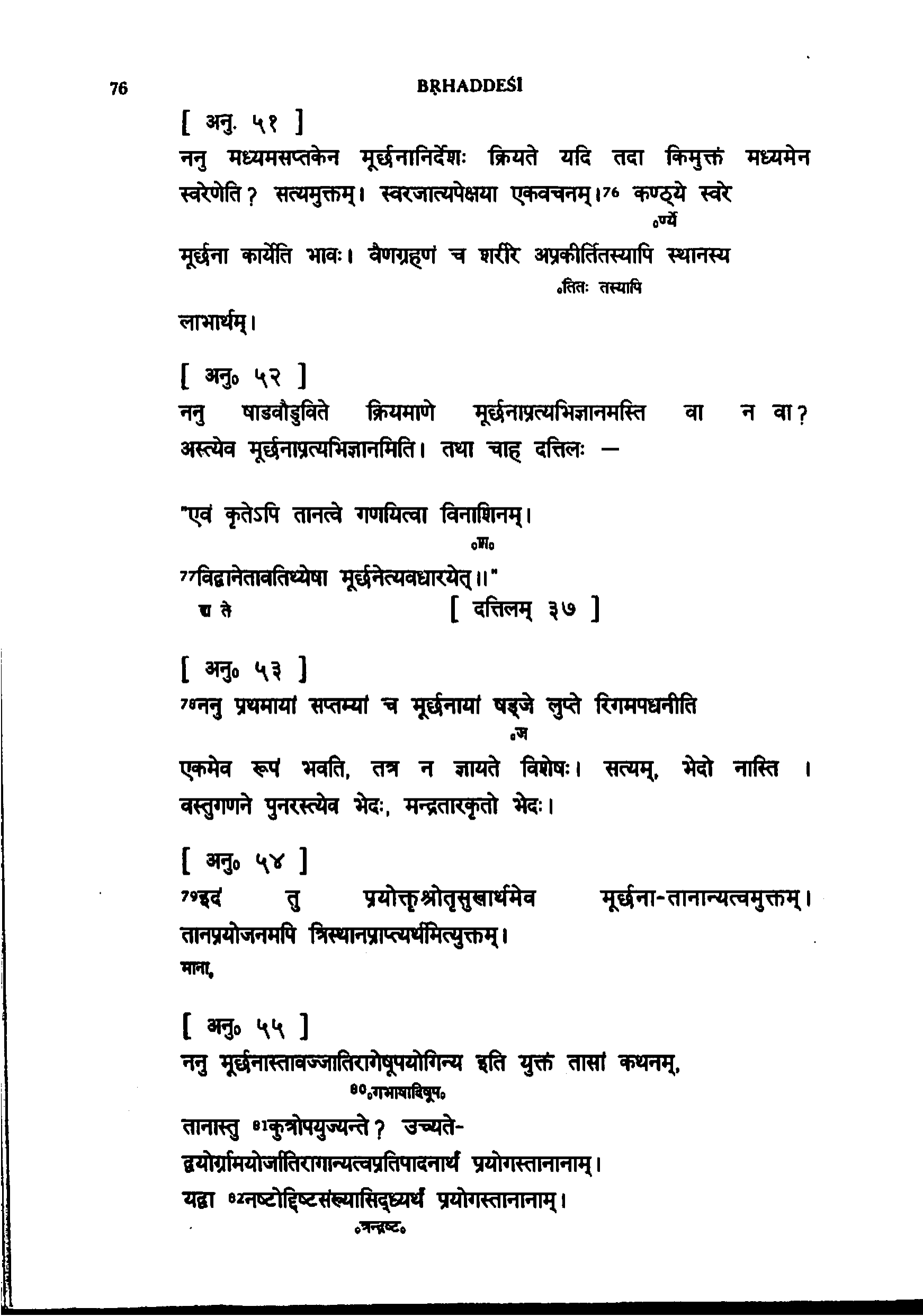
ननु मध्यमसप्तकेन मूर्छनानिर्देशः क्रियते यदि तदा किमुक्तं मध्यमेन स्वरेणेति ? सत्यमुक्तम्। स्वरजात्यपेक्षया एकवचनम्। १७ कण्ठ्ये₀णर्ये स्वरे मूर्छना कार्येति भावः।11 वैणग्रहणं च शरीर अप्रकीर्तितस्यापि्रतितः तस्यापि स्थानस्य
लाभार्थम्।
अनु₀ ५२ ननु षाडवौडुविते क्रियमाणे मूर्छनाप्रत्यभिज्ञानमस्ति वा न वा ? अस्त्येव मूर्छनाप्रत्यभिज्ञानमिति2। तथा चाह दत्तिलः —
"एवं कृतेऽपि तानत्वे गणयित्वा विनाशिनम्।
oWo ७७विद्वानेतावतिथ्येषाच ते मूर्छनेत्यवधारयेत्।।"दत्तिलम् ३७ |
[अनु₀ ५३]
७४ननु प्रथमायां सप्तम्यां च मूर्छनायां षड्जे लुप्ते रिगमपधनीति
एकमेव रूप भवति, तत्र न ज्ञायते विशेषः। सत्यम्, भेदो नास्ति ।
वस्तुगणने पुनरस्त्येव भेदः, मन्द्रतारकृतो भेदः8
[अनु₀ ५४]
७१इद तु प्रयोक्तृश्रोतृसुखार्थमेव मूर्छना-तानान्यत्वमुक्तम्3
तानप्रयोजनमपिमाना, त्रिस्थानप्राप्त्यर्थीमेत्युक्तम्4
[अनु₀ ५५]
ननु मूर्छनास्तावज्जातिरागेषूपयोगिन्य80ंगभाषादिषुपः इति युक्तं7 तासां कथनम्, तानास्तु कुत्रोपयुज्यन्ते ? उच्यते-
द्वयोग्रामयोजीतिरागान्यत्वप्रतिपादनार्थं प्रयोगस्तानानाम्105
यद्वा ६४नष्टोद्दिष्टसंख्यासिद्ध्यर्थं<b>ेत्रन्द्रष्ट</b>ः प्रयोगस्तानानाम्6
English — Sharma
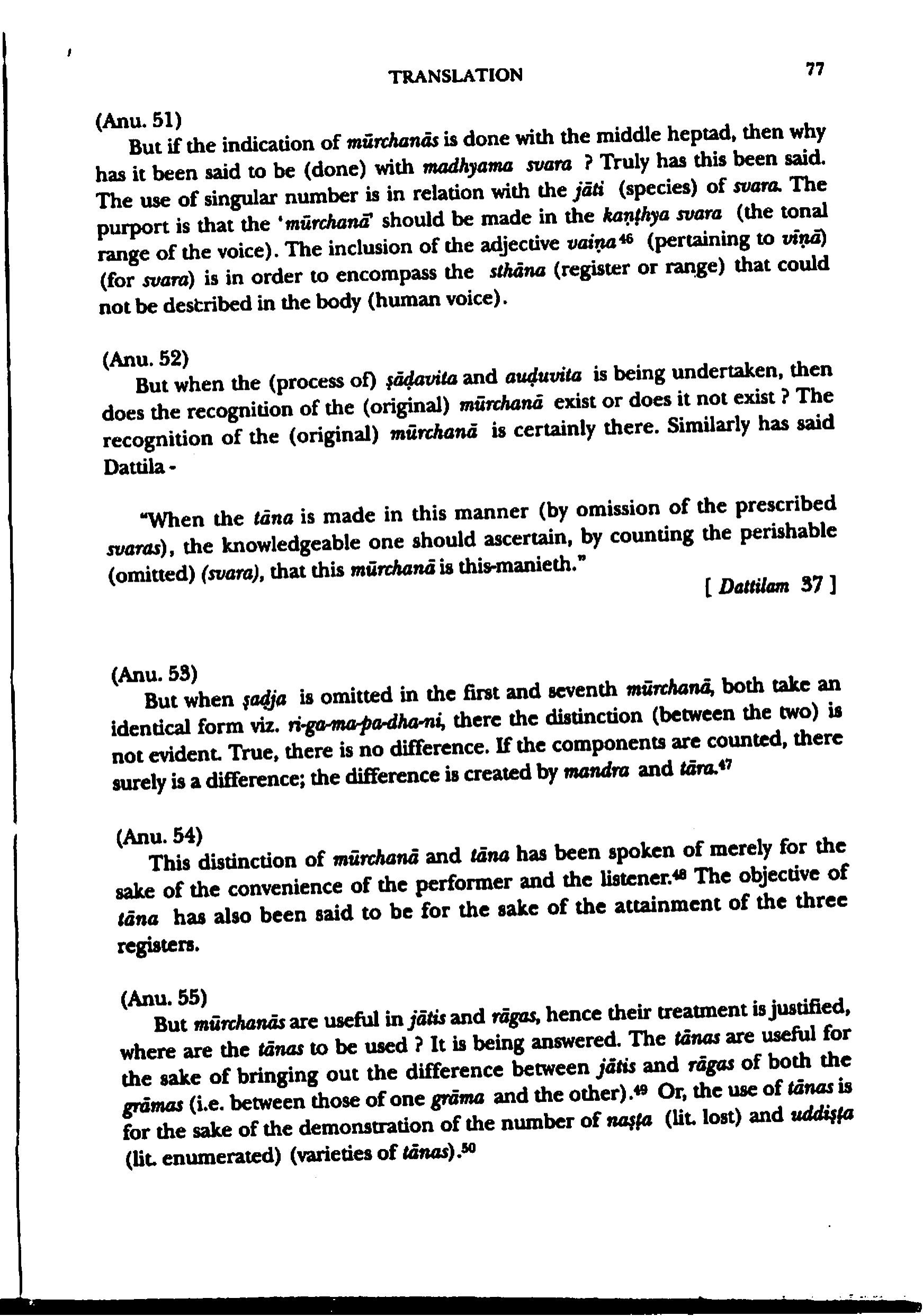
(Anu. 51) But if the indication of murchanas is done with the middle heptad, then why has it been said to be (done) with madhyama svara? Truly has this been said. The use of singular number is in relation with the jāti (species) of svara. The purport is that the 'murchana' should be made in the kanthya svara (the tonal range of the voice).11 The inclusion of the adjective vaina 46 (pertaining to viņā) (for svara) is in order to encompass the sthana (register or range) that could not be described in the body (human voice).9 (Anu. 52) But when the (process of) sādavita and auduvita is being undertaken, then does the recognition of the (original) murchana exist or does it not exist? The recognition of the (original) mūrchanā is certainly there.2 Similarly has said Dattila - "When the tana is made in this manner (by omission of the prescribed svaras), the knowledgeable one should ascertain, by counting the perishable (omitted) (svara), that this murchana is this-manieth."1 (Anu. 53) But when şadja is omitted in the first and seventh mūrchanā, both take an identical form viz. ri-ga-ma-pa-dha-ni, there the distinction (between the two) is not evident. True, there is no difference. If the components are counted, there surely is a difference; the difference is created by mandra and tara.847 (Anu. 54) This distinction of murchana and tana has been spoken of merely for the sake of the convenience of the performer and the listener.348 The objective of tāna has also been said to be for the sake of the attainment of the three registers.4 (Anu. 55) But mūrchanās are useful in jātis and rāgas7, hence their treatment is justified, where are the tanas to be used? It is being answered. The tanas are useful for the sake of bringing out the difference between jatis and ragas of both the grāmas105 (i.e. between those of one grāma and the other).49 Or, the use of tānas is for the sake of the demonstration of the number of nașța (lit. lost) and uddișța (lit. enumerated) (varieties of tānas).650
2.[relation] Recognition of the original murchana exists even when sadavita and auduvita processes are undertakenअस्त्येव मूर्छनाप्रत्यभिज?्ञानमिति
3.[relation] The distinction between murchana and tana is explained for the convenience of performer and listenerइद तु प्रयोक्तृश्रोतृसुखार्थमेव मूर्छना-तानान्यत्वमुक्तम्
4.[relation] The objective of tana is for attainment of the three registersतानप्रयोजनमपि त्रिस्थानप्राप्त्यर्थीमेत्युक्तम्
5.[relation] Tanas are used to bring out the difference between jatis and ragas of both gramasद्वयोग्रामयोज?ीतिरागान्यत्वप्रतिपादनार्थं प्रयोगस्तानानाम्
6.[relation] Tanas are used for demonstration of the number of nasta (lost) and uddista (enumerated) varietiesनष्टोद्दिष्टसंख्यासिद्ध्यर्थं प्रयोगस्तानानाम्
7.[relation] Murchanas are useful in jatis and ragasननु मूर्छनास्तावज्ज?ातिरागेषूपयोगिन्य इति युक्तं
8.[relation] The difference between first and seventh murchana (when sadja is omitted) is created by mandra and taraमन्द्रतारकृतो भेदः
9.[relation] The term vaina (pertaining to vina) is included to encompass registers that could not be described in human vocal rangeवैणग्रहणं च शरीर अप्रकीर्तितस्यापि स्थानस्य नितिः तस्यापि लाभार्थम्
10.[relation] Grama is used as a framework for distinguishing jatis and ragas through the use of tanasद्वयोग्रामयोज?ीतिरागान्यत्वप्रतिपादनार्थं प्रयोगस्तानानाम्
11.[structural]Murchana should be performed in the vocal range (kanthya svara)कण्ठ्ये स्वरे मूर्छना कार्येति भावः।
1.[attribution]Dattila is cited as an authority on recognizing murchanas through counting omitted svarasSimilarly has said Dattila - "When the tana is made in this manner (by omission of the prescribed svaras), the knowledgeable one should ascertain, by counting the perishable (omitted) (svara), that this murchana is this-manieth."
2.[relation]Recognition of the original murchana exists even when sadavita and auduvita processes are undertakenThe recognition of the (original) mūrchanā is certainly there.
3.[relation]The distinction between murchana and tana is explained for the convenience of performer and listenerThis distinction of murchana and tana has been spoken of merely for the sake of the convenience of the performer and the listener.
4.[relation]The objective of tana is for attainment of the three registersThe objective of tāna has also been said to be for the sake of the attainment of the three registers.
5.[relation]Tanas are used to bring out the difference between jatis and ragas of both gramasThe tanas are useful for the sake of bringing out the difference between jatis and ragas of both the grāmas
6.[relation]Tanas are used for demonstration of the number of nasta (lost) and uddista (enumerated) varietiesthe use of tānas is for the sake of the demonstration of the number of nașța (lit. lost) and uddișța (lit. enumerated) (varieties of tānas).
7.[relation]Murchanas are useful in jatis and ragasmūrchanās are useful in jātis and rāgas
8.[relation]The difference between first and seventh murchana (when sadja is omitted) is created by mandra and tarathe difference is created by mandra and tara.
9.[relation]The term vaina (pertaining to vina) is included to encompass registers that could not be described in human vocal rangeThe inclusion of the adjective vaina 46 (pertaining to viņā) (for svara) is in order to encompass the sthana (register or range) that could not be described in the body (human voice).
10.[relation]Grama is used as a framework for distinguishing jatis and ragas through the use of tanasThe tanas are useful for the sake of bringing out the difference between jatis and ragas of both the grāmas
11.[structural] Murchana should be performed in the vocal range (kanthya svara)The purport is that the 'murchana' should be made in the kanthya svara (the tonal range of the voice).