Source scans · vol_I_p049
recto · open full
scan recto
verso · open full
scan verso
Bṛhaddeśī · Volume I
pp. 80–81folio 049
Devanāgarī
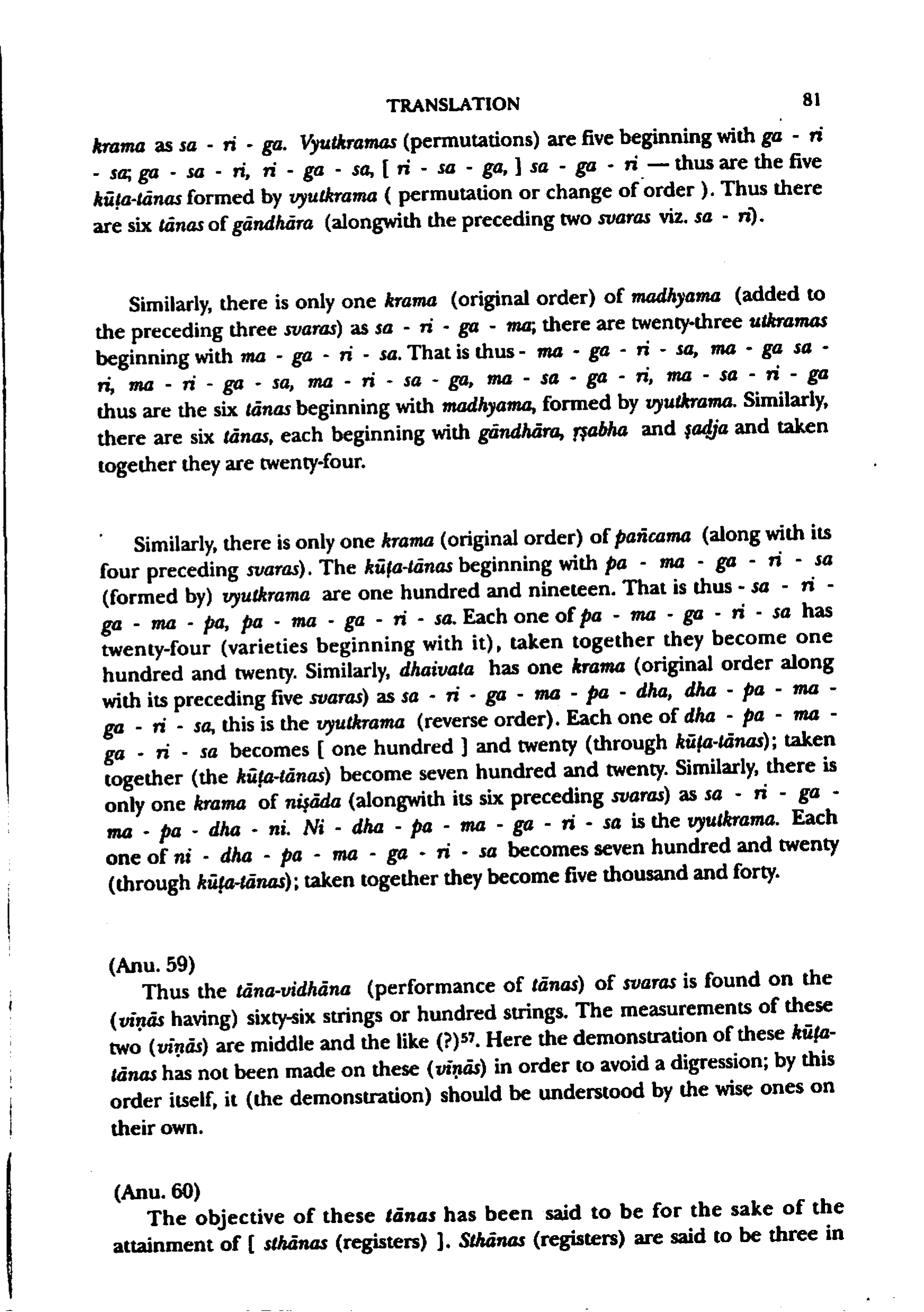
व्युत्क्रमाः पञ्च।गरिस गसरि रिगस [ रिसग ] सगरि इति व्युत्क्रमेण2
क्टतानाः पञ्च। तदेवंुञ्चम (?) गान्धारस्यरिगस गसरि षट् तानाः।
एवं मध्यमस्य सरिगमेत्येकः क्रमः। मगरिसेत्येवमादयस्त्रयो-्रयो- - विंशतिरुत्क्रमाः। तद्यथा—ब्ध्मगरिस, मगसरि, मरिगस, मरिसग, मसगरि, मसरिग इति मध्यमपूर्वाः षट् तानाः व्युत्क्रमकृताः। एवं गान्धारर्षभषङ्जानां प्रत्येकं षट् ताना भवन्ति मिलित्वा चतुर्विशतिर्भवन्ति।5 एवं पञ्चमस्य सरिगमपेत्येक एव क्रमः। पमगरिसेत्या-
दिव्युत्क्रमकूटतानानां शतमेकोनविंशतिर्भवन्ति। तद्यथा— सरिगमप, पमगरिस।
पमगरिसानां प्रत्येकं चतुर्विंशतिर्भवन्ति, मिलित्वा विंशत्यधिकं शतं
भवति। एवं धैवतस्य सरिगमपधेत्येकः क्रमः। धपमगरिसेति व्युत्क्रमःमिलित्वा
धपमगरिसानां प्रत्येकं विंशत्यधिकं [ शतं ] भवति, सप्तशतानि विंशत्यधिकानि भवन्ति। एवं निषादस्यापि सरिगमपधनीत्येकः क्रमः। निधपमगरिसेति व्युत्क्रमः। निधपमगरिसानां प्रत्येकं सप्तशतानि विंशत्यधिकानि भवन्ति, मिलित्वा पञ्चसहस्राणि चत्वारिशच्च भवन्ति।11 . अनु₀ ५९ ो तदेवमेतेषां स्वराणांुन् तानविधानंुना षट्षष्टितन्त्र्यां शततन्त्र्यां चोपलभ्यते।9
तयोः स्वमानानिुभावा ऋ (२म) ना मध्यमादीनि ।
( तत्र ) कूटतानभेदप्रदर्शनमिह न कृतमितप्रसङ्गनिवृत्त्यर्थम् । एतेनैव
क्रमेण बुद्धिमद्भिःुरुविधो स्वयमेवस्यू लक्षणीयमिति।
[अनु0 ६०]
87 तदेषां तानानां प्रयोजनं 88 [ स्थान- ] प्राप्त्यर्थमुक्तम् 89स्थानानि
त्रीण्युक्तानि4 काकुविधौ6, व्यस्तानि षट्षष्टिं विद्या [न्] मन्द्रादिसिद्धये।
English — Sharma (translation)
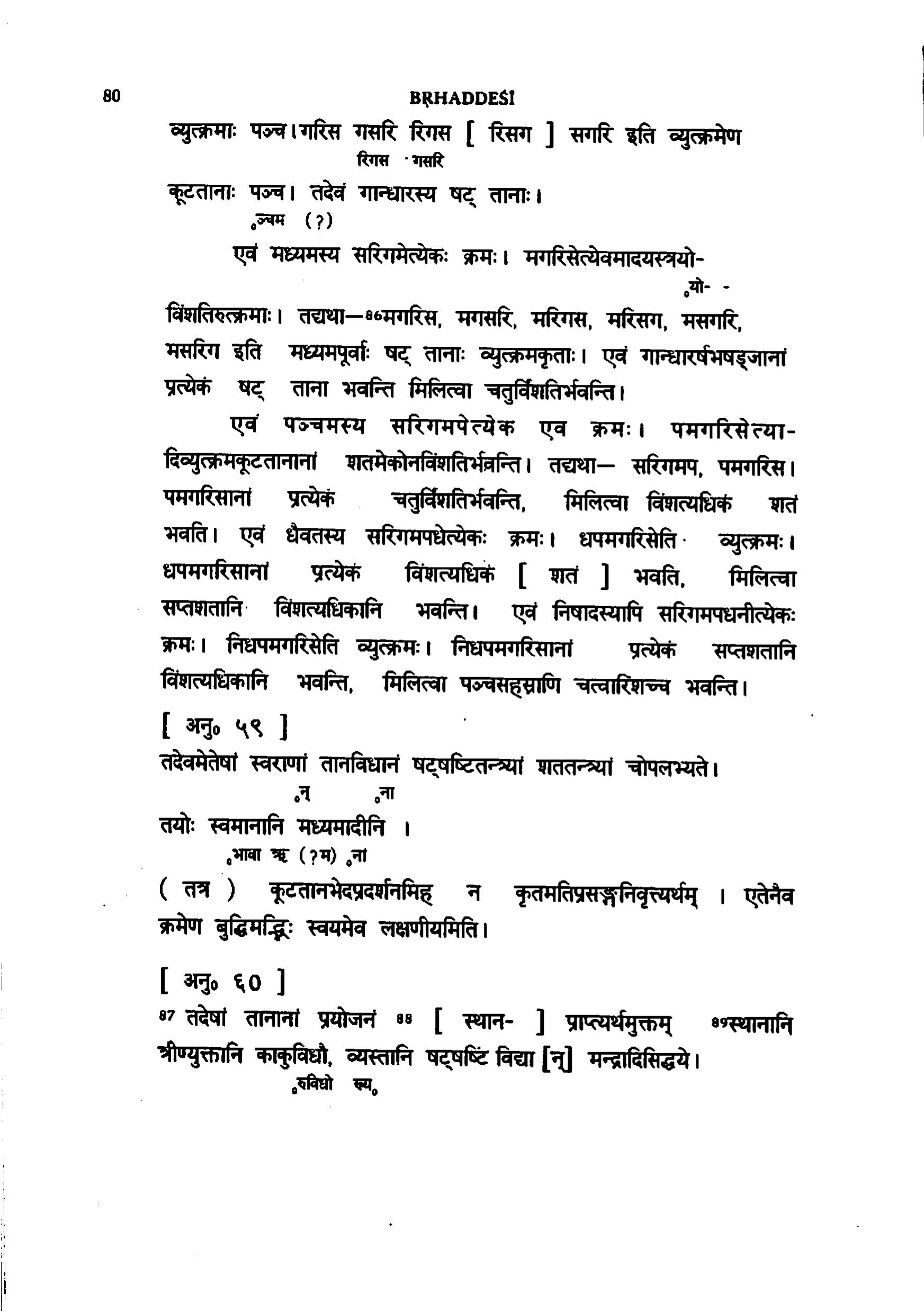
krama as sa - ri - ga. Vyutkramas (permutations) are five beginning with ga - ri - <math>sa</math>; <math>ga - sa - ri</math>, <math>ri - ga - sa</math>, <math>[ri - sa - ga]</math> <math>sa - ga - ri</math> — thus are the five <math>k\bar{u}_{l}a</math>-tanas formed by vyutkrama (permutation or change of order). Thus there are six tanas of gandhara (along with the preceding two svaras viz. sa - n). Similarly, there is only one krama (original order) of madhyama (added to the preceding three svaras) as sa - ri - ga - ma; there are twenty-three utkramas beginning with ma - ga - ri - sa.3 That is thus - ma - ga - ri - sa, ma - ga sa - ri, ma - ri - ga - sa, ma - ri - sa - ga, ma - sa - ga - ri, ma - sa - ri - ga thus are the six tānas beginning with madhyama, formed by vyutkrama. Similarly, there are six tānas, each beginning with gāndhāra, ṛṣabha and ṣadja and taken together they are twenty-four. Similarly, there is only one krama (original order) of pañcama (along with its four preceding svaras). The kūṭa-tānas beginning with pa - ma - ga - ri - sa (formed by) vyutkrama are one hundred and nineteen.7 That is thus - sa - ni - ga - ma - pa, pa - ma - ga - ri - sa. Each one of pa - ma - ga - ri - sa has
ordered sequence list
five kūṭa-tānas of gāndhāra formed by vyukrama (permutation) — Anu. 58 (continuation) — 'Vyutkramas (permutations) are five beginning with ga - ri - sa, ga - sa - ri, ri - ga - sa, [ ri - sa - ga ], sa - ga - ri — thus are the five kūṭa-tānas formed by vyukrama'
ga · ri · sa
ga · sa · ri
ri · ga · sa
ri · sa · ga
sa · ga · ri
— five kūṭa-tānas of gāndhāra (vyukrama)
ga - ni - sa, this is the vyutkrama (reverse order). Each one of dha - pa - ma - ga - ni - sa becomes [one hundred] and twenty (through kūļa-tānas); taken together (the kūṭa-tānas) become seven hundred and twenty.8 Similarly, there is only one krama of niṣāda (alongwith its six preceding svaras) as sa - ri - ga - ma - pa - dha - ni. Ni - dha - pa - ma - ga - ri - sa is the vyutkrama. Each one of ni - dha - pa - ma - ga - ni - sa becomes seven hundred and twenty (through <math>k\bar{u}ta</math>-tānas); taken together they become five thousand and forty. (Anu. 59) Thus the tāna-vidhāna (performance of tānas) of svaras is found on the (viṇās having) sixty-six strings or hundred strings.9 The measurements of these two (<math>vin\bar{a}s</math>) are middle and the like (?)57. Here the demonstration of these <math>k\bar{u}ta</math>- tānas has not been made on these (viņās) in order to avoid a digression; by this order itself, it (the demonstration) should be understood by the wise ones on their own. (Anu. 60) The objective of these tanas has been said to be for the sake of the attainment of [ sthānas (registers) ]. Sthānas (registers) are said to be three in4
1.[definition] Vyutkramas are permutations or changes of order of svarasव्युत्क्रमा पञ्च।गरिस ग स रि रि ग स [ रि स ग ] स ग रि इति व्युत्क्रमेण
2.[definition] Kuta-tanas are varieties of melodic sequences created through vyutkrama (permutation)इति व्युत्क्रमेण
4.[enumeration] Sthanas (registers) are three in number and are the objective purpose of tanasतदेषा तानाना प्रयोजनं 88 [ स्थान- ] प्राप्त्यर्थमुक्तम् 89स्थानानि त्रीण्युक्तानि
5.[relation] Kuta-tanas are systematically derived from svaras through vyutkrama processes for each ascending svaraएवं गान्धारर्षभषङ्ज?ाना प्रत्येकं षट् ताना भवन्ति मिलित्वा चतुर्विशतिर्भवन्ति।
6.[relation] Kakuvidhau (register variations) involves three registersस्थानानि त्रीण्युक्तानि काकुविधौ
8.[structural] Dhaivata svara with six preceding svaras generates seven hundred twenty kuta-tanasधपमगरिसाना प्रत्येकं विंशत्यधिकं [ शतं ] भवति, मिलित्वा सप्तशतानि विंशत्यधिकानि भवन्ति।
9.[structural] Tana-vidhana (performance of tanas) of svaras is found on viņas with sixty-six or hundred stringsतदेवमेतेषा स्वराणा तानविधानं षट्षष्टितन्त्र्या शततन्त्र्या चोपलभ्यते।
10.[structural] Gandhara svara produces six tanas when combined with preceding svaras sa and riतदेवं गान्धारस्य षट् ताना।
11.[structural] Nishada svara with six preceding svaras generates five thousand forty kuta-tanasनिधपमगरिसाना प्रत्येकं सप्तशतानि विंशत्यधिकानि भवन्ति, मिलित्वा पञ्चसहस्राणि चत्वारिशच्च भवन्ति।
1.[definition]Vyutkramas are permutations or changes of order of svarasVyutkramas (permutations) are five beginning with ga - ri - sa; ga - sa - ri, ri - ga - sa, [ri - sa - ga] sa - ga - ri — thus are the five kar{u}_{l}a-tanas formed by vyutkrama (permutation or change of order).
2.[definition]Kuta-tanas are varieties of melodic sequences created through vyutkrama (permutation)thus are the five kar{u}_{l}a-tanas formed by vyutkrama (permutation or change of order)
3.[enumeration]Madhyama svara has one original krama order (sa-ri-ga-ma) and twenty-three utkramasSimilarly, there is only one krama (original order) of madhyama (added to the preceding three svaras) as sa - ri - ga - ma; there are twenty-three utkramas beginning with ma - ga - ri - sa.
4.[enumeration]Sthanas (registers) are three in number and are the objective purpose of tanasThe objective of these tanas has been said to be for the sake of the attainment of [ sthānas (registers) ]. Sthānas (registers) are said to be three in
5.[relation]Kuta-tanas are systematically derived from svaras through vyutkrama processes for each ascending svaraThus there are six tānas beginning with gāndhāra, ṛṣabha and ṣaḍja and taken together they are twenty-four.
6.[relation]Kakuvidhau (register variations) involves three registersSthānas (registers) are said to be three in kāku-vidhau
7.[structural]Panchama svara has one krama order and produces one hundred nineteen kuta-tanas through vyutkramaSimilarly, there is only one krama (original order) of pañcama (along with its four preceding svaras). The kūṭa-tānas beginning with pa - ma - ga - ri - sa (formed by) vyutkrama are one hundred and nineteen.
8.[structural]Dhaivata svara with six preceding svaras generates seven hundred twenty kuta-tanasEach one of dha - pa - ma - ga - ni - sa becomes [one hundred] and twenty (through kūļa-tānas); taken together (the kūṭa-tānas) become seven hundred and twenty.
9.[structural]Tana-vidhana (performance of tanas) of svaras is found on viņas with sixty-six or hundred stringsThus the tāna-vidhāna (performance of tānas) of svaras is found on the (viṇās having) sixty-six strings or hundred strings.
10.[structural]Gandhara svara produces six tanas when combined with preceding svaras sa and riThus there are six tānas of gandhara (along with the preceding two svaras viz. sa - n).
11.[structural]Nishada svara with six preceding svaras generates five thousand forty kuta-tanasEach one of ni - dha - pa - ma - ga - ni - sa becomes seven hundred and twenty (through kar{u}ta-tānas); taken together they become five thousand and forty.