Source scans · vol_I_p050
recto · open full
scan recto
verso · open full
scan verso
Bṛhaddeśī · Volume I
pp. 82–83folio 050
Devanāgarī (Bṛhaddeśī)
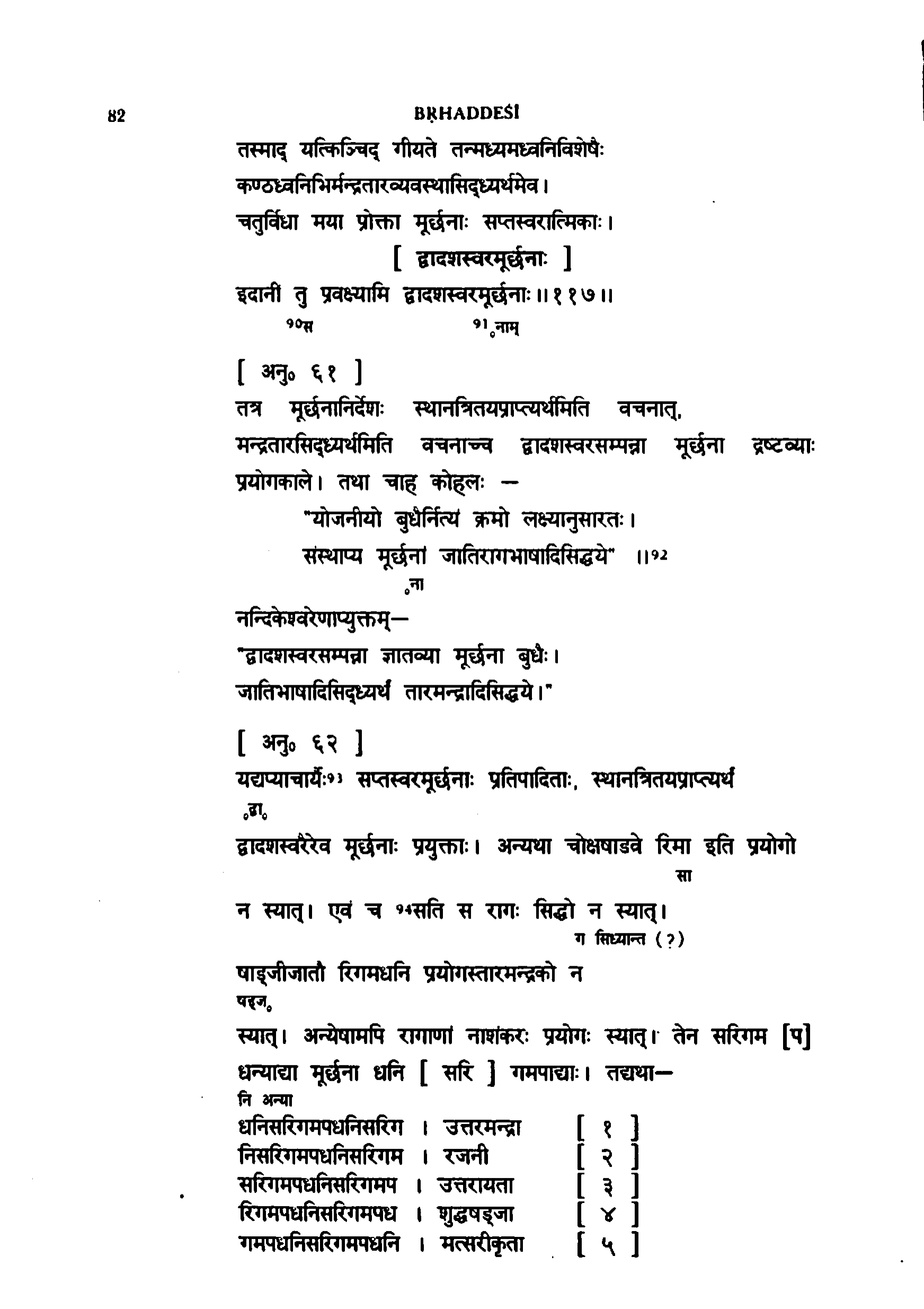
तस्माद् यत्किञ्चिद् गीयते तन्मध्यमध्वनिविशेषैः
कण्ठध्वनिभिर्मन्द्रतारव्यवस्थासिद्ध्यर्थमेव।
चतुर्विधा मया प्रोक्ता मूर्छनाःद्वादशस्वरमूर्छनाः सप्तस्वरात्मिकाः।
इदानी तु प्रवक्ष्यामि द्वादशस्वरमूर्छनाः ॥११७॥ 90H 91ुनाम्
[अनु॰ ६१]
तत्र मूर्छनानिर्देशः स्थानित्रतयप्राप्त्यर्थमिति7 वचनात्, मन्द्रतारसिद्ध्यर्थमिति वचनाच्च द्वादशस्वरसम्पन्ना मूर्छनाद्रष्टव्याः प्रयोगकाले। तथा चाह कोहलः -- "योजनीयो बुधैर्नित्यं क्रमो लक्ष्यानुसारतः।21 संस्थाप्य मूर्छनाुना जातिरागभाषादिसिद्धये6" ।।१२ नान्दकश्वरणाप्युक्तम्-
“द्वादशस्वरसम्पन्ना ज्ञातव्या मूर्छना बुधैः।
जातिभाषादिसिद्ध्यर्थं तारमन्द्रादिसिद्धये।98"
[अनु₀ ६२]
यद्यप्याचार्यैःुदा अप्तस्वरमूर्छनाः प्रतिपादिताः, स्थानत्रितयप्राप्त्यर्थं द्वादशस्वरैरेव मूर्छनाः प्रयुक्ताः। अन्यथा चोक्षषाडवे रिमासा इति प्रयोगो
न स्यात्। एवं च १५सति स रागः सिद्धो न स्यात्ग सिध्यान्त (२)
षाङ्जीजातौपर्ज,नि अन्या रिगमधनि प्रयोगस्तारमन्द्रको न स्यात्। अन्येषामपि रागाणां नाशंकरः प्रयोगः स्यात्। तेन सरिगम [प] धन्याद्या मूर्छना धनि [ सरि ] गमपाद्याः। तद्यथा— धनिसरिगमपधनिसरिग । उत्तरमन्द्रा
[8]
निसरिगमपधनिसरिगम । रजनीि ३ ो सरिगमपधनिसरिगमप । उत्तरायता रिगमपधनिसरिगमपध । शुद्धषड्जा [ ४ ] गमपधनिसरिगमपधनि । मत्सरीकृता [ ५
English — Sharma
the kāku-vidhi (prescription about kāku) (in Nāţyaśāstra?); considered separately, one should know them as sixty-six58 for the sake of (the sthānas) mandra and the like. Hence whatever is sung is only for the sake of establishing the arrangement of mandra (low) and tara (high) through the sounds of the voice that are particularised by medium sounds i.e. that belong to the medium category.59 I have spoken of the fourfold mūrchanās composed of seven svaras.10
[The murchana of twelve svaras]
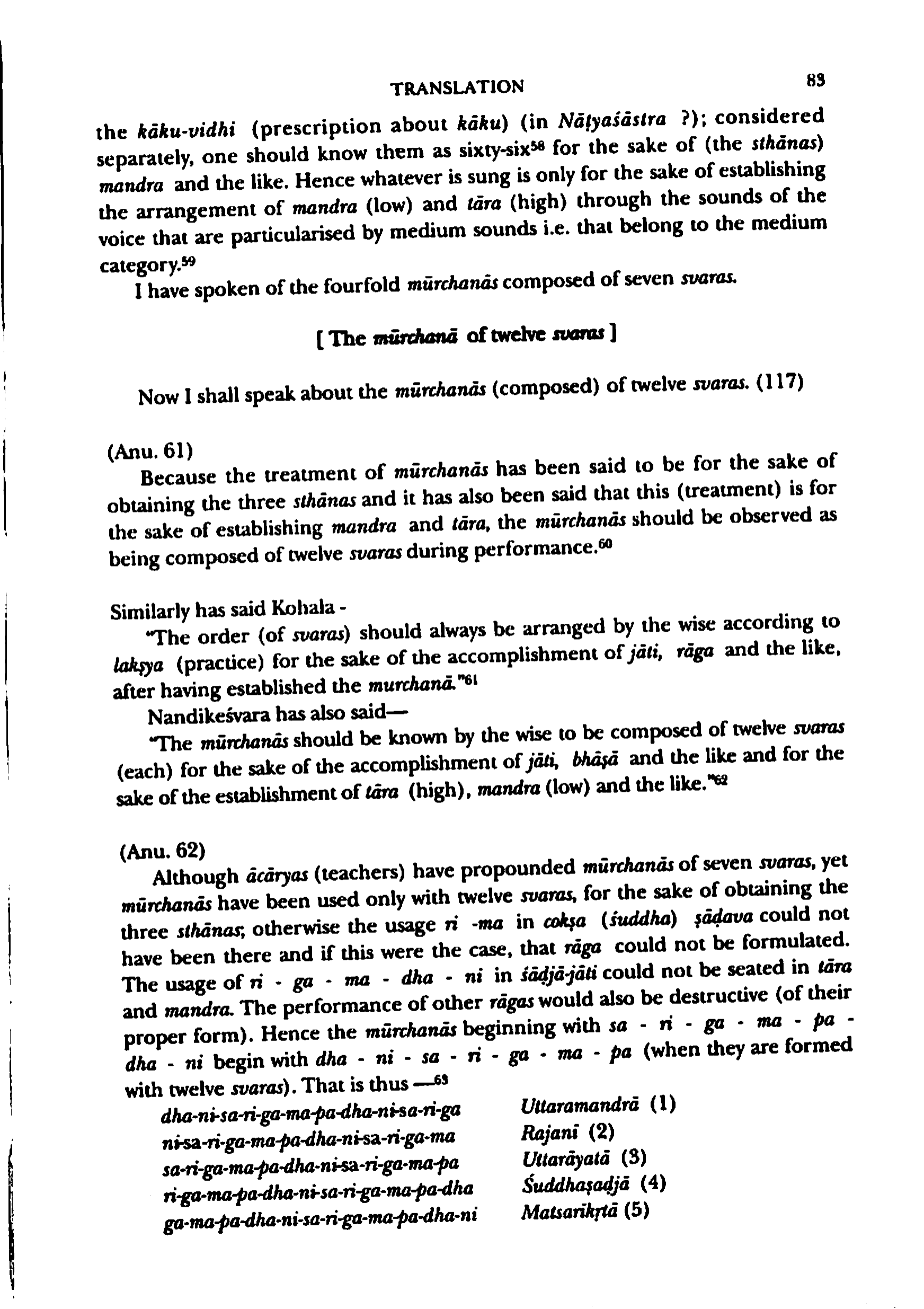
Now I shall speak about the mūrchanās (composed) of twelve svaras. (117) (Anu. 61) Because the treatment of murchanas has been said to be for the sake of obtaining the three sthanas7 and it has also been said that this (treatment) is for the sake of establishing mandra and tāra, the mūrchanās should be observed as being composed of twelve svaras during performance.60 Similarly has said Kohala - "The order (of svaras) should always be arranged by the wise according to lakşya (practice)21 for the sake of the accomplishment of jāti, rāga and the like6, after having established the murchanā."61 Nandikeśvara has also said— "The murchanas should be known by the wise to be composed of twelve svaras (each)3 for the sake of the accomplishment of jāti, bhāṣā and the like and for the sake of the establishment of tara (high), mandra (low) and the like.98"62 (Anu. 62) Although acaryas (teachers) have propounded murchanas of seven svaras, yet murchanas have been used only with twelve svaras, for the sake of obtaining the three sthānas11; otherwise the usage ri -ma in cokşa (śuddha) şāḍava could not have been there and if this were the case, that raga could not be formulated. The usage of <math>\vec{n}</math> - <math>ga</math> - <math>ma</math> - <math>dha</math> - <math>ni</math> in <math>\hat{s}adjaja\hat{t}i</math> could not be seated in <math>t\bar{a}ra</math> and mandra. The performance of other ragas would also be destructive (of their proper form). Hence the mūrchanās beginning with sa - ri - ga - ma - pa - dha - ni begin with dha - ni - sa - ni - ga - ma - pa (when they are formed with twelve svaras). That is thus -63 Uttaramandrā (1) dha-ni-sa-ri-ga-ma-pa-dha-ni-sa-ri-ga Rajani (2) ni-sa-ri-ga-ma-pa-dha-ni-sa-ri-ga-ma Uttarāyatā (3) sa-ri-ga-ma-pa-dha-ni-sa-ri-ga-ma-pa Śuddhasadjā (4) ri-ga-ma-pa-dha-ni-sa-ri-ga-ma-pa-dha Matsarikṛtā (5) ga-ma-pa-dha-ni-sa-ri-ga-ma-pa-dha-ni4
1.[attribution]The order of svaras should be arranged according to lakşya (practice) by the wiseयोजनीयो बुधैर्नित्यं क्रमो लक्ष्यानुसारतः।
2.[attribution]Kohala teaches that the order of svaras should be arranged by wise practitioners according to practiceतथा चाह कोहलः -- "योजनीयो बुधैर्नित्यं क्रमो लक्ष्यानुसारतः।
3.[attribution]Nandikeśvara states that murchanas should be known to be composed of twelve svaras for accomplishing jāti and bhāṣāनान्दकश्वरणाप्युक्तम्- "द्वादशस्वरसम्पन्ना ज?्ञातव्या मूर्छना बुधै।
5.[relation]Murchanas composed of twelve svaras should be observed during performance for obtaining three sthanasद्वादशस्वरसम्पन्ना मूर्छना द्रष्टव्या प्रयोगकाले। तथा चाह कोहलः
6.[relation]Murchanas are established for the sake of accomplishing jāti, rāga, and bhāṣāज?ातिरागभाषादिसिद्धये
7.[relation]Treatment of murchanas is for the sake of obtaining three sthanasमूर्छनानिर्देशः स्थानित्रतयप्राप्त्यर्थमिति
8.[relation]Jāti is accomplished through proper arrangement of murchanas with twelve svarasज?ातिभाषादिसिद्ध्यर्थं तारमन्द्रादिसिद्धये।
9.[relation]Bhāṣā is accomplished through proper arrangement of murchanas with twelve svarasज?ातिभाषादिसिद्ध्यर्थं तारमन्द्रादिसिद्धये।
10.[structural]Murchanas are composed of seven svaras in a fourfold classificationचतुर्विधा मया प्रोक्ता मूर्छना सप्तस्वरात्मिका।
11.[structural]Seven-svara murchanas have been propounded by teachers but twelve-svara murchanas are used in practiceयद्यप्याचार्यै अप्तस्वरमूर्छना प्रतिपादिता, स्थानत्रितयप्राप्त्यर्थं द्वादशस्वरैरेव मूर्छना प्रयुक्ता।
1.[attribution] The order of svaras should be arranged according to lakşya (practice) by the wiseThe order (of svaras) should always be arranged by the wise according to lakşya (practice)
2.[attribution] Kohala teaches that the order of svaras should be arranged by wise practitioners according to practiceSimilarly has said Kohala - "The order (of svaras) should always be arranged by the wise according to lakşya (practice)
3.[attribution] Nandikeśvara states that murchanas should be known to be composed of twelve svaras for accomplishing jāti and bhāṣāNandikeśvara has also said— "The murchanas should be known by the wise to be composed of twelve svaras (each)
4.[enumeration]Five named murchanas are enumerated with their twelve-svara sequencesUttaramandrā (1) dha-ni-sa-ri-ga-ma-pa-dha-ni-sa-ri-ga Rajani (2) ni-sa-ri-ga-ma-pa-dha-ni-sa-ri-ga-ma Uttarāyatā (3) sa-ri-ga-ma-pa-dha-ni-sa-ri-ga-ma-pa Śuddhasadjā (4) ri-ga-ma-pa-dha-ni-sa-ri-ga-ma-pa-dha Matsarikṛtā (5) ga-ma-pa-dha-ni-sa-ri-ga-ma-pa-dha-ni
6.[relation] Murchanas are established for the sake of accomplishing jāti, rāga, and bhāṣāfor the sake of the accomplishment of jāti, rāga and the like
7.[relation] Treatment of murchanas is for the sake of obtaining three sthanasBecause the treatment of murchanas has been said to be for the sake of obtaining the three sthanas
8.[relation] Jāti is accomplished through proper arrangement of murchanas with twelve svarasfor the sake of the accomplishment of jāti, bhāṣā and the like and for the sake of the establishment of tara (high), mandra (low) and the like.
9.[relation] Bhāṣā is accomplished through proper arrangement of murchanas with twelve svarasfor the sake of the accomplishment of jāti, bhāṣā and the like and for the sake of the establishment of tara (high), mandra (low) and the like.
10.[structural] Murchanas are composed of seven svaras in a fourfold classificationI have spoken of the fourfold mūrchanās composed of seven svaras.
11.[structural] Seven-svara murchanas have been propounded by teachers but twelve-svara murchanas are used in practiceAlthough acaryas (teachers) have propounded murchanas of seven svaras, yet murchanas have been used only with twelve svaras, for the sake of obtaining the three sthānas