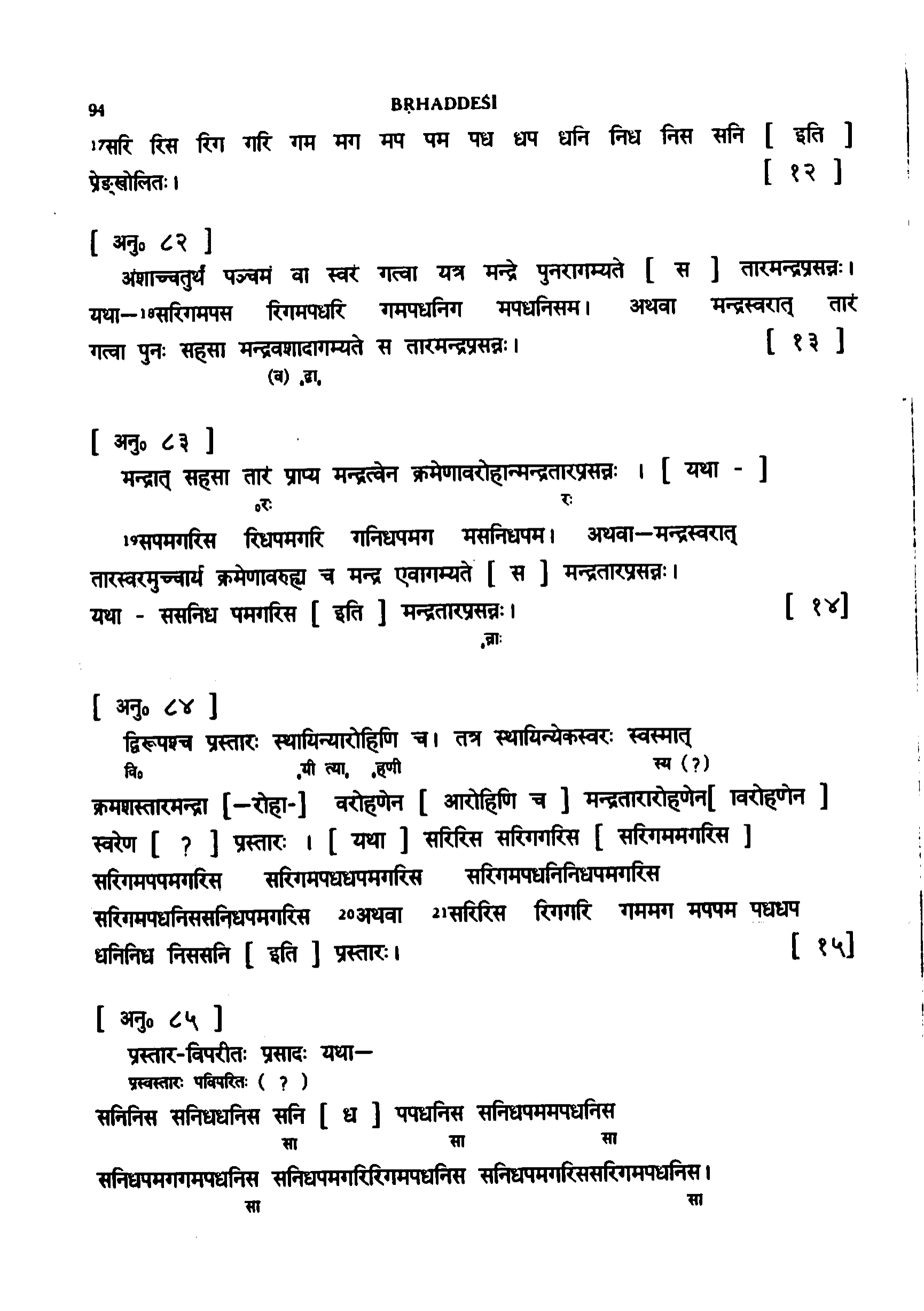
units (samakala). As - sari risa, riga gari, gama maga, mapa pama, padha dhapa,
(12)
dhani nidha, nisa sani. Thus is (ends) prenkholita.1
(Anu. 82)
Where, having gone to the fourth or fifth svara from the amsa47 (beginning
point of a given phrase), the lower (point) is again reached (returned to), that
is tāramandra-prasanna.248 As—sarigamapasa, rigamapadhari, gamapadhaniga,
mapadhanisama.49 Or, having gone to the higher (svara) from the lower one, the
lower point is again suddenly reached (returned to), that is taramandra-
(13)
prasanna.
(Anu. 83)
Having suddenly reached the higher (svara) from the lower one, on account
of gradual descent to the lower (initial svara) mandratāra-prasanna (comes into
being).3 As - sapamagarisa, ridhapamagari, ganidhapamaga, masanidhapama. Or,
having pronounced the higher (octave) svara after the lower svara, through
gradual descent the low (svara) itself is reached, that is
mandratāraprasanna. As -
(14)
sasanidhapamagarisa.50 Thus is (ends)
mandratāraprasanna.
(Anu. 84)
Prastāra has two forms (obtaining in) the sthāyin (steady) and ārohin
(ascending) (varna).5 Out of them, in the sthayin 51 (varna), one svara gradually
ascends 'high' from itself and descends 'low'8;
and in the arohin (varna), prastara
(is formed) by a svara that ascends 'high' from 'low' and descends.9 As - saririsa,
sarigamapapamagarisa,
sarigamamagarisa,
sarigagarisa,
sarigamapadhaninidhapamagarisa,
sarigamapadhadhapamagarisa,
sarigamapadhanisa 52 sanidhapamagarisa; Or, saririsa, rigagari, gamamaga,
mapapama, padhadhapa, dhaninidha, nisasani. Thus is (ends)
prastāra.
(15)
(Anu. 85)
sanidhadhanisa,
Prasada is the opposite of prastara.6 As - saninisa,
sanidhapapadhanisa, sanidhapamamapadhanisa, sanidhapamagagamapadhanisa,